Introduction
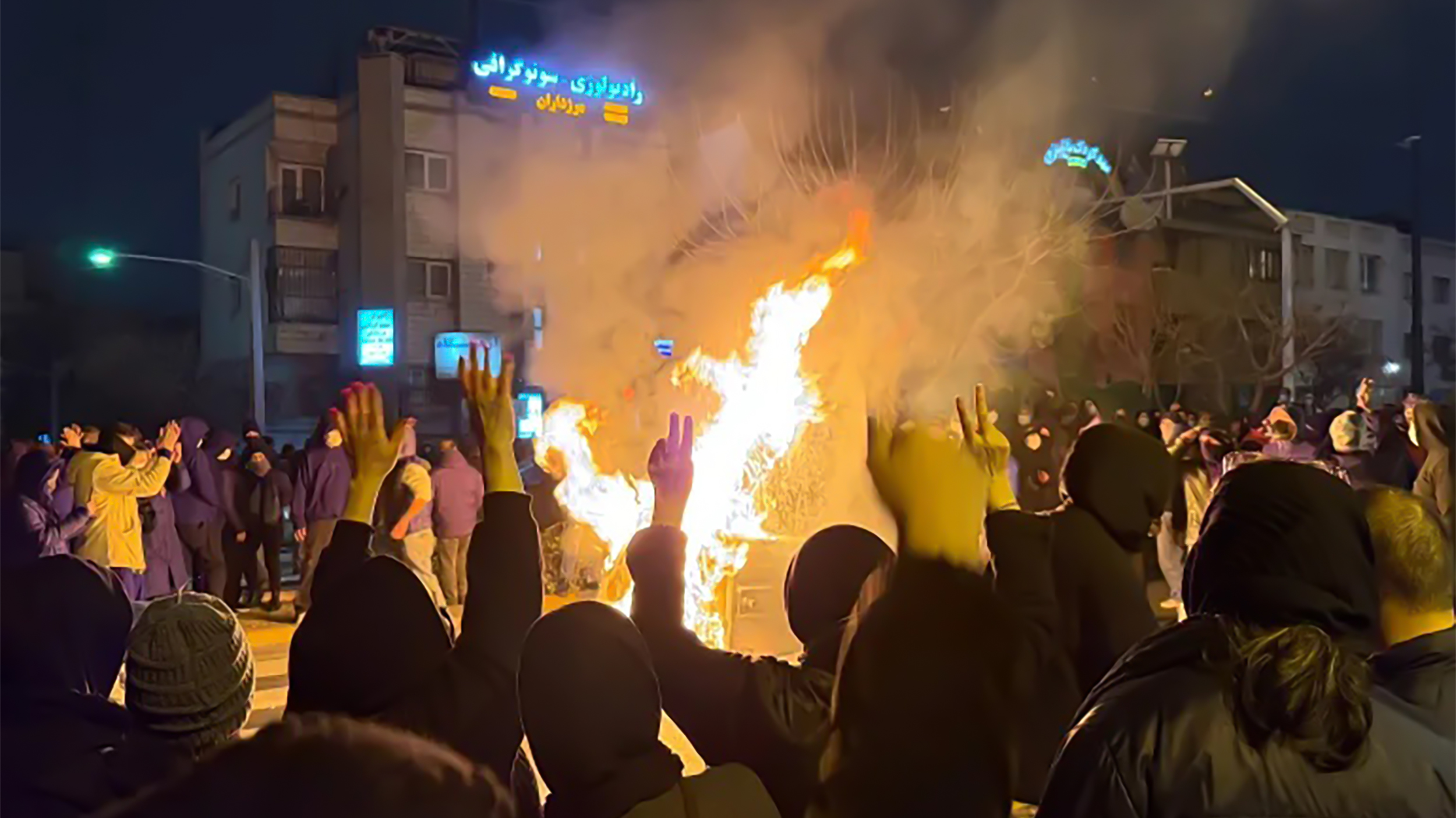
The developments began in Tehran’s bazaar, where traders protested fluctuations in the national currency. These protests quickly spread to other cities in response to inflation, declining purchasing power, and deteriorating economic conditions. After ten days of peaceful demonstrations and slogans focused on improving living standards, Iran entered a phase of violence that was rare in the country. Protest slogans moved beyond economic grievances to directly target the regime and the country’s security and stability.
Developments did not stop at Iran’s borders. Israeli politicians encouraged Iranians to persist until the overthrow of the regime. The US president reinforced this position by explicitly threatening to come to the “aid” of demonstrators if the authorities began killing them. (1) This paper aims to clarify the circumstances of the protests, their trajectory, and the violence that accompanied their conclusion, before examining their domestic impact and outcomes, as well as Iran’s interactions with external actors, particularly the United States.
New Policy and Protest
Protests have been a recurring feature in contemporary Iran, and periods of escalation or decline do not necessarily mean that the country is experiencing an exceptional moment. What distinguishes the recent wave, however, is what accompanied the protests: first, the declared and explicit support for the protests and the accompanying acts of violence by Israel and the United States; and second, the level of violence itself, which the Iranian government has described as “armed terrorism”.
Iran is currently experiencing one of its most sustained periods of protests in recent years. Each wave of protest has a primary driving force. For example, two years ago, the protests were driven by the issue of the veil. This does not mean that other motives were absent. The recent wave of protests was driven by the deterioration of economic conditions and the growing popular discontent over the decline in the value of the Iranian currency, the rial, against the dollar, as well as the steady erosion of citizens’ purchasing power.
Currency depreciation played a key role in the initial wave of bazaar protests in Tehran. Many traders and merchants in Iran’s largest bazaar closed their shops and organised demonstrations, arguing that instability in the dollar exchange rate prevented them from conducting business. Importers, for example, purchase goods at one exchange rate, and after selling them, are forced to import again at higher prices that exceed the value of their sales. Iranian authorities, including the Supreme Leader and the President, expressed understanding of these demands and acknowledged the protesters’ rights, which helped prevent clashes. (2) This situation persisted for approximately ten days.
President Masoud Pezeshkian’s government announced sweeping economic reforms, focusing on changing the policy of subsidising imports in order to decouple prices from the dollar exchange rate and thus control the rising cost of living. These policies are complex, but their main pillars are outlined here to clarify the broader picture.
It had become customary practice for a group of companies and institutions to obtain dollars from the Central Bank at subsidised rates in order to import essential goods and medicine and sell them to citizens at prices below market rates. In theory, importers were required to sell goods at subsidised prices and return the equivalent amount of dollars to the Central Bank after completing the process. In practice, however, this system failed to achieve its intended goals, and the entire process became rife with financial and economic corruption. The Minister of Economy recently announced that many importing entities failed to return the dollars they had received to the Central Bank, while others sold imported goods at market prices rather than subsidised ones. Over decades, this system evolved into a mechanism of corruption, with importers treating subsidised dollars as “rents” for personal gain rather than for the benefit of citizens. Oversight efforts ultimately failed to curb this corruption.
As a result, the government announced the suspension of subsidised dollar allocations to importers. (3) Because commodity prices would now reflect market exchange rates, the government announced that it would distribute the difference between the subsidised rate and the market rate to citizens in the form of grants. In Pezeshkian’s words, the government decided to provide direct support to the final link in the supply chain, the citizen, instead of indirectly subsidising the first link, the importer. This policy aims to eliminate one of the country’s most significant sources of financial corruption and retain hard currency reserves in government hands, enabling better control of the exchange rate and slowing the depreciation of the national currency. Those who benefited from the previous system therefore opposed the policy and sought to mobilise the bazaar against the government’s measures. But managing these pressures and allowing society to adapt to the new reality requires time.
The announcement of this major policy shift did not immediately calm the market or reassure citizens. Nevertheless, the government began implementing the policy during the protests in hopes of slowing their momentum. Bazaar protests continued for nearly ten days, during which demonstrations spread to several smaller and border cities, particularly in western Iran. Authorities sought to avoid confrontation with protesters, although some incidents of violence were reported. However, after one of the most prominent opposition figures abroad—the son of the Shah overthrown in the 1979 revolution—called on Iranians to rise up against the regime and take to the streets on Thursday and Friday, 8 and 9 January 2026, the country experienced a level of violence rarely witnessed in previous protests.
Violence Comes to the Protest
Thursday initially resembled the preceding ten days of bazaar protests and demonstrations in other cities, which focused on economic slogans and livelihood issues. However, by Thursday evening, widespread violence erupted alongside the protests, targeting sovereign institutions across various cities and provinces. This violence included attacks on security forces, the Basij, and military and security headquarters, despite the continued official policy of avoiding direct confrontation with protesters. Gunfire was reported at several mosques and banks, and numerous public and private facilities were damaged. In the northern city of Rasht alone, the burning of a single private store led to a fire that destroyed an entire market containing dozens of shops.
The shootings – some of which were captured on video, showing individuals firing indiscriminately at security forces and civilians – had a profound impact on the Iranian public. Attacks on security forces and popular mobilisation units resulted in alarming numbers of casualties, alongside numerous civilian deaths and injuries. At a single funeral ceremony held in Tehran following the violence, more than one hundred members of the security forces and civilians were commemorated. (4)
As violence escalated and slogans shifted from economic demands to direct opposition to the regime, protest momentum declined sharply on the evening of Thursday, 8 January 2026. On Friday, 9 January, many protesters stayed home, and by Saturday calm had returned more quickly than many observers had anticipated. Authorities called on citizens to demonstrate against “armed terrorism” on 12 January 2026. Large crowds responded in Tehran and other cities, with officials claiming participation exceeded three million in the capital alone. No protest rallies or violence occurred. The reasons for this can be summarised as follows:
- Escalating violence: By Thursday night, protests were effectively extinguished. Most protesters withdrew after scenes of violence emerged. Citizens seeking economic improvement did not wish to be drawn into acts of violence that neither advanced their demands nor improved their conditions, but instead generated insecurity, injuries and deaths.
- Israeli-American support: Political figures in Israel and the United States openly called on Iranians to overthrow the regime. While protesters initially ignored these statements, many later feared that the violence was linked to these calls and began questioning whether they were being drawn into externally driven confrontations. Iranian authorities emphasised this linkage in their discourse, which resonated with citizens who had recently witnessed foreign attacks on their country and the ongoing devastation in Gaza.
- Security at stake: Protesters initially mobilised to pressure the government over economic and living conditions, but chaos and insecurity quickly became a greater concern. As soon as disorder appeared, many citizens withdrew from the streets out of desire to avoid security collapse. This withdrawal does not signify acceptance of economic hardship, but rather a clear rejection of violence and armed action.
- Return to the economy: Protesters’ initial focus was economic reform. Their retreat from the streets can be interpreted as an effort to reassert this priority and reject slogans and actions that shifted the protests from economic demands toward political and security confrontation.
The Clash of Narratives
Competing claims over the meaning of the protests and the accompanying violence became another arena of conflict in media and political discourse. Two primary narratives emerged.
The opposition narrative rests on a complete rejection of the regime, portraying both protests and violence as expressions of widespread popular opposition. This narrative emphasises three dimensions: the erosion or collapse of regime legitimacy; the portrayal of entire population as unified against the ruling system; and the promotion of alternatives under the banners of “democracy” and “constitutionalism”.
This narrative offers an oversimplified reading of reality. The opposition remains fragmented and has never agreed on unified leadership. Abroad, it is divided abroad between royalists, the People’s Mojahedin Organisation, and various nationalist or separatist movements. For the first time, these factions appeared to mobilise simultaneously against the regime, a development that some observers in Iran attribute to the involvement of Israeli or American intelligence. (5) All of these groups view violence and armed confrontation as legitimate means for overthrowing the regime and have employed them in the past.
Reading every protest as an attempt to overthrow the regime is overly simplistic. Many Iranians critical of economic governance do not support regime change. Even supporters of the system criticise government performance without seeking its collapse. Less than two years ago, more than half of Iranians participated in presidential elections, signalling engagement with reform through existing institutions. Moreover, leaders across Iran’s political spectrum called for unity in the face of violence and foreign-backed opposition. The revival of pre-revolutionary alternatives, supported by states that attacked Iran only months earlier, has limited appeal among the population. Nevertheless, the opposition has advanced its confrontation with the regime further than in previous episodes.
In contrast, the government narrative distinguishes between legitimate economic protesters and violent groups described as “armed terrorists” linked to foreign agendas. Officials recognise citizens’ right to protest economic conditions while accusing violent groups of receiving foreign funding, training and weapons. This narrative asserts that economic protest does not equate to regime opposition, that the people stand with the state against foreign-backed adversaries, and that Iranians remain committed to their legal system rather than externally imposed alternatives. (6)
While this narrative separates protest from violence, the reality is more complex. Those who carried out violent acts and chanted anti-regime slogans are Iranian citizens, even if they received external support. Some opposition factions openly view Israel and the United States as allies, echoing Shah-era alliances with Washington and Tel Aviv.
Economic protest does not automatically translate into regime confrontation, but accumulated pressures can blur this distinction during crises. This ambiguity has been exploited by opposition forces, though with limited success.
The Role of the Outside
External involvement in Iran’s protests took two forms: direct support for violent groups and indirect political pressure. Israeli political figures and institutions openly voiced support for the protesters, while reports also suggested involvement by Mossad. (8) Iranian authorities allege that Israeli agents smuggled weapons and sought to exploit protests. US rhetoric emphasised alleged repression and threatened intervention if protesters were killed.
Authorities framed the violence as a second phase of the twelve-day war of June 2025, aimed at achieving through internal conflict what military confrontation failed to accomplish. That war ended due to Iran’s missile deterrence, limited US escalation and strong domestic unity.
The strategy of provoking internal chaos ultimately failed. Violence subsided rapidly, limiting international pressure and prompting a rhetorical shift from Washington. (10) Iran’s Defence Council declared threats to national unity a red line, signalling a shift toward a more initiative-driven defence doctrine. (11)
Iran’s deterrence capabilities, readiness and rapid restoration of internal calm reduced the likelihood of renewed military confrontation. While future conflict remains possible, reliance on internal fragmentation as a strategy has significantly declined.
Diplomatic prospects remain bleak. Talks between Iran and the United States have been suspended since the June war, with both sides operating under fundamentally different negotiating frameworks. The protests and associated violence have not altered Iran’s position.
Conclusion
Protests in Iran began with economic grievances and objections to government mismanagement and lasted for ten days before opposition groups escalated violence on Thursday, 29 December 2025. As violence spread, protest momentum declined, and citizens did not return to the streets. Meanwhile, the new economic policies of Pezeshkian’s government came into effect, aiming to improve living conditions and curb inflation by stabilising the dollar exchange rate and slowing the depreciation of the rial.
Narratives diverged sharply: the opposition framed events as a rejection of the entire regime, while the government distinguished economic protest from violent destabilisation. Authorities accused Israel and the United States of exploiting unrest to undermine national unity. The rapid decline in violence thwarted these efforts and reduced the risk of external targeting.
With calm restored, speculation is once again focused on the possibility of future conflict or renewed negotiations between Iran and the United States. Whatever the outcome, reliance on internal division as a strategy to weaken Iran has, for now, largely failed.
- Donald J. Trump, “If Iran shots and violently kills peaceful protesters, which is their custom, the United States…”, Truth Social, 2 January 2026, https://tinyurl.com/2fm693yk (accessed 5 February 2025).
- “بیانات در دیدار مردم قم [Remarks Delivered to the People of Qom]”, The Supreme Leader’s Official Website, 9 January 2026, https://tinyurl.com/mryvs5fm (accessed 14 January 2026).
- “چند شرط برای موفقیت حذف ارز ترجیحی [Several Conditions for Ending the Preferential Exchange Rate]”, ISNA, 5 January 2026, https://2u.pw/0eQxE (accessed 16 January 2026).
- “مراسم تشییع پیکر بیش از 100 شهید مردمی و مدافع امنیت در تهران آغاز شد [Funeral Procession for Over 100 Civilian and Security Martyrs Begins in Tehran]”, Sputnik Iran, 14 January 2026, https://tinyurl.com/y5kkh7py (accessed 5 February 2026).
- Abdollah Ganji, “راز ۸ شب [The Mystery of 8 p.m.]”, Fars News Agency, 12 January 2026, https://tinyurl.com/5h4d8dd7 (accessed 14 January2026).
- “بیانات در دیدار مردم قم [Remarks Delivered to the People of Qom]”, The Supreme Leader’s Official Website, 9 January 2026, https://tinyurl.com/mryvs5fm (accessed 14 January 2026).
- Opposition media claim that 12,000 protesters were killed, while Israeli sources place the number at 5,000. The sources of these figures, announced immediately after the end of the events, are unknown. Meanwhile, the authorities have not yet released any statistics, stating that they will rely on forensic medicine reports to do so. The number of security personnel killed, as reflected in the funeral processions for the “martyrs of security”, indicates that a substantial portion of the dead and wounded were from the ranks of security forces and the popular mobilisation.
- The Persian-language Mossad page published a tweet addressing Iranians, stating that it was “with them on the ground”. See “موساد به معترضان ایرانی: «به خیابانها بیایید؛ در میدان همراهتان هستیم» [Mossad to Iranian Protesters: ‘Take to the Streets; We Are with You on the Ground]”, Euronews, 31 December 2025, https://tinyurl.com/bde5tcty (accessed 16 January 2026).
- “هوشنگی: اغتشاشات اخیر در ادامه جنگ ۱۲ روزه است [Houshangi: Recent Unrest Is a Continuation of the 12-Day War]”, Tasnim News, 11 January 2026, https://2u.pw/DJ3Qw (accessed 16 January 2026).
- Patrick Wintour and Lorenzo Tondo, “Trump says Iran has told him ‘killing has stopped’ as he pulls back from strike threats”, The Guardian, 15 January 2026, https://2u.pw/3lACO (accessed 16 January 2026).
- “هشدار صریح شورای دفاع: امنیت و تمامیت ارضی ایران خط قرمز غیرقابل عبور است [Defence Council Issues Stern Warning: Iran’s Security and Territorial Integrity Are an Uncrossable Red Line], Pooya Press, 6 January 2026, https://2u.pw/hzIyh (accessed 16 January 2026).