
In April 2026, the International Chamber of Commerce’s International Maritime Bureau (IMB) revealed that maritime piracy and armed robbery had reached their lowest levels in the first quarter of the year since 1991, with only one case of theft recorded at the Takoradi anchorage in Ghana. (1) This news comes amid other reports that Russia has intensified its efforts to secure “port access agreements” in West African coastal countries, (2) while the “frantic competition” between the United States and China is ongoing over strategic locations in the Gulf of Guinea, with officials in Washington expressing “grave concern” over reported China’s ongoing effort to establish a permanent naval base in the port of Bata in Equatorial Guinea. (3) This is in addition to some agreements and frictions between some countries in the Gulf of Guinea and the shifting alliance of the Alliance of Sahel States (AES), amid southward migration of “terrorists” from the Sahel.
These events show that the Gulf of Guinea is an important area for global competition and a place where indirect conflicts are increasing, not just because of foreign military presence and changes in regional alliances, but also because of its rich resources and crucial role as a major shipping route.
Maritime Security in the Gulf of Guinea
The Gulf of Guinea is the main maritime corridor for West and Central Africa, stretching approximately 6,000 kilometres from Senegal to Angola. Its countries are rich in mineral resources, including traditional resources such as oil, natural gas, gold and diamonds, as well as strategic natural resources needed for the modern industrial revolution and the global transition to clean energy, such as bauxite, cobalt, manganese, uranium and tin. (4)
The Gulf of Guinea's economy depends largely on maritime transport, as this sea corridor serves as a conduit for regional trade and global energy flows. It is estimated that 90% of international trade (including imports, exports and vital oil shipments) for coastal countries in West and Central Africa passes through the Gulf. (5) Also, the region has approximately 4.5% of the world's proven oil reserves, 2.7% of natural gas reserves, and about 11% of all global hydrocarbon discoveries since 2020 have been along its coasts. This is in addition to the region's fisheries, which are vital to local livelihoods. (6)
The Gulf experienced a fragile decline in reported piracy incidents in recent years. (7) In 2023, only 22 piracy incidents were recorded, 18 in 2024, and 21 in 2025. (8) Nigeria’s Deep Blue project, which includes command and control systems, intelligence platforms, over 100 naval vessels, aerial assets and drones, is said to contribute to this decline by inflicting significant losses and operational costs on pirate groups. (9) Also, the Yaoundé Structure and its Code of Conduct, which divides the Gulf of Guinea into five maritime zones, each served by a regional coordination centre, provide the infrastructure for information sharing among nations and a coordinated response to piracy. This structure enhances information exchange between regional maritime centres, particularly the Regional Maritime Security Centre for West Africa (CRESMAO), and the Regional Maritime Safety Centre for Central Africa (CRESMAC). (10)
Multinational efforts have also strengthened maritime security. These include the Grand African NEMO (GANo), held in November 2025 and co-organised by France and the Interregional Coordination Centre in Yaoundé, with 19 African navies and seven international partners. (11) Similarly, the US Navy’s Obangame Express, held in May 2025 in Cabo Verde, brought together 30 countries, making it the largest maritime security exercise in the Gulf of Guinea. (12)
*A Maritime Thematic Map from January 2025 Showing Security Hotspots and Foreign Maritime Presence in The Gulf of Guinea.
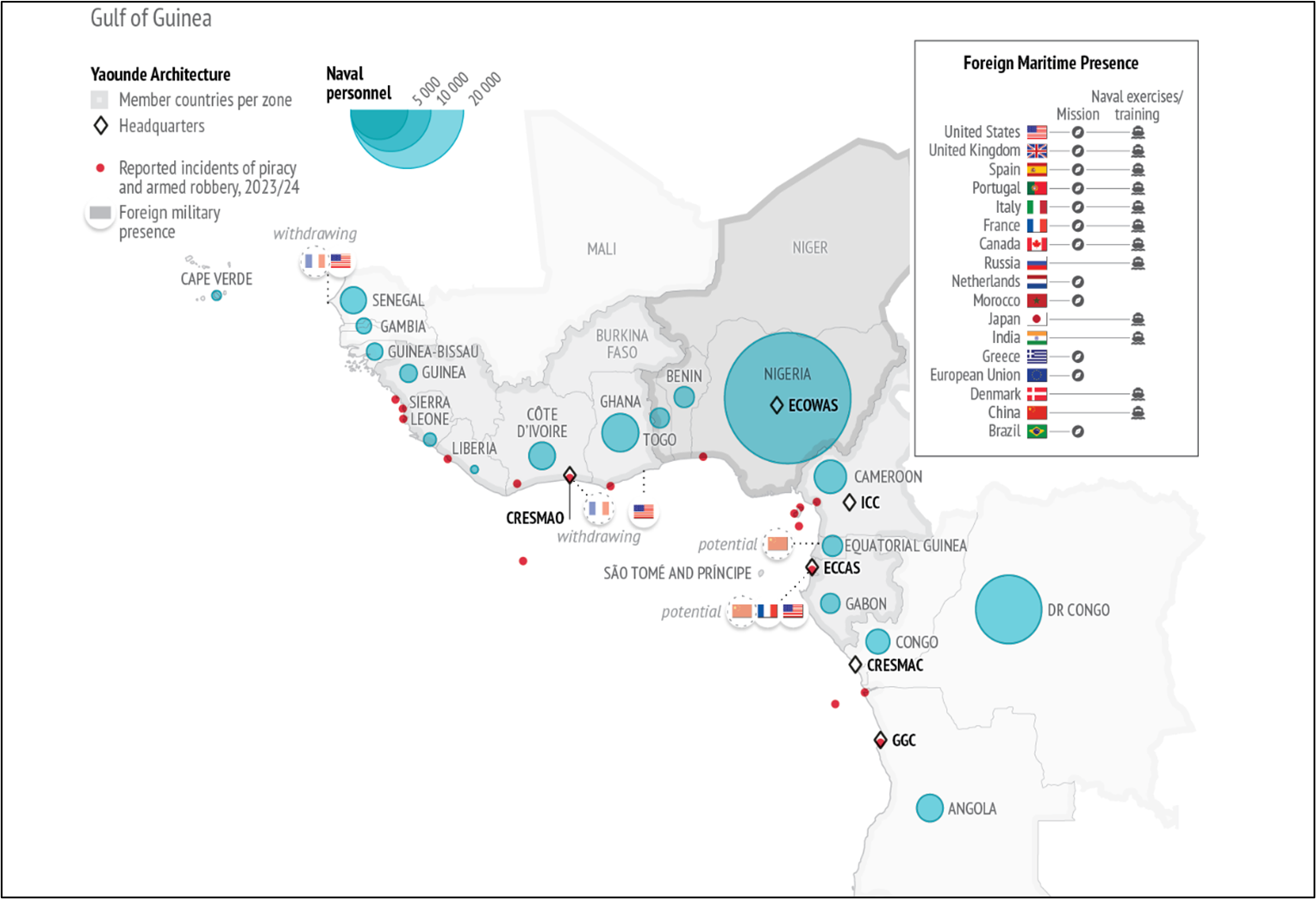
*Map Source: Rossella Marangio. (13) Data Source: European Commission, GISCO, 2024; IISS, Military Balance, 2024; EU CMP, US Africom, UK Royal navy, Africa Center for Strategic studies, 2024 Acronyms: ECCAS (Economic Community of Central African States), GGC (Gulf of Guinea Commission) , ECOWAS (Economic Community of West African States), CRESMAC (Regional Maritime Security Centre for Central Africa), ICC (Interregional Coordination Centre), CRESMAO (Regional Maritime Security Centre for West Africa).
However, despite the significant practical progress, deep structural and legal shortcomings continue to undermine the sustainability of maritime security management in the region. An increase in “dark vessels” that manipulate or disable the automatic identification system (AIS) has been recorded, with operations mostly linked to transnational networks that deal drugs and weapons without going through the authorities of regional states. These developments are transforming insecurity in the Gulf from sporadic piracy to more organised and systematic maritime crises serving the interests of shadowy external actors and sanctioned entities. (14)
The operational record of the Yaoundé Structure and its Code of Conduct remain inconsistent. The United Nations Office on Drugs and Crime reported that only three piracy cases were recorded over the past decade – in Togo, Nigeria and Denmark – a disparity that highlights significant procedural delays, ambiguity in jurisdiction, and limited legal capabilities of member states. Law enforcement is further weakened by compliance gaps in the commercial shipping sector, where ship security recommendations are often misapplied. (15)
Competition between Western-Backed Patrols
The region maritime security is witnessing a new phase of geopolitical competition for institutional influence between Western-aligned security frameworks and a multipolar alternative. The current Western approach can be traced to 2021 and is based primarily on a coordinated EU-US maritime presence and promises of strengthening the Yaoundé structure, (16) hence ensuring long-term normative alignment with regional countries in the face of non-Western powers, especially in light of the Western withdrawal from Niger, Mali, Burkina Faso and Chad, which has forced actors like Washington to redeploy their special operations assets and surveillance capabilities to other countries in the region including the Ivory Coast.
In February 2022, the European Council reinforced its leading role by extending the coordinated maritime presence (CMP) in the Gulf of Guinea for two more years (17) and continuing its maritime security efforts, including the Enhanced Maritime Action in the Gulf of Guinea (EnMAR) from 2022 to 2026, (18) presenting the European Union as a “permanent provider of maritime security” in the region. Furthermore, the 2025 Obangame Express exercises signals Washington's tactical move towards combatting illegal, unreported and unregulated fishing and arms trafficking.
In contrast, the period between 2025 and 2026 witnessed what appeared to be a direct challenge to Western hegemony and influence on the region’s security landscape by some of the BRICS Plus members even though the bloc does not operate as a formal security alliance in the Gulf of Guinea. The “Will for Peace 2026”, a week-long multilateral naval exercise led by China and hosted by South Africa in January 2026, with the participation of Iran and Russia, (19) has sparked debate about whether BRICS Plus is gradually developing into a security bloc capable of extending its naval influence in Africa. (20)
Also, in addition to the reports of China trying to establish a strategic Chinese naval base in Equatorial Guinea, (21) China’s 48th Maritime Task Force between 2024 and 2025 made at least 15 visits to African ports (22), signalling a move from random anti-piracy operations to a more organised, sovereignty-focused security posture that appeals to countries in the region seeking “strategic independence”. Russia reportedly signed military cooperation agreements with Togo in 2025, (23) discussed maritime cooperation with Sao Tome & Principe, (24) and uses Guinea's port of Conakry as a strategic logistics hub for transporting military equipment to Sahel countries, particularly Mali. (25)
Private Security Actors and Shifting Alliances
Ghana, in February 2026, formally initiated legal proceedings against Togo at the International Tribunal for the Law of the Sea. This illustrates the tension and escalation at the state level in the region's conflicts over oil-rich areas and strategic maritime boundaries. (26) Influential local private companies, such as Tantita Security Services in Nigeria's Niger Delta, (27) are emerging, along with non-Western private actors, such as the Russian-backed “Africa Corps” (formerly the Wagner Group), which deployed over 200 personnel to Equatorial Guinea in late 2024 and early 2025 to provide security for the presidency and train special forces, with other possible services that include maritime infrastructure security services. (28) These local and non-Western private actors are transforming the geopolitical competition among private security companies in the region into a “hybrid” market where non-Western paramilitary groups and local companies challenge traditional security providers.
There are also indications of a change in regional alliances due to the ongoing tension between the Economic Community of West African States (ECOWAS) and the Alliance of Sahel States (AES), which includes Mali, Niger and Burkina Faso. These countries, ruled by military juntas, endorsed an initiative by Morocco to gain access to transatlantic trade routes, (29) thereby abandoning their traditional ECOWAS partners on the Gulf of Guinea coast (such as Benin and the Ivory Coast). This creates new spheres of influence for non-Western powers supporting these military regimes.
Western private security firms, such as British firm Neptune P2P in Libreville, Gabon (30) and French group IRENA in Cotonou, Benin (31) are responding to this by focusing on specialised, high-tech surveillance and formal, integrated partnerships with the region’s states to maintain their strategic advantage. These companies are increasingly competing not only in terms of military capabilities but also in providing intelligence as a service and risk mapping using artificial intelligence in an effort to create a security model that remains compatible with US and European naval patrols.
Southward Spread of Sahelian Instability
The southward expansion of “terrorist” operations from the Sahel region is creating a “coastal-inland” threat, as “terrorists” seek to bridge the gap between the Sahel and maritime routes. By the last quarter of 2025, groups like Jama'at Nusrat al-Islam wal-Muslimin (JNIM) had increased their incursions into northern Benin, Togo and Ghana, raising serious maritime security concerns. (32) In addition, both Boko Haram and the Islamic State (IS) are moving from Nigeria’s north to its south.
The southward migration of “terrorists” appears to be a regional expansion and a deliberate effort to secure “maritime corridors” for illicit revenues, linking inland smuggling routes for fuel, drugs and gold to global trade flows managed through major coastal ports. Some reports indicate that while these terrorist groups do not necessarily operate as drug traffickers, they control key transit routes; they levy “taxes” or protection fees on smugglers, providing a steady source of funding for weapons and operations, and creating an “agency” relationship where maritime criminal networks act as logistical and financial backers for the “terrorist” groups.
This has forced regional actors to steer their operational focus on maritime security, prioritising a reassessment of risks and the protection of port infrastructure and coastal stability from the threat of “maritime terrorism”, sabotage of land-based power lines, and even disruption of land-based supply chains. For example, by January 2026, the maritime security services of Togo and Benin had integrated coastal surveillance radars with sensor systems along their northern borders, recognising that the security of the ports of Lomé and Cotonou was inextricably linked to containing “terrorist” groups active just a few hundred miles inland.
Regional security frameworks are also accelerating the creation of maritime and land-based “buffer” forces designed to protect the maritime domain. ECOWAS, in August 2026, announced its plan to establish a regional force specifically tasked with combating terrorist groups. (33) Also, five ECOWAS navies – Ivory Coast, Ghana, Gambia, Liberia and Sierra Leone – have announced their joining Nigeria to activate the Combined Maritime Task Force for Gulf of Guinea in May 2026. (34) Furthermore, the Yaoundé system has begun adapting its maritime domain surveillance protocols to include monitoring rivers and lakes, areas that were previously neglected when high-seas piracy was the main concern.
There are also indications that Western security frameworks are being shaped to keep pace with this development. This was underscored by a series of joint maritime border exercises by early 2026, such as the defence agreement signed by the European Union and Ghana on 14 April 2026, which is largely framed as a response to the evolving security dynamics in the Sahel region. (35)
Conclusion
It can be concluded from the above that the Gulf of Guinea is a complex geopolitical border region affected by crime and terrorism from the Sahel and global rivalries. While traditional kidnapping-for-ransom piracy has declined significantly, the vacuum has been filled by proxy conflicts and “grey zone” activities that provide “fuel” (financing and supply) for broader political destabilisation, transforming the threat from a mere domestic criminal nuisance to a systematic challenge to territorial sovereignty and proxy-driven instability.
To consolidate these gains and counter the proxy-led maritime crime, countries in the region must move from purely kinetic maritime responses to an integrated governance framework. Starting with a greater focus on “legal outcome”, particularly ensuring that naval arrests lead to successful local trials by aligning national laws with regional frameworks (specifically the Yaoundé structure). Regional powers will also need to limit global rivalries and agency by asserting their strategic independence through the sustainable activation of the Yaoundé structure and leveraging the African Continental Free Trade Area Agreement to ensure that maritime security serves African economic integration rather than external geopolitical interests and rivalries.
Finally, security efforts must be inward-looking to address driving social and economic factors, such as youth unemployment and environmental degradation, that allow recruitment intermediaries to maintain a foothold in coastal communities. The establishment of a joint cell to integrate maritime intelligence between West African countries and international partners is also essential to monitor the complex financial flows and maritime cyber threats that characterise these modern agency networks.
1. “Lowest first-quarter maritime piracy and armed robbery figures since 1991, but vigilance remains essential”, International Chamber of Commerce, 8 April 2026, https://shorturl.at/lUo9N (accessed 19 April 2026).
2. “Military alliance and port deal with Russia goes live”, Africa Confidential, Vol. 66 Issue 9, 28 April 2025, https://shorturl.at/2xMq6 (accessed 22 April 2026); “US, Russia intensifying efforts to make Togo West Africa’s key maritime hub over Nigeria”, The Street Journal, 29 July 2025, https://shorturl.at/T1tVC (accessed 19 April 2026).
3. Lea Thome, “China Continues Its Search for a Maritime Military Presence in West Africa”, The Diplomat, 20 February 2024, https://shorturl.at/gFE3D (accessed 19 April 2026).
4. Rossella Marangio, “Deep waters: the maritime security landscape in the Gulf of Guinea”, European Union Institute for Security Studies (EUISS), 9 January 2025, https://shorturl.at/U7QA2 (accessed 19 April 2026).
5. “Maritime Security in the Gulf of Guinea: A Comprehensive Guide to Regional Stability in 2026”, Council on African Security and Development (CASADE), 28 March 2026, https://shorturl.at/e4bzQ (accessed 19 April 2026).
6. Olivier de Souza, “Gulf of Guinea regains appeal as a key exploration hub for oil majors”, Ecofin Agency, 7 February 2026, https://shorturl.at/8hOhe (accessed 19 April 2026).
7. “Lowest first-quarter maritime piracy and armed robbery figures since 1991, but vigilance remains essential”, International Chamber of Commerce, 8 April 2026, https://shorturl.at/lUo9N (accessed 19 April 2026).
8. “Global maritime piracy and armed robbery increased in 2025”, International Commercial Crime Services, 15 January 2026, https://shorturl.at/dGJUI (accessed 19 April 2026).
9. Peter Udochukwu Ohagwa, “Analysis of Nigeria’s Deep Blue Project: a new paradigm for maritime security in the Gulf of Guinea”, World Maritime University, 31 October 2022, https://shorturl.at/8dFoi (accessed 19 April 2026).
10. “Yaounde Architecture Reinforces Fight Against Piracy”, Dryad Global, 25 July 2022, https://shorturl.at/t2u08 (accessed 19 April 2026).
11. Ekene Lionel, “Grand African Nemo 2025: Regional Navies Pivot to Integrated ‘State Action at Sea’”, Military Africa, 15 December 2025, https://shorturl.at/8TgKr (accessed 19 April 2026).
12. U.S. Naval Forces Europe-Africa/U.S. Sixth Fleet, “Building Security Through Cooperation: Exercise Obangame Express 2025 concludes in Cabo Verde”, United States Navy, 16 May 2025, https://shorturl.at/O0ky5 (accessed 19 April 2026).
13. Rossella Marangio, “Deep waters: the maritime security landscape in the Gulf of Guinea”, European Union Institute for Security Studies (EUISS), 9 January 2025, https://shorturl.at/U7QA2 (accessed 19 April 2026).
14. Nengi Anita Banigo-Abah and Dr. Fabian C. Ikeh, “Artificial Intelligence and the Combat of Piracy in the Gulf of Guinea”, Journal of Law, Policy and Globalization, Vol. 149, 2025, pp. 97-110, https://shorturl.at/h9g9S (accessed 22 April 2026).
15. “Lowest first-quarter maritime piracy and armed robbery figures since 1991, but vigilance remains essential”, International Chamber of Commerce, 8 April 2026, https://shorturl.at/lUo9N (accessed 19 April 2026).
16. “EU Action Enhancing Maritime Security in The Gulf of Guinea”, Expertise France, 24 November 2025, https://shorturl.at/TCNo5 (accessed 22 April 2026); EU Gulf of Guinea Security and Defence Initiative - Press Team, “EU Expands Partnership for Peace and Security in the Gulf of Guinea”, European External Action Service (EEAS), 15 October 2025, https://shorturl.at/XXASs (accessed 20 April 2026).
17. “Coordinated Maritime Presences: Council extends implementation in the Gulf of Guinea for two years and establishes a new Maritime Area of Interest in the North-Western Indian Ocean”, Council of the European Union, 21 February 2022, https://shorturl.at/e6nng (accessed 20 April 2026).
18. “European Union Maritime Strategy in the Gulf of Guinea”, Expertise France, November 2025, https://shorturl.at/0r6Gz (visited on 20 April 2026).
19. Tim Cocks, “China, Russia, Iran start 'BRICS Plus' naval exercises in South African waters”, Reuters, 10 January 2026, https://shorturl.at/BVUE3 (accessed 20 April 2026).
20. Paul Nantulya, “China’s Military Footprint in Africa Deepens with PLA-led BRICS Naval Drills”, Africa Center for Strategic Studies, 30 January 2026, https://shorturl.at/bFdEa (accessed 20 April 2026).
21. Lea Thome, “China Continues Its Search for a Maritime Military Presence in West Africa”, The Diplomat, 20 February 2024, https://shorturl.at/gFE3D (accessed 19 April 2026).
22. Paul Nantulya, “China’s Military Footprint in Africa Deepens with PLA-led BRICS Naval Drills”, Africa Center for Strategic Studies, 30 January 2026, https://shorturl.at/bFdEa (accessed 20 April 2026).
23. Benjamin Roger and Marie Jégo, “Russia's navy now has privileged access to the Gulf of Guinea”, Le Monde, 25 November 2025, https://shorturl.at/byZhW (accessed 20 April 2026).
24. “Russia, São Tomé & Principe Discuss Increasing Bilateral Cooperation”, Russia's Pivot to Asia, 7 July 2025, https://shorturl.at/y66XK (accessed 20 April 2026).
25. “How Guinea became a gateway for Russian weapons to reach the Sahel”, RFI, 20 June 2025, https://shorturl.at/iZKiN (accessed 20 April 2026).
26. “Gulf of Guinea: Ghana Escalates Maritime Dispute with Togo to International Tribunal”, African Security Analysis, 28 February 2026, https://shorturl.at/rBCAm (accessed 20 April 2026).
27. Tamarautare Esther Fullpower and Preye Inimiesi Oba, “Examining the Tantita Security Services and Illegal Bunkering Activities in Bayelsa State”, Taraba International Journal of Social Sciences Research, Vol. 1 Issue 2, December 2024, pp. 172-191, https://shorturl.at/iGztO (accessed 22 April 2026).
28. “Russia’s Expanding Security Footprint in Equatorial Guinea”, African Security Analysis, 1 March 2026, https://shorturl.at/prr3S (accessed 20 April 2026).
29. “Mali, Burkina Faso and Niger to have access to the Atlantic ocean”, Africa News, 29 April 2025, https://shorturl.at/t1IZR (accessed 20 April 2026).
30. “New Operations Center – Libreville, Gabon”, Neptune P2P Group, https://shorturl.at/VQLOw (accessed 20 April 2026).
31. “Private security firm Irena gets down to business in Cotonou”, Africa Intelligence, 14 January 2026, https://shorturl.at/D0m5a (accessed 20 April 2026).
32. David Doukhan, “The Sahel is the Epicenter of Jihadist Expansion in Africa”, Reichman University International Institute for Counter-Terrorism, 6 January 2026, https://shorturl.at/9kUQW (accessed 20 April 2026).
33. Hassane Koné, “How ECOWAS can make its new counter-terrorism force effective”, Institute for Security Studies (ISS), 25 March 2026, https://shorturl.at/mM00x (accessed on 20 April 2026).
34. “Nigeria, Five ECOWAS Navies Launch Maritime Task Force for Gulf of Guinea”, PRNigeria, 24 February 2026, https://shorturl.at/4gy4S (accessed 20 April 2026).
35. “Ghana, EU sign first pact to counter West Africa's growing insecurity”, Africa News, 24 March 2026, https://shorturl.at/gXLNZ (accessed 20 April 2026).