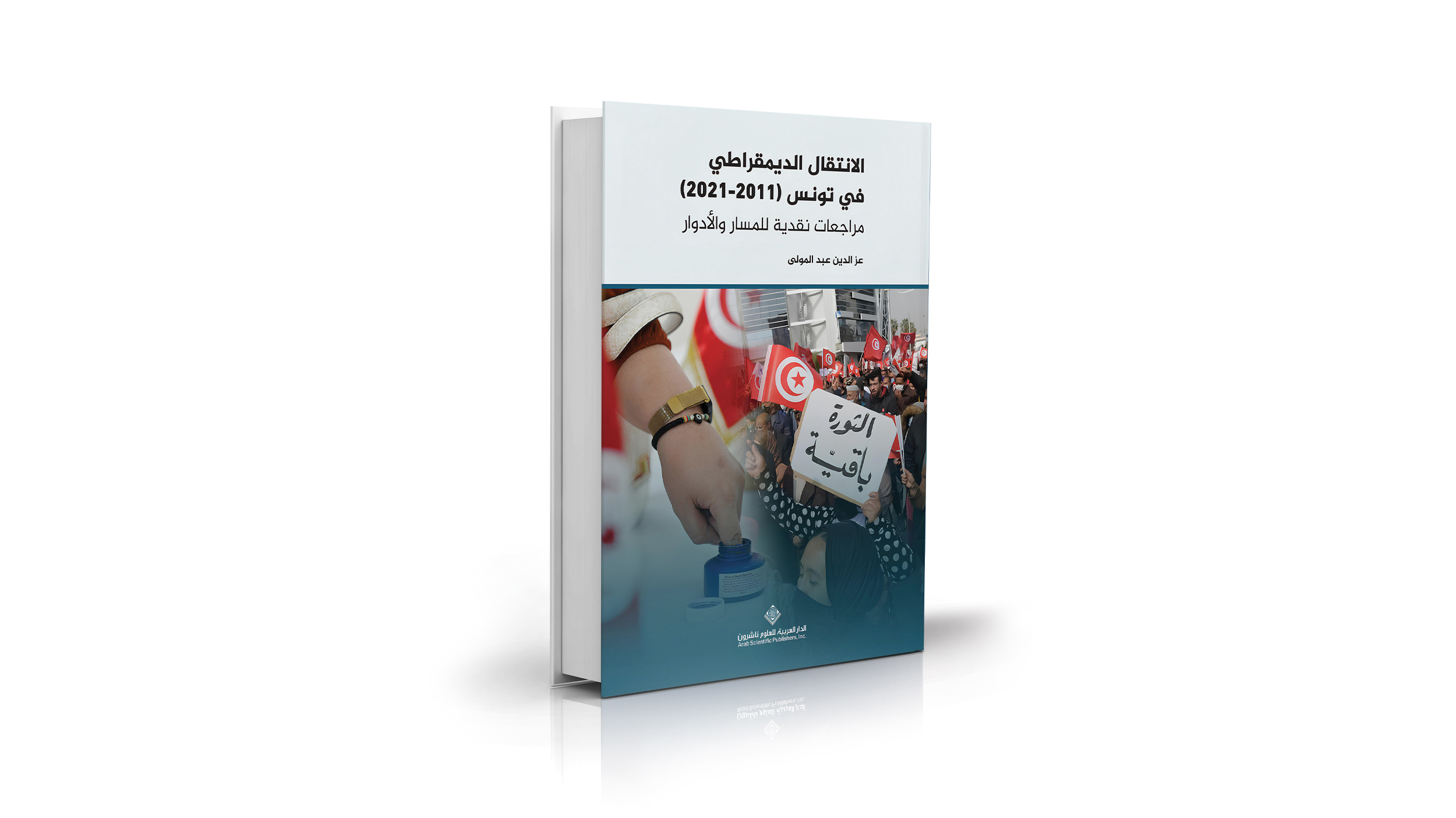
Al Jazeera Centre for Studies has published a new book titled Al-Intiqal ad-Dimuqrati fi Tunis (2011–2021): Muraja‘at Naqdiya lil-Masar wal-Adwar [Democratic Transition in Tunisia (2011–2021): Critical Reassessments of the Trajectory and the Roles], which offers a critical reading of Tunisia’s democratic transition over the decade following the 2011 revolution. It traces the contexts in which this experience emerged, the roles of its main actors, the factors that contributed to the success of some phases and the stagnation of others, and ultimately the suspension of the democratic process in 2021.
The author, Dr. Ezzeddine Abdelmoula, Director of Research at Al Jazeera Centre for Studies, begins from the premise that the Tunisian experience—despite its eventual setbacks and failures—represents one of the most important democratic transition cases in the Arab world. It contains significant political, institutional and intellectual lessons that merit review and analysis, both for understanding Tunisia itself and for grasping the broader challenges facing democratisation processes in the Arab region.
Published by the Arab Scientific Publishers in Beirut, the book spans eight chapters addressing various dimensions of the Tunisian experience. These range from the theoretical framework of democratic transition and its local, regional and international contexts, to the roles of political elites, Islamists, the Tunisian General Labour Union, the media and external actors. It also examines the conditions for the return of democracy and the prospects for its sustainability in the future.
The author situates the Tunisian experience within a broader framework linked to comparative literature on democratic transitions, drawing on accumulated theoretical insights from political transformation processes in different parts of the world. He also connects it to national, Arab and international contexts, aiming to explain the reasons for both success and failure beyond simplistic interpretations or preconceived judgments.
The first chapter addresses the trajectory of Tunisia’s democratic transition from a comprehensive perspective. It reviews the national, Arab and post-colonial contexts surrounding the experience and discusses the concept of the “Tunisian exception,” which dominated academic and political debate over the past decade. It also examines key milestones of the transition, from the establishment of transitional institutions and the drafting of the 2014 constitution, through periodic elections and transitional justice processes, to the political and institutional crises that ultimately led to the closure of the democratic path.
The second chapter examines the role of the Tunisian elite, highlighting its contribution to building political compromises that enabled important stages of the transition. It also shows how internal divisions and conflicts within these elites became one of the main reasons for the experience’s decline. The author concludes that the Tunisian elite played a dual role: it helped establish the emerging democratic experiment, but also contributed to creating the conditions that weakened it.
The third chapter focuses on the experience of Islamists in power, particularly the Ennahda Movement. It analyses its shift from opposition to governance, the challenges it faced in managing the transitional period, and the broader relationship between Islamism and democracy in terms of political practice, intellectual foundations, and their impact on the transition process.
The fourth chapter addresses the role of the Tunisian General Labour Union as one of the most prominent political and social actors in modern Tunisia. It reviews its contributions during the revolution and the transitional period, including its role in the national dialogue that helped overcome the 2013 political crisis, as well as the impact of its political and trade union positions on the evolution of the democratic process and the crises it faced.
The fifth chapter is devoted to examining media performance during the decade of democratic transition, drawing on several theoretical approaches in media and communication studies, such as agenda-setting, gatekeeping and news framing. It concludes that large segments of the media failed to keep pace with democratic transformations and, to varying degrees, contributed to deepening the crises of the transitional period.
The sixth chapter discusses the concept of the “deep state” and the theoretical and political debates surrounding it. It traces the origins, evolution and spread of the concept in contemporary political literature, before examining its relevance to the Tunisian case and its potential role in shaping certain trajectories of political life during the transitional period.
The seventh chapter explores the impact of external actors on the Tunisian experience by analysing the positions of international and regional powers toward both the revolution and the democratic transition. It also examines how regional and international dynamics influenced the chances of success or failure, as well as the transformations the country experienced after 2021.
The book concludes with a final chapter dedicated to the future of democracy in Tunisia, discussing the possibilities of returning to a democratic path and the conditions required for doing so. The author distinguishes between resuming the previous experiment from where it stopped and the idea of “re-democratisation”, which involves building a new experience that draws on past lessons and overcomes earlier failures. In this context, he outlines several necessary conditions for any future democratic project, including collective critical reassessment, elite renewal, the establishment of a broad democratic pact, constitutional and institutional reform, strengthening democratic culture, reforming the media system, and leveraging national expertise.
The book concludes that Tunisia’s decade of democratic transition, with its achievements and setbacks, represents a pivotal moment in modern Arab political history and a rich source of lessons for understanding the challenges and possibilities of democratic transformation in the Arab world.