
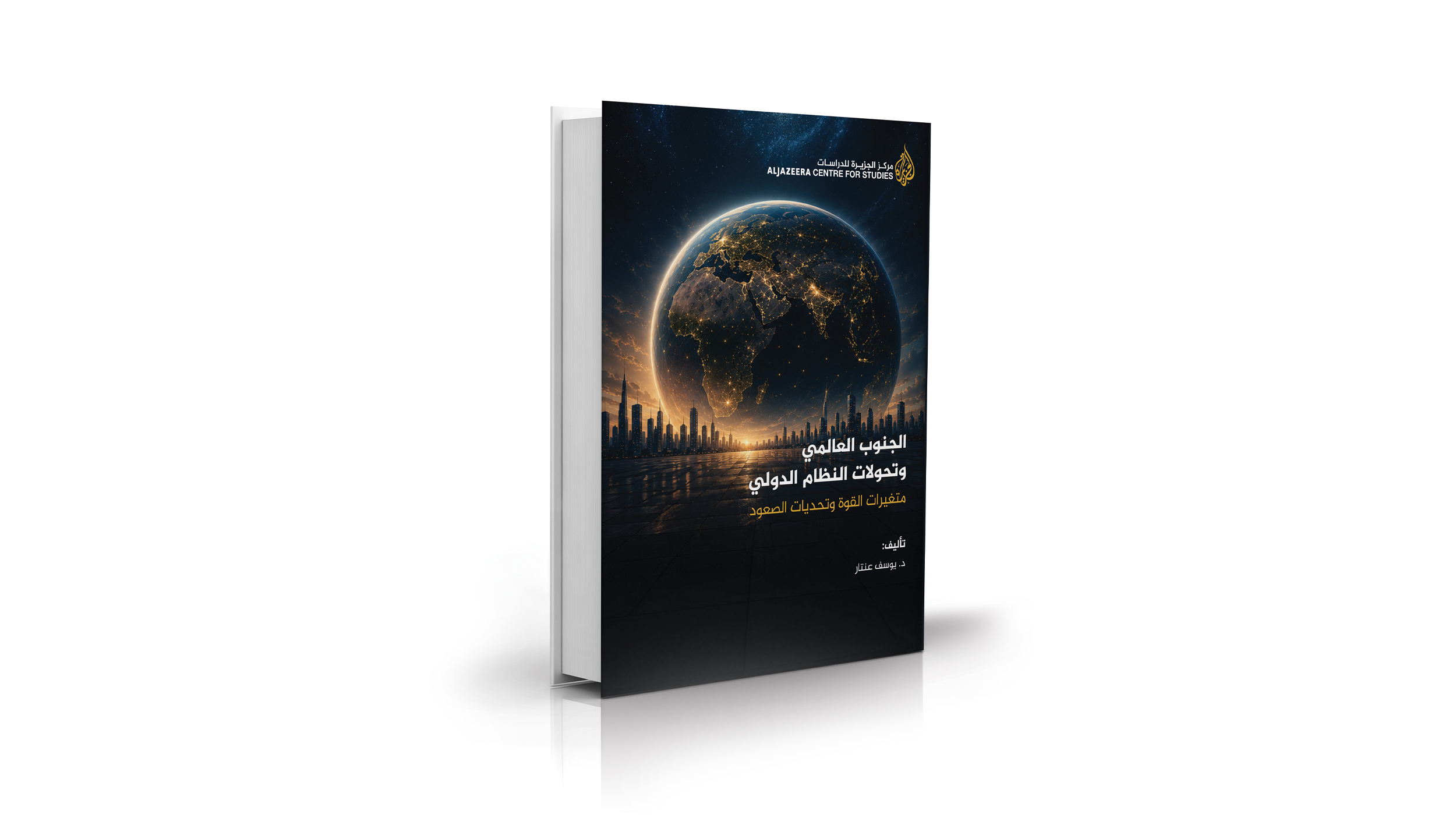
Al Jazeera Centre for Studies has published a new book titled Al-Janoub Al-‘Alami wa Tahawwulat An-Nidham ad-Dawli: Mutaghayyirat Al-Quwwa wa Tahaddiyat As-Su‘ud [The Global South and Transformations of the International System: Power Shifts and Challenges of Rising Influence”, by Youssef Antar. The book offers an in-depth analytical reading of the transformations taking place within the Global South amid rapid geopolitical and economic changes shaping the contemporary international system. It examines the potential for the Global South to shift from a space characterised by dependency and fragility into a more active and influential international pole.
The book begins from the premise that the Global South is no longer merely a geographical label, but has become a political and intellectual concept reflecting imbalances in the international system, as well as economic, technological and knowledge gaps that emerged during and after the colonial era. The author argues that understanding Global South issues requires a deeper grasp of ongoing global transformations and the intensifying struggle to reshape power balances between the dominant industrial North and the South seeking to consolidate its presence in an unstable global order.
The book addresses a set of structural challenges facing Global South countries, including mass migration, brain drain, capital flight, stalled regional integration projects, as well as crises of leadership and the absence of a unifying project capable of aligning Southern perspectives in the face of growing international challenges. At the same time, it highlights latent sources of strength in the Global South, including natural resources, demographic weight, the rising influence of emerging powers, and the development of intellectual and institutional experiments that challenge Western dominance in knowledge production.
A central question posed by the book is whether the Global South is a fragmented space shaped by structural weakness and dependency, or whether it possesses genuine potential to emerge as an influential pole capable of rebalancing the international system. This is explored through a critical analytical approach combining conceptual analysis, comparative methods, and structural and sociological perspectives, drawing on experiences from Africa, Asia and Latin America.
The book is comprised of six main chapters. The first examines conceptual shifts surrounding the term “Global South”, while the second explores structural fragility and push factors within Southern countries. The third discusses the failure of regional integration projects, and the fourth focuses on leadership crises and competition among rising powers such as China, India and Brazil over representing and leading the Global South.
The two remaining chapters analyse the role of intellectual elites and research centres in the Global South, assessing their effectiveness in knowledge production and policymaking, and identifying challenges such as epistemic dependency, funding constraints and weak institutional independence. The author emphasises that building Southern autonomy is not solely an economic and political task but also requires an independent knowledge infrastructure capable of producing strategic visions that reflect Southern interests and challenges.
The book argues that the Global South is undergoing a critical transitional phase where dependency dynamics coexist with efforts to build developmental and epistemic autonomy. It suggests that successive global crises—economic, geopolitical and technological—have allowed for the redefinition of the South’s position in the international system and for stronger demands to reform global governance and enhance multilateralism.
The author concludes that the future of the Global South depends on its ability to build an independent civilisational and developmental project based on investing in human capital, strengthening regional integration, developing think tanks and research institutions, and building independent knowledge and development networks free from Western dominance. Ultimately, the rise of the South is not limited to economic growth, but is tied to its capacity to transform its diversity into an intellectual and institutional force capable of contributing to a more just and multipolar global order.