
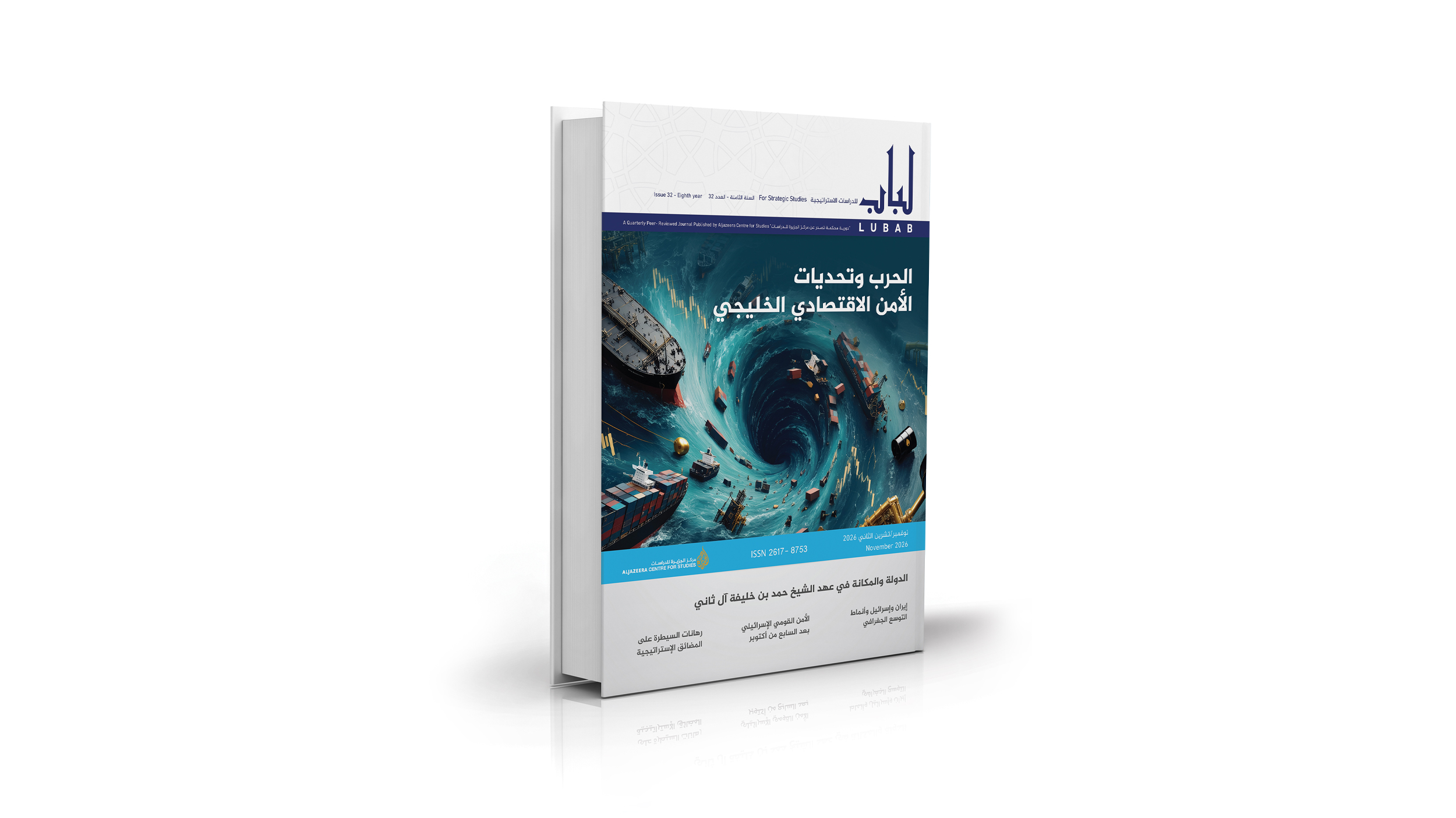
Lubab Journal for Strategic Studies has released its 32nd issue, examining the rapid transformations reshaping the strategic environment of the Gulf and the wider region, and the challenges they pose regarding sources of power, how they are wielded, and the limits of their influence. From multiple perspectives, the issue explores the relationship between economic resources, geographic location, military capabilities, institutions, knowledge and technology, and how these factors shape states’ ability to protect their interests and strengthen their standing in a regional and international environment marked by escalating conflicts and shifting balances of power.
The issue’s editorial, titled “The Gulf and Shifts in the Strategic Environment”, argues that ongoing international and regional transformations are redistributing power among states and bringing about profound changes in how its sources and limits are defined. Against this backdrop, states’ ability to leverage their economic and military resources and geographic advantages, build their institutions, manage their relationships, and adapt to crises is becoming increasingly important to strengthening their security, standing and influence. The Gulf lies at the heart of these transformations, given its wealth, geographic position and strategic standing, as well as the surrounding conflicts and interactions reshaping its strategic environment.
From this perspective, the study “Gulf Economic Security Amid the 2026 War: Energy and Maritime Route Challenges” examines the challenges facing Gulf states as they seek to protect their economic resources and ensure that their exports reach global markets. According to the study, the war highlights the strategic importance of maritime chokepoints, particularly the Strait of Hormuz and the Bab el-Mandeb Strait. It also demonstrates how security disruptions, rising insurance costs, and interruptions to shipping can affect energy security and economic stability. The study calls for broadening the concept of energy security to encompass the security of transportation, exports and storage, while strengthening Gulf integration, diversifying export routes, and enhancing resilience in the face of crises.
While the protection of resources presents significant challenges, the study “State and Status under Sheikh Hamad bin Khalifa Al Thani: A Reading of the Legacy of Qatar’s Transformation” offers a model of how wealth can be converted into institutional and developmental capabilities and regional and international standing. It examines Qatar’s rise between 1995 and 2013, exploring how the development of its gas resources was accompanied by investment in education, healthcare, infrastructure and sovereign assets. It also considers how diplomacy, media, investment, culture and sport were used to strengthen the country’s international presence. The study concludes that this period laid the foundations for an institutional and strategic transformation whose effects extended beyond 2013.
From the relationship between resources and international standing, attention shifts to the limits of military power in reshaping regional balances. The study “The Limits of Power Between Iran and Israel: Comparing Patterns of Geographical Expansion After the Wars of 2025 and 2026” examines the role of geography in the conflict between the two sides through the lens of Israeli threat perceptions, Iran’s strategic depth and the Arab vacuum. It explores how these geographic realities constrain the ability to translate military superiority into lasting political and security outcomes. In the same context, the study “‘Permanent Security’ as the Guiding Principle for the Reshaping of Israel's National Security Strategy after 7 October” examines shifts in Israeli security doctrine and the growing reliance on military force to eliminate sources of threat. It highlights the persistent gap between operational gains and the achievement of strategic objectives, alongside the mounting military, economic and political costs.
These transformations are closely linked to the growing strategic importance of geography and maritime routes as factors shaping balances of power and economic security. In this context, the issue’s book review section features an examination of Géopolitique des détroits. Enjeux de contrôle de passages stratégiques by Frédéric Lasserre and Pauline Pic. The review explores the role of straits in international trade and energy security, as well as the crises triggered by disruptions to these waterways and their repercussions for the global economy. It emphasises the importance of viewing these routes through the lens of the interests of the states and societies bordering them, and of considering their potential to become spaces for regional integration and prosperity.
Alongside resources, geography and military power, political, economic and knowledge-based influence emerges as another dimension of international transformation. The study “China's Image in the Middle East: Between Self-Definition and the Perception of the Other” examines how China presents itself in the region and the extent to which its narratives concerning the international order, development, and its political model feature in Arab perceptions. It concludes that Arab recognition of China as an economic and political partner is growing, with some Arab positions adopting elements of China’s terminology and narratives. This reflects shifts in patterns of influence and international relations.
The exploration of emerging sources of power extends to the role of knowledge and technology in anticipating and managing risks. The study “Smart Climate Modelling and the Prevention of Future Conflicts over Resources” examines the potential of artificial intelligence and big data to predict conflicts linked to climate change and natural resources. It proposes the concept of “algorithmic climate security”, emphasising the importance of algorithmic governance, data sovereignty and equitable access to knowledge and technology.
In another dimension concerning institutional capacity to address challenges, the issue’s Updates section examines “The Role of the African Union in Combating Corruption: Mechanisms, Challenges and Opportunities”. It reviews continent-wide efforts to establish legal and institutional frameworks for combating corruption, along with the challenges involved in implementing them. The analysis underscores the importance of moving beyond the creation of rules and institutions to ensuring their effective implementation, while strengthening regional cooperation, asset recovery and efforts to combat illicit financial flows.
Taken together, the issue’s contributions converge on a central question: the ability of states to transform their resources and advantages into effective and sustainable power. From energy security and maritime routes to institution-building and the strengthening of international standing, and from the limits of military power to the rise of knowledge-based and technological influence, the studies reveal profound shifts in the nature of power and the conditions under which it can be effectively exercised. At the heart of these transformations lies the challenge facing Gulf states: strengthening their ability to protect their interests, absorb shocks, expand their room for manoeuvre, and help shape the strategic environment around them.
The issue is available in Arabic only and can be accessed and downloaded here.