
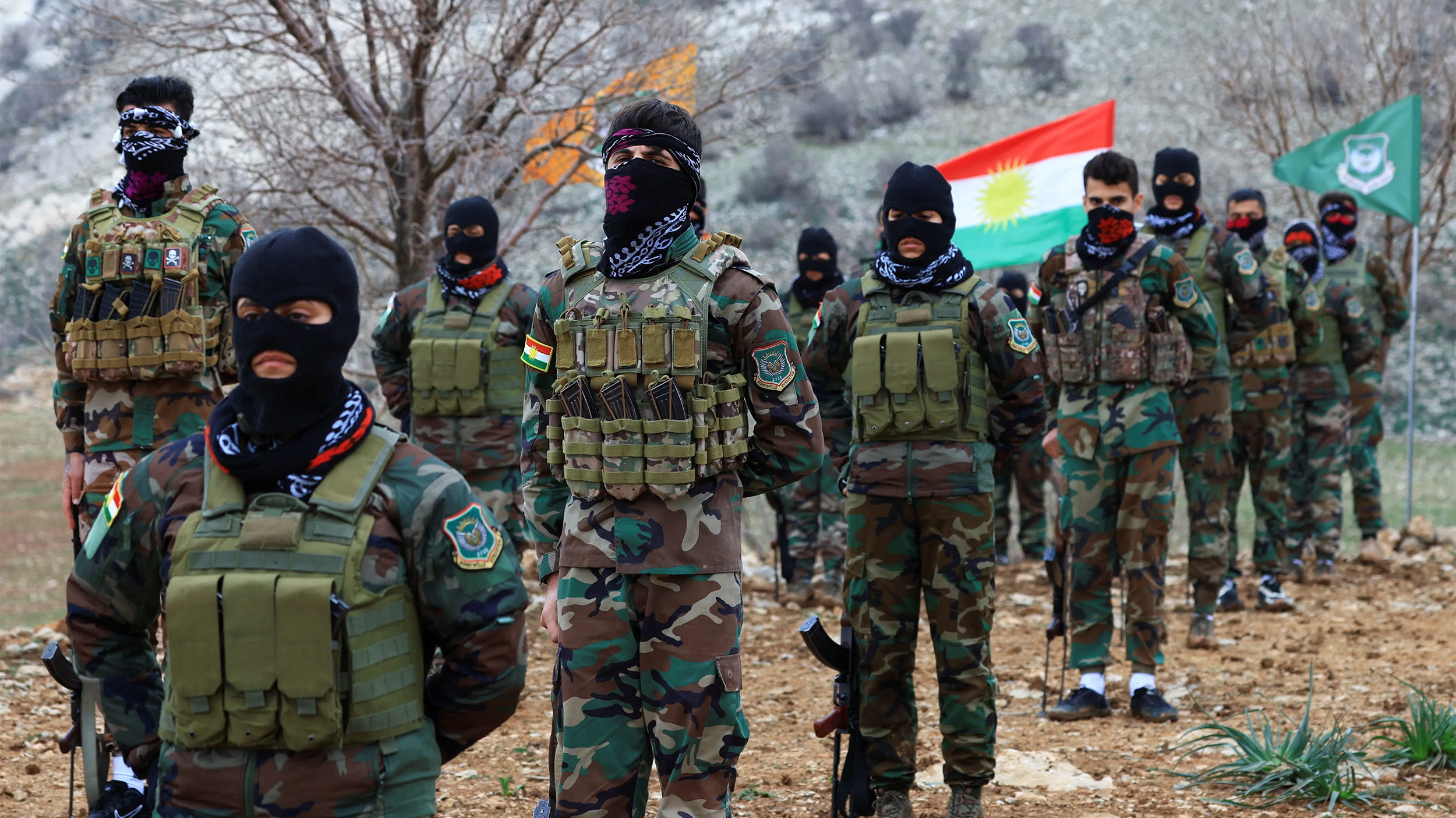
Israel’s plan to use Iranian Kurdish opposition groups as an armed force in the war against Iran failed before it could be implemented, largely because of serious miscalculations about Iran’s political system, Kurdish opposition groups, and the level of popular support for regime change. From the outset of the war, regime change appeared to be the principal Israeli and American objective, while other aims, including the complete destruction of Iran’s nuclear programme, were viewed as secondary and expected to follow from the overthrow of the Islamic Republic. The participation of Iranian Kurdish forces was therefore considered an important component of the strategy.
Israel had spent decades developing intelligence relationships with Kurdish groups in Iraq, Iran and Syria. Although the precise timing and intermediaries involved in establishing regular contacts with Iranian Kurdish opposition groups remain unclear, Iranian Kurdish militants appear to have long figured in Israeli calculations against the Islamic Republic. Serious consideration of regime change reportedly returned to the Israeli leadership’s agenda in the summer of 2024. At that stage, the emerging concept appears to have involved Israeli-linked Iranian agents encouraging a popular uprising, followed by Kurdish armed groups crossing into Iran to support the protesters and advance toward Tehran.
The rapid overthrow of Bashar al-Assad’s government in Syria in December 2024 may have reinforced Israeli confidence in this approach. The success of an organised armed opposition in defeating a deeply rooted government in less than two weeks seemingly encouraged the belief that a comparable strategy could work in Iran. This assumption, however, overlooked major differences between the two countries. The Syrian opposition operated in the context of a broad popular uprising, whereas Iranian Kurdish armed groups represented only a portion of an ethnic minority and lacked a comparable nationwide social base.
Israeli efforts to prepare Iranian Kurdish groups intensified during 2025. Israeli officials reportedly visited militant camps in Iraqi Kurdistan and supplied weapons, while connections with Iranian opposition figures, merchants and businessmen were strengthened. These efforts appear to have been linked to the expectation that a new wave of popular protests would create an opening for armed intervention. Economic protests that began on 28 December 2025, did expand and were joined by armed elements that attacked government institutions and security forces. However, their involvement gave the Iranian authorities grounds to respond forcefully. Beginning on 8 January 2026, the government suppressed the protests; and within two days, the movement had been completely extinguished, with several hundred people reportedly killed.
The failure of the uprising prompted a major revision of the Kurdish strategy. Rather than waiting for a domestic rebellion to create the conditions for an armed advance, Israel envisaged using an Israeli-American war to weaken the Iranian state first. The expectation was that attacks would eliminate senior leaders, disrupt command-and-control structures, and weaken security and military institutions, particularly in Iran’s Kurdish-majority western provinces. This would supposedly allow Kurdish armed groups to cross the border and establish a secure route toward Tehran.
Netanyahu’s meeting with Donald Trump in Washington on 11 February 2026, appears to have been important in securing American support for this concept. Although subsequent American reports denied that Washington had given prior approval for Kurdish participation, Trump continued to refer to a Kurdish role during the first week of the war and mentioned weapons being supplied to Kurdish groups. He did not explicitly reject their participation until 7 March 2026, the eighth day of the war.
A central weakness of the strategy was the fragmented nature of the Iranian Kurdish opposition. Israel reportedly believed that Kurdish groups could mobilise around 15000 fighters and attract additional recruits as they advanced into Iran. Israeli planners recognised that the groups were divided but apparently assumed that a new coalition could overcome their rivalries. On 22 February 2026, five Kurdish political and armed organisations announced the formation of the Political Forces of Iranian Kurdistan coalition following negotiations involving seven groups. The coalition consisted of the Democratic Party of Iranian Kurdistan (PDKI), the Kurdistan Freedom Party (PAK), the Party for a Free Life in Kurdistan (PJAK), the Kurdistan Struggle Organisation (KHABAT), and Komala of the Toilers of Kurdistan. Yet none possessed significant influence throughout the Kurdish provinces, and several had only limited political or military capabilities. Their activities were largely confined to particular regions, while ideological and organisational divisions remained significant.
The Kurdish option was still being considered in Washington shortly before its abandonment. On 3 March 2026, Trump spoke by telephone with PDKI leader Mustafa Hijri, while Israeli media reported that tens of thousands of Kurdish fighters were gathered on the Iraqi side of the border. At the same time, Iranian Kurdish-majority provinces were subjected to intensive airstrikes against security, police, Basij and intelligence facilities, apparently in preparation for a possible armed incursion.
The strategy nevertheless collapsed before the Kurdish forces entered Iran. Israeli sources close to Netanyahu attributed the reversal partly to Turkish President Recep Tayyip Erdoğan, who they claimed had persuaded Trump, during a conversation between the two in the first days of the war, that Kurdish participation was both dangerous and futile. However, because neither Erdoğan nor Trump disclosed the contents of their conversation, the accuracy of this account is difficult to verify.
Ankara understood that an external Kurdish invasion was unlikely to succeed and could instead produce a massacre of Iranian Kurds, particularly Sunni Kurds, while plunging Iran into prolonged armed instability. Turkey may also have sought to influence Iranian Kurdish groups, especially the PDKI, to distance themselves from the Israeli plan. Abdullah Öcalan reportedly warned the Iranian branch of the Kurdistan Workers’ Party against becoming an instrument of outside powers.
More decisive, however, was the assessment conducted by American officials after the war began. According to reports, US officials visited Kurdish groups in northern Iraq and met their leaders directly. They concluded that claims of tens of thousands of armed Kurdish fighters were greatly exaggerated and found no evidence that Kurdish forces would receive broad popular support in Iran’s Kurdish-majority provinces. They also determined that Iranian military and security forces were prepared for an external invasion.
The failure of the strategy reflected a broader pattern of Israeli overconfidence and misjudgement. Israel underestimated the complexity of Iran’s political structure, the distribution of power among its numerous governing and security institutions, and the resilience of its military and security apparatus. It also failed to distinguish between popular dissatisfaction with government policies and an actual desire to overthrow the Islamic Republic or divide Iran. Even reports of contacts with figures around former President Mahmoud Ahmadinejad would indicate little more than connections with peripheral actors within a highly complex political system.
The Kurdish component was based on equally questionable assumptions. Most of the groups prepared to cooperate with Israel were small and lacked substantial political or military weight, while their actual popular support among Iranian Kurds was uncertain. Crucially, at least 35 percent of Iranian Kurds are Shiite, many of whom are integrated into state institutions, and several prominent figures within the Iranian establishment have Kurdish Shiite backgrounds. Consequently, there was no basis for assuming that Iran’s Kurdish population as a whole would welcome an armed invasion.
The collapse of the regime-change strategy and the Kurdish intervention plan therefore demonstrated the depth of the gap between Israeli perceptions and the realities of Iran and its surrounding region. The failure was not simply a consequence of the strength of the Iranian state or the weaknesses of Kurdish organisations. It exposed a broader inability within Israeli strategic thinking to understand the political, social, and historical complexities of the Arab and Muslim societies in its regional environment.
*This is a summary of a policy brief originally written in Arabic available here.