
A 6 August article in Foreign Affairs by Michael Fox, a former Biden administration official, argues that the US-Israeli war with Iran has exposed the failure of Washington’s longstanding Middle East strategy and demonstrated the limits of US military power in providing security and stability. Fox contends that the United States should withdraw its forces from the Middle East once the war ends and replace military intervention with diplomacy, economic cooperation, and targeted forms of engagement. He links the region’s instability to more than three decades of policies that relied heavily on military power to preserve US influence. Rather than enhancing security, he argues, these policies generated further conflict and made countries hosting US bases targets for America’s adversaries. The human and financial costs have been enormous: roughly $8 trillion has been spent on post-9/11 wars, involving about three million Americans, while more than 940000 people in the region have been killed directly and some 38 million displaced.
Fox proposes regional security arrangements led by Middle Eastern states themselves, with Washington retaining primarily diplomatic and economic roles. He argues that the war with Iran demonstrated that US military forces could not adequately protect America’s Gulf partners. He similarly advocates conditioning aid to Israel on ending the occupation, pursuing peace with the Palestinians, and halting military campaigns against neighbouring states. He rejects the argument that a US withdrawal would weaken Washington relative to China and Russia, maintaining that it would allow the United States to concentrate on challenges in Europe and Asia. His argument, however, largely overlooks the Trump administration’s December 2025 National Security Strategy, which expressed similar ambitions to abandon nation-building, avoid “forever wars”, and encourage regional allies such as Israel and Turkey to assume greater responsibility for Middle East security. Fox’s omission nevertheless points to a broader development: an emerging American consensus in favour of reducing the US military presence in the region.
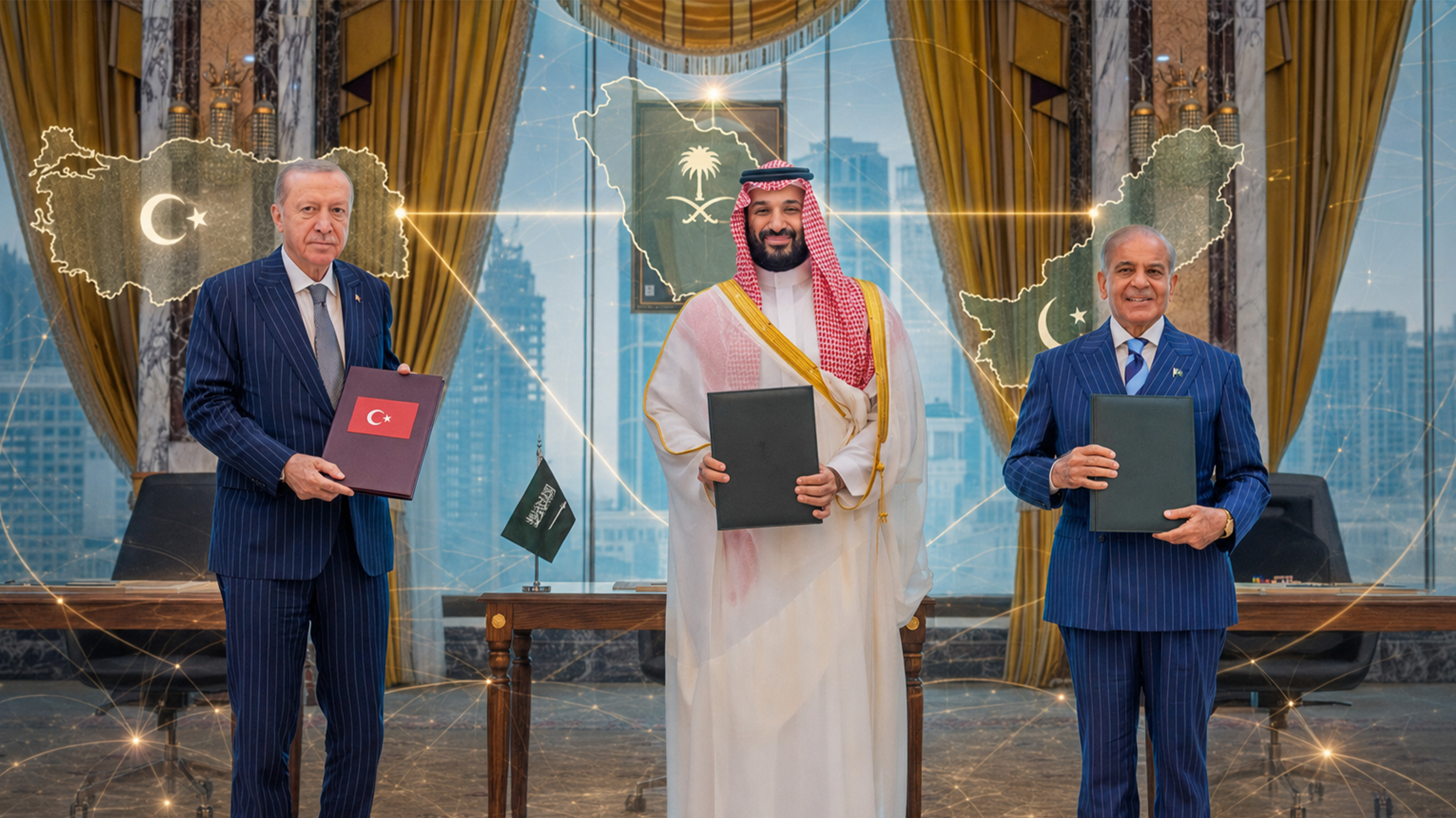
Against this backdrop, Saudi Arabia, Turkey and Pakistan signed a trilateral mutual defence agreement in Mecca the day after Fox’s article appeared. The agreement declares that an armed attack against one of the three constitutes an attack against all, although the precise mechanisms for implementing this commitment remain unclear. Turkish officials have described it as based on “collective deterrence” and intended to deepen defence-industrial cooperation, military interoperability, counterterrorism efforts and joint preparedness. The agreement also resembles NATO’s Article 5 in allowing each member to determine the nature of its response to an attack according to its national constitutional procedures.
The agreement was not created solely in response to the latest war with Iran. It followed a much longer regional search for security arrangements based on the capabilities of Middle Eastern powers themselves. US officials had already been encouraging regional allies before Trump returned to office to assume greater responsibility for regional security. At the same time, several competing regional models had emerged. Gulf states considered strengthening the Gulf Cooperation Council (GCC)’s own defence capabilities, while Iran promoted a comprehensive Arab-Iranian Gulf security system based on excluding US forces. Neither initiative proved viable. Saudi Arabia and Pakistan had also signed a bilateral defence agreement in September 2025, while proposals circulated for either a five-power system including Turkey, Saudi Arabia, Egypt, Pakistan and Iran or a four-power arrangement involving Turkey, Saudi Arabia, Egypt and Pakistan. The latter proposal was ultimately transformed into the trilateral Mecca agreement when Egypt did not join.
The trilateral arrangement reflects the different security concerns of its members. Turkey faces challenges involving Greece, Cyprus, Israel and Iran; Saudi Arabia confronts threats associated particularly with Iran and Israel; and Pakistan remains focused heavily on India. The agreement therefore offers each member a broader deterrent framework and the possibility of sharing defence capabilities, expertise and industrial capacity. Saudi and Turkish officials have stressed that it is not directed against any particular country, does not constitute a sectarian or military bloc, and is not connected to a nuclear programme or arms race.
Nevertheless, the agreement has generated concern among countries excluded from it. Iranian reactions have ranged from warnings that it could represent an anti-Iranian alignment to arguments that it reflects regional efforts to reduce dependence on US protection. Egypt reacted negatively to its exclusion, while some Emirati voices interpreted the agreement as evidence of strategic divisions within the GCC. Israel expressed concern about Turkey’s expanding role in the Arab neighbourhood, while Greece reportedly viewed Saudi participation with disappointment. Some observers have predicted that India, the United Arab Emirates, Israel and Greece could respond by strengthening their own cooperative alignment.
China, by contrast, did not regard the agreement as threatening its interests and welcomed the initiative, even calling for Muslim countries to develop a common security system with China. The United States also reacted positively, with some American officials portraying the agreement as an achievement that could advance regional stability.
The agreement nonetheless raises a fundamental question about Iran’s place in any future regional security architecture. Iran can either be incorporated into a broader system alongside the major regional powers, requiring it to limit expansionist policies while addressing mutual security concerns, or be excluded and isolated. The latter approach could deepen Tehran’s insecurity and encourage more aggressive behaviour. Israel presents a different challenge: although the current balance of power makes a regional war against Israel unrealistic, reducing its isolation would require a much broader regional agreement and potentially an end to normalisation with it—developments that do not appear imminent.
The Mecca agreement therefore represents an important first step toward a Middle East security order built primarily by regional powers rather than external powers. Unlike Cold War-era arrangements such as the Baghdad Pact and Central Treaty Organisation, it is fundamentally a product of changing perceptions among the region’s own major states about their security needs and capabilities. Yet its significance should not be overstated. Its long-term success will depend on whether its members can address the concerns of excluded states, expand participation, clarify the obligations created by collective defence, and develop mechanisms capable of managing both Iranian and Israeli-related security challenges. The agreement marks the beginning of a process rather than the completion of a new regional security system.
*This is a summary of a policy brief originally written in Arabic available here.