
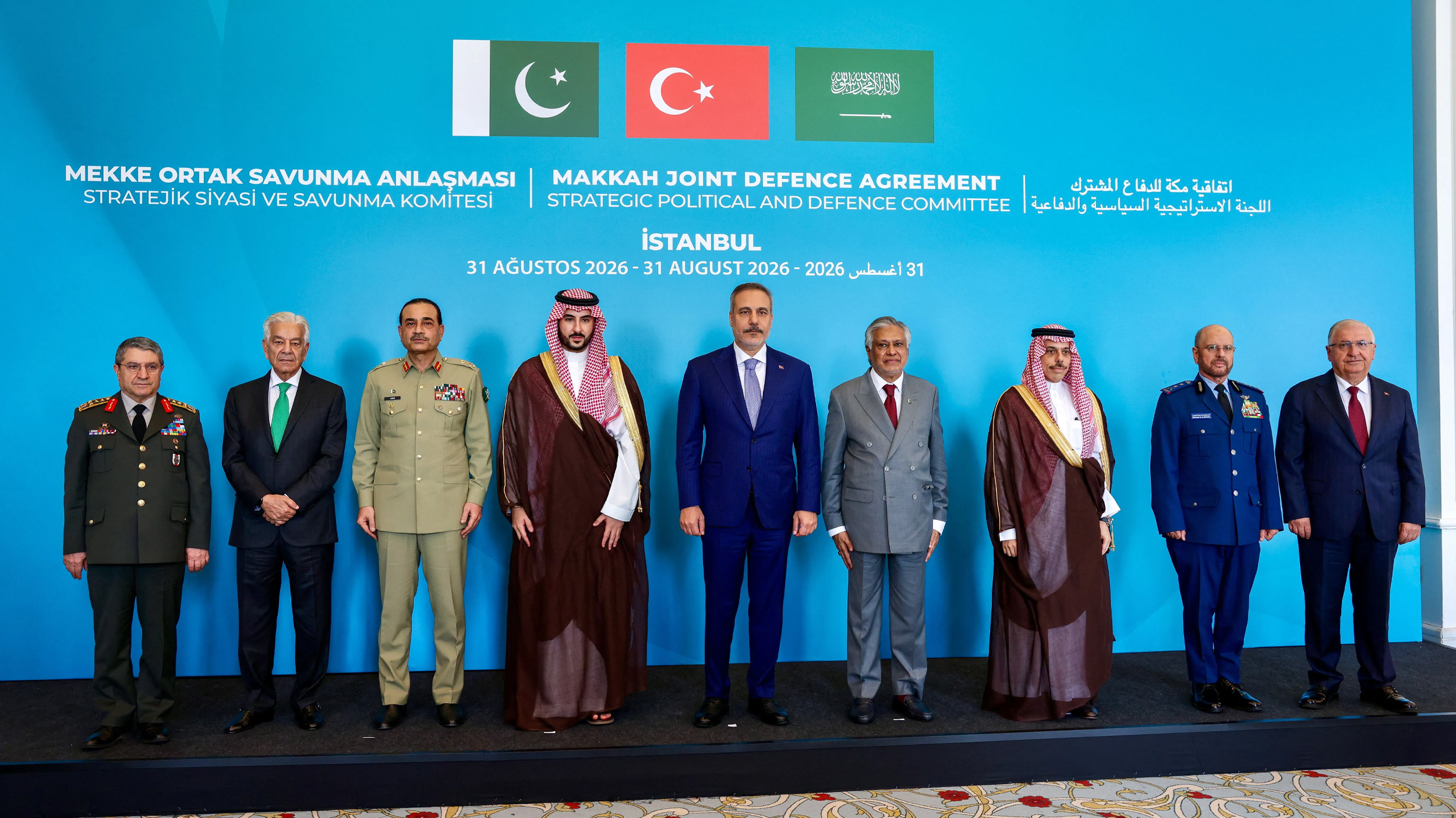
The Mecca Agreement can become the deterrent core of a layered security architecture stretching from the Eastern Mediterranean to South Asia—one that restrains Israeli escalation, leaves room for negotiated security with Iran, and turns political solidarity into institutional practice of regional peace without reproducing another closed bloc.
The Mecca Joint Defence Agreement should be read first as an idea, and only then as a military pact. Signed by Türkiye, Saudi Arabia and Pakistan on 7 August 2026, it declares that an armed attack against one will be regarded as an attack against all and frames the arrangement as defensive collective deterrence. (1) Three weeks later, the three states moved from declaration to organisation: their foreign and defence ministers and military chiefs met in Istanbul, agreed to establish a permanent secretariat in Saudi Arabia, and committed themselves to joint defence-industry cooperation, technology development and production. (2) The movement from declaration to organisation is therefore already visible; the harder transition is from organisation to durable institutional practice.
The timing is not accidental. The genocide in Gaza has been followed by Israeli operations across Lebanon, Syria, Yemen and Iran, while the latest India-Pakistan confrontation again showed that security crises do not respect neat regional boxes. “Middle East” remains a useful shorthand, but Türkiye, Saudi Arabia and Pakistan connect the Mediterranean, Gulf, Red Sea, Indian Ocean and South Asia, which has a potential to redefine the “region”.
There is also a question that goes back to 1914. Europe before the First World War was crowded with alliances, ententes and military understandings. Today, new defence commitments also appear amid heightened great-power competition. But alliances do not automatically cause war. The danger comes when commitments are opaque, blocs become rigid, and escalation is easier than restraint. Credible deterrence can do the opposite: clarify the cost of aggression before a crisis begins. American economic and professor of foreign policy Thomas Schelling’s insight remains useful: military power has political value not only in its use, but in the behaviour it can prevent. (3) The question is therefore whether Mecca can raise the cost of aggression while preserving relations with the United States, China, Russia, Europe and India.
Mecca: An Idea Before an Institution
The choice of Mecca as the location in which the trilateral pact was signed is not merely ceremonial. As Islam’s holiest city and the centre of the Islamic pilgrimage, it gives the agreement a shared civilisational frame of reference. But symbolism alone cannot sustain a security architecture. The significance of the agreement will depend on whether political solidarity can be translated into durable institutions, procedures and habits of cooperation.
South Asian poet, philosopher and statesman Muhammad Iqbal, who is widely accepted as one of the most influential thinkers throughout modern era, opened The Reconstruction of Religious Thought in Islam with a striking observation: the Qur’an emphasises “deed rather than idea.” The distinction is useful here. The Mecca Agreement expresses a proposition: that regional states should not merely consume security guarantees designed elsewhere, but should also be capable of producing security collectively. The harder task is to turn that proposition into institutional practice without withdrawing from the wider multilateral system.
The Mecca Agreement therefore begins with a premise about regional agency: states in these interconnected regions should be capable of producing security themselves rather than relying exclusively on guarantees designed elsewhere. The challenge is to convert that premise into durable cooperation while remaining embedded in the wider multilateral system.
These interconnected spaces are therefore not simply arenas in which Washington, Beijing or Moscow determine the available alignments. Political science professors Barry Buzan and Ole Wæver’s regional security complex approach reminds us that regions develop their own patterns of threat and interdependence. (4) Today, the Middle East, the Eastern Mediterranean and South Asia increasingly overlap. Türkiye, Saudi Arabia and Pakistan connect these spaces rather than belonging neatly to one of them.
The question is whether the three states can institutionalise that commonality deeply enough for cooperation to survive crises, leadership changes and political disagreement.
Strategic Multi-Alignment: Beyond American Hegemony
The significance of the three countries lies in the fact that none fits comfortably within a single geopolitical camp.
Türkiye remains a NATO member and a long-standing partner of the United States, is economically tied to Europe while simultaneously expanding its engagement beyond the transatlantic space while diverging sharply from Israel’s regional policies. It also maintains working relations with Russia, engages with China and Iran, develops relations with Global South, including BRICS and Shanghai Cooperation Organisation, has an autonomous defence industry and pursues its own agenda across the Eastern Mediterranean and West Asia. This is better described as strategic autonomy than as a break with the West.
Saudi Arabia is moving similarly. Its relationship with Washington remains deep but no longer exclusive. China is an important partner in energy exports and industrial and technological transformation, while Russia plays a significant role in energy diplomacy and OPEC+. Riyadh also resists being drawn automatically into confrontation with Iran or into normalisation with Israel on terms defined elsewhere.
Pakistan adds a third pattern: an exceptionally deep partnership with China alongside long-standing ties with Washington and the Gulf. Its rivalry with India gives it a distinct set of security concerns, reinforced by India’s close defence and security relationship with Israel. But the pact rests on overlapping interests, not identical foreign policies.
This is strategic multi-alignment, not an anti-American or pro-Chinese bloc. Professor of international relations Amitav Acharya’s “multiplex” world captures these overlapping partnerships. (5) Washington can engage all three parties; Beijing has major interests in all three; Europe remains linked through Türkiye; and India remains important to Saudi Arabia even as it is Pakistan’s principal rival.
For the United States, this does not necessarily represent a strategic loss. If Washington’s long-term priority is China, more capable partners can reduce the burden of repeated crises. The greater problem is unchecked Israeli escalation, which pulls Washington back into conflicts it says it wants to contain. The actor with the greatest leverage over Israeli behaviour remains the United States.
Deterrence, Israel, Iran and a Layered Security Architecture
An India-UAE-Israel-US geometry has emerged through the concept of I2U2 following the Abraham Accords and the India-Middle East-Europe Economic Corridor (IMEC). I2U2 connected India, Israel, the UAE and the United States around investment, technology, energy and infrastructure. (6) IMEC went further by imagining a corridor linking India to the Gulf and Europe through the UAE, Saudi Arabia, Jordan and Israel. (7)
Before 7 October 2023, the region had entered what is previously described as a brief “Dengist” turn: (8) a competition centred increasingly on state-led development, infrastructure and connectivity rather than ideological and proxy warfare. IMEC was one expression of this trajectory, but so were Türkiye’s Development Road Project and the wider rapprochement among regional states. Israel’s war in Gaza and its subsequent operations across Lebanon, Syria, Yemen and Iran destroyed much of the security environment on which that trajectory depended. (9)
Mecca does not mirror the India-UAE-Israel alignment; it creates a different strategic configuration. Pakistan adds balancing capacity in South Asia, Türkiye brings Mediterranean-European connectivity, and Saudi Arabia anchors the Gulf and Red Sea. The pact’s strategic effect could therefore be to restore the security conditions under which the region’s “Dengist” turn, development, connectivity and state-centred competition, can resume.
The wider architecture also leaves room for Iran rather than defining it as the permanent enemy. In June 2026, Türkiye, Saudi Arabia and Pakistan, together with Egypt, welcomed the US-Iran memorandum of understanding and called for a lasting negotiated solution. (10) The China-brokered Saudi-Iran agreement of March 2023 restored diplomatic relations and explicitly revived the 2001 Saudi-Iran Security Cooperation Agreement. (11)
China’s Global Security Initiative adds another layer. President Xi Jinping proposed it in 2022, and the 2023 concept paper emphasised common security and dialogue over confrontation. (12) A more substantive Saudi-Iranian security arrangement or non-aggression mechanism, potentially facilitated by China, would complement rather than contradict Mecca: deterrence protects against aggression; dialogue reduces the probability of war.
Türkiye has already experimented with this logic. In March 2025, Türkiye, Jordan, Iraq, Lebanon and Syria brought foreign and defence ministers, military chiefs and intelligence heads together in Amman. (13) Mecca is therefore one layer among several: trilateral deterrence, neighbour-to-neighbour cooperation, Saudi-Iranian dialogue and a political settlement centred on Palestine.
Palestine cannot be an appendix. It is simultaneously a moral, domestic-legitimacy and hard-security question. Israeli aggression is no longer confined to Palestinian territory; its expansion across Lebanon, Syria, Yemen and Iran shows how the unresolved Palestinian question transmits instability into other states. A security order that leaves Palestine outside its strategic imagination cannot produce wider security.
From Agreement to Institution: State and Society Institutionalise Together
At the 31 August meeting in Istanbul, the three countries began putting the pact into practice, agreeing to establish a secretariat and pursue political and military consultations, joint activities, defence-industry cooperation and joint technology development. But an organisation is not yet an institution.
NATO illustrates this distinction. Its deterrent power did not come from Article 5 alone, but from political consultation, planning, exercises and standardisation. European integration offers the societal parallel: bureaucracies, businesses and universities normalised cooperation long before a common defence identity emerged.
The Mecca pact starts with security, but it builds on centuries of Islamic intellectual exchange, pilgrimage, trade, education and migration among the three societies. These connections also have historical roots in the support extended by Muslims of the Indian subcontinent to Türkiye’s war against the colonial aspirations in the aftermath of the First World War. The issue is how to convert that commonality into modern institutional density.
Official and societal institutions therefore need to reinforce one another. Ministries can institutionalise consultation, crisis hotlines, staff exchanges and clear escalation procedures; defence industries can move toward co-production and joint research. Universities and think tanks can build joint centres and common assessments; business councils, parliaments, media and civil society can sustain channels when governments disagree; student and researcher exchanges can make the relationship socially familiar. Institutional density is therefore not an addition to deterrence; it is what makes deterrence politically sustainable.
These mechanisms also manage difficult histories. Ottoman history does not mean the same thing in Ankara and Riyadh; Wahhabism occupies different places in Saudi and Turkish consciousness; Pakistani migration to the Gulf combines deep human ties with questions of labour and hierarchy. Institutionalisation does not erase such differences; it creates disagreement without rupture.
The Mecca Agreement will have lasting significance if it anchors three transformations at once: from dependence to shared security ownership, from symbolic solidarity to institutionalised cooperation, and from declaration to durable practice. Its success should not be measured by whether it becomes a ‘Muslim NATO’, but by whether it raises the price of aggression, restrains Israeli escalation, supports negotiated security with Iran and connects state institutions with societies strongly enough to survive political change.
- “Makkah Al-Mukarramah Summit for Joint Defence”, Ministry of Foreign Affairs, Government of Pakistan, 7 August 2026, https://tinyurl.com/3zns75bb (accessed 2 September 2026).
- “Strategic Political and Defence Committee of the Makkah Agreement for Joint Defence, Joint Statement, 31 August 2026”, Republic of Türkiye Ministry of Foreign Affairs, 31 August 2026, https://tinyurl.com/3y8fjtea (accessed 2 September 2026).
- Thomas C. Schelling, Arms and Influence (New Haven: Yale University Press, 1966).
- Barry Buzan and Ole Wæver, Regions and Powers: The Structure of International Security (Cambridge: Cambridge University Press, 2003).
- Amitav Acharya, “After Liberal Hegemony: The Advent of a Multiplex World Order”, Ethics & International Affairs, Vol. 31, No. 3, Fall 2017, pp. 271–285, https://tinyurl.com/3tb82pfj (accessed 2 September 2026).
- “I2U2”, U.S. Department of State, https://tinyurl.com/jaxb5hp5 (accessed 2 September 2026).
- “Memorandum of Understanding on the Principles of an India-Middle East-Europe Economic Corridor”, The White House, 9 September 2023, https://tinyurl.com/3ae4fbbz (accessed 2 September 2026).
- Selçuk Aydın, “The War No One Can Win: Why Shattering the Iranian Regime Is a Strategic Miscalculation”, Al Jazeera Centre for Studies, 26 March 2026, https://tinyurl.com/2pt24hfu (accessed 2 September 2026).
- Selçuk Aydın, “Navigating Crisis: Why the US Is Fuelling Global Violence”, Al Jazeera Centre for Studies, 29 September 2024, https://tinyurl.com/24tnt66p (accessed 2 September 2026)
- Gizem Nisa Demir, “Türkiye, Egypt, Pakistan, Saudi Arabia Welcome US-Iran MoU, Reaffirm Support for Palestinian Statehood”, Anadolu Agency, 21 June 2026, https://tinyurl.com/52fypayx (accessed 2 September 2026).
- “Joint Trilateral Statement by the People’s Republic of China, the Kingdom of Saudi Arabia, and the Islamic Republic of Iran”, Ministry of Foreign Affairs, People’s Republic of China, 10 March 2023, https://tinyurl.com/3csatupx (accessed 2 September 2026).
- Xi Jinping, “Rising to Challenges and Building a Bright Future Through Cooperation”, Ministry of Foreign Affairs, People’s Republic of China, 21 April 2022, https://tinyurl.com/mrxhswxn (accessed 9 September 2026); “The Global Security Initiative Concept Paper”, Ministry of Foreign Affairs, People’s Republic of China, 21 February 2023, https://tinyurl.com/y93b527f (accessed 2 September 2026).
- Turgut Alp Boyraz, Seda Sevencan and Muhammed Enes Calli, “Regional security meeting kicks off in Jordan with officials from 5 countries including Türkiye”, Anadolu Agency, 9 March 2025, https://tinyurl.com/2r85ezbu (accessed 2 September 2026).