
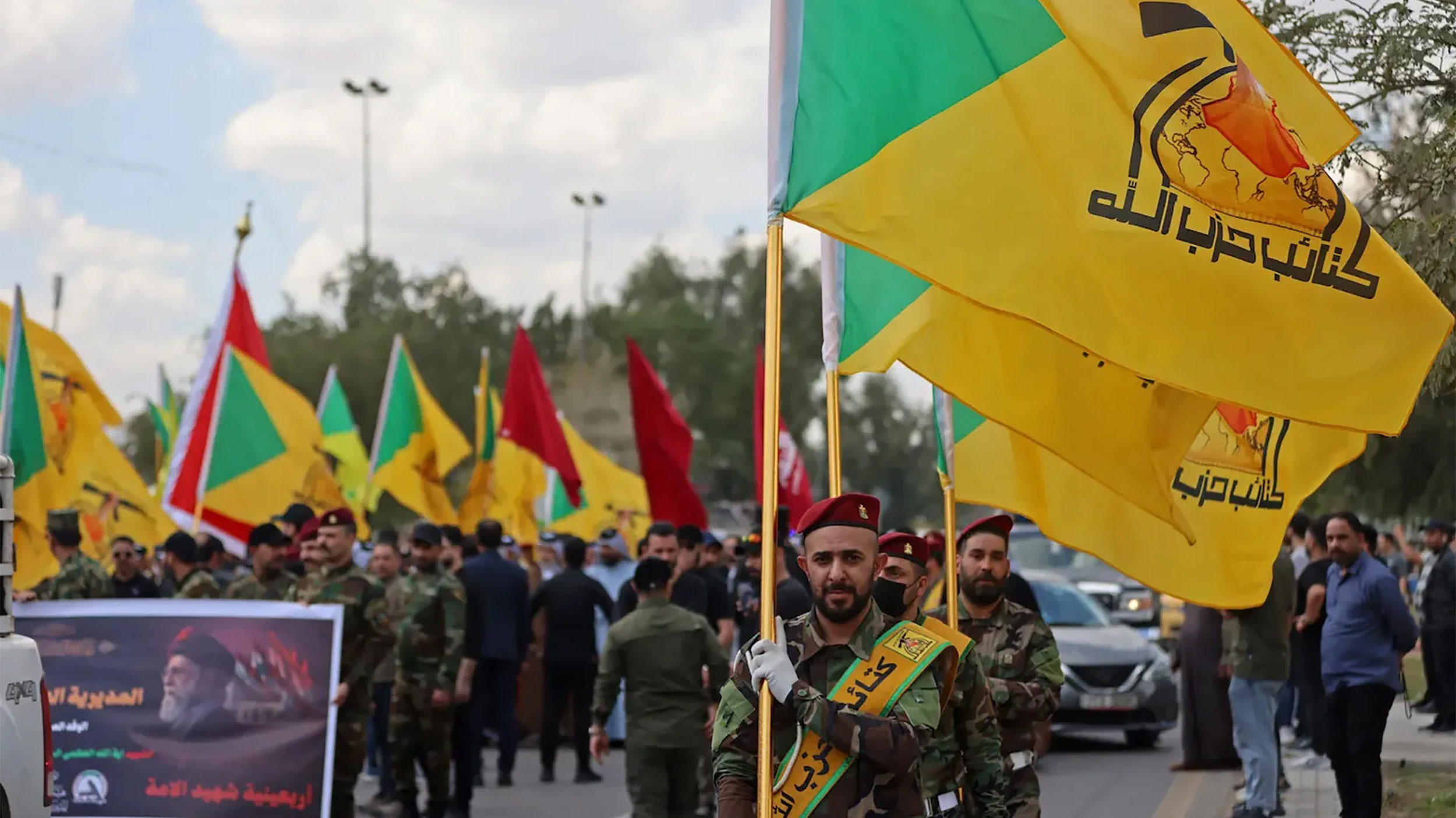
This paper examines the dilemma of identity and allegiance among Iraqi armed factions operating under the umbrella of what is commonly known as the “Islamic Resistance” or the “Axis of Resistance”. It begins by asking how these factions might behave if military hostilities between Iran and the United States or Israel were to resume. Specifically, what would they do if the Iranian leadership decided to widen the confrontation while the Iraqi government opted for neutrality and prohibited the use of Iraqi territory for military operations? Would they abide by the decisions of the state to which they belong, or follow the directives of Iran’s Supreme Leader, to whom some of their most prominent constituent groups pledge allegiance as vali-ye faqih (the guardian jurist), the religious and political authority?
The paper proceeds from the hypothesis that the contradiction between national identity and ideological authority does not necessarily become apparent under ordinary circumstances, when Iraqi and Iranian interests coincide or do not conflict. Rather, it is exposed when decisions concerning war and peace diverge. At that point, the problem is no longer one of multiple affiliations but of competing sources of binding authority, and of who possesses the final decision over the use of armed force.
The Moment of Truth: When Baghdad’s and Tehran’s Wills Diverge
A broad military escalation between the United States and Israel on one side and Iran on the other would not be surprising at any point in the coming weeks, particularly after the US midterm elections scheduled for 3 November 2026. According to various statements from Tehran, Iran is expected to expand the scope of its response to include American interests and bases in the region, as well as critical infrastructure in Gulf countries in particular, including energy facilities. All this would unfold amid an intensifying war in Yemen and the possibility of Lebanese Hezbollah joining the conflict by striking Israel in support of Iran, potentially forcing other regional states into the war.
Such a potentially explosive regional scenario would challenge the Iraqi government’s declared desire to avoid being drawn into the regional polarisation. One of the foremost conditions of this policy of non-involvement is, of course, preventing Iraqi territory from being used to launch attacks against states or other parties in the region.
The central question concerns the position of Iraqi factions that align themselves with the Axis of Resistance. Would they comply with the official Iraqi position and the prime minister’s decisions, refraining from joining Iran in the conflict? Or would they respond to the Iranian Supreme Leader, whom they regard as their guardian and supreme authority in ideological matters, vested with legitimate religious authority? If the two decisions conflicted, which would take precedence?
This is not merely a theoretical supposition. It is a foreseeable dilemma in light of the relationship that has developed between some Iraqi factions and Iran over the past two decades. Its significance increases as the regional confrontation expands and American pressure is renewed to end the independence of factional weapons from the Iraqi state.
These factions are not foreign groups that the state can deal with through expulsion or prohibition, as it has done, for example, with the Kurdistan Workers’ Party (PKK) and the Iranian People’s Mojahedin Organisation (MEK). They are Iraqi organisations rooted in the country’s social and political fabric. Some of their leaders hold official positions within the state; their political wings are represented in parliament; and their armed formations receive government funding through state institutions, including the security apparatus and, most notably, the Popular Mobilisation Commission.
If the state cannot prevent an armed formation operating on its territory from participating in a regional war, the problem extends beyond that formation’s possession of weapons to the existence of a parallel authority contesting the state’s right to decide on war and peace.
From National Resistance to Alignment with a Regional Axis
Iraqi armed factions emerged in different historical and political circumstances and therefore cannot be reduced to a single experience. Some were associated with opposition to the regime of the late President Saddam Hussein; others emerged after the 2003 US invasion; while additional formations gained broad social and political legitimacy during the war against ISIS after 2014.
Armed groups such as Kataib Hezbollah, Asa’ib Ahl al-Haq and Harakat al-Nujaba derive their claimed legitimacy from resisting the American military presence, which led the international coalition against ISIL from 2014 onward. Yet this justification has always been at odds with the fact that international forces were present at the request of the Iraqi government to help defeat ISIL, which had seized approximately one-third of the country. Their complete withdrawal on 30 September 2026 should, in principle, have undermined the factions’ claim to legitimacy on these grounds. Instead, some have advanced new narratives to justify their continued existence as armed groups outside state control, invoking the “right to resistance”.
Some factions have not confined their self-definition to national resistance movements operating within Iraqi borders. They have gradually become associated with a broader regional project led by Iran, one that frames confrontation with the United States and Israel as an interconnected struggle not bounded by national frontiers.
This transformation was manifested in Iraqi factions’ participation in the Syrian war, their adoption of the concept of the “unity of fronts”, and their framing of the defence of other members of the Axis of Resistance as a part of defending Iraq itself.
From these particular organisations’ perspective, this does not contradict Iraqi patriotism. They believe that Iraqi security cannot be separated from the security of Iran, Syria or Lebanon, and that weakening one member of the axis could weaken the others, including Iraq.
This view rests on a conception of regional security based on interconnected fronts. The difficulty begins when that conception becomes a basis for military decisions independent of the Iraqi government. The state may agree that Iran’s security affects Iraq’s, yet disagree over how to address that relationship or how to weigh the costs of joining Iran in a war against those of remaining neutral. A still greater problem arises when the state determines that its strategic interest requires alliances with regional and international powers, some of which are in conflict with Iran—for example, the United States and Saudi Arabia amid the present Tehran–Washington confrontation, or the Saudi-led Arab coalition’s conflict with the Houthis in Yemen.
Here lies the distinction between strategic alliance and ideological obligation. The former allows a state to reassess its interests and adjust its alliances; the latter can turn commitment to a regional project serving Iranian interests into an “ideological” duty overriding immediate national calculations.
Thus, in factional discourse, defending Iraq becomes an expandable concept encompassing defence of Iran or other axis members even when the Iraqi government decides not to join the conflict, or when factional involvement entails targeting Arab states with which Iraq has growing strategic relations, such as Gulf states, Syria and Jordan. In other words, factions would forcibly assume the state’s function of deciding on war, using their Iraqi identity and capabilities developed under Iraqi state patronage to perform missions serving another state on the basis of ideological allegiance, even where this seriously harms Iraq’s vital interests.
Velayet-e faqih: An Authority Transcending National Borders
Understanding this duality requires revisiting the doctrine of velayet-e faqih (or the guardianship of the Islamic jurist), and distinguishing religious authority as a source of legal opinions and guidance from the political formulation of guardianship that gives the ruling jurist authority beyond religion, including leadership of the state and determination of its fundamental policies.
In Shiite tradition, following a religious authority does not necessarily entail recognising that authority’s political jurisdiction over the state in which the follower lives. The doctrine of velayet-e faqih, as developed by Ayatollah Khomeini and established as the foundation of Iran’s political system, grants the ruling jurist extensive political powers.
Some Iraqi factions embrace this doctrine as part of their ideological and organisational identity and declare their commitment to the authority of Iran’s Supreme Leader as the holder of legitimate religious guardianship.
Three levels must be distinguished: religious belief in velayet-e faqih, political allegiance to the Iranian leadership, and direct military obedience to its orders. These levels are interconnected for some organisations, but they are not necessarily identical.
An Iraqi individual may believe in the guardianship of the jurist without violating Iraqi law, and an organisation may maintain close political ties with Iran without receiving direct military orders. The sovereignty problem arises when commitment to the Supreme Leader’s decisions becomes a source of political and military decisions that conflict with the state’s authority and potentially its interests.
The true test, therefore, is not the factions’ declared identities or allegiances, but which authority they obey when the Iraqi prime minister orders non-participation in a war and Iran’s Supreme Leader issues contrary instructions. In that case, the question of their real authority becomes one of ultimate power, not sentiment or affiliation.
The Factions Loyal to the Jurist: From Ideology to Military Decision-Making
Media and research discourse commonly use the expression al-fasa’il al-wala’iyya ( or “loyalist factions”) for armed groups that declare their commitment to following Iran’s ruling jurist or Supreme Leader. These factions are among the most hardline in their positions and possess substantial military capabilities, manpower and economic resources. Prominent examples include Harakat al-Nujaba, Kata’ib Hezbollah and Kata’ib Sayyid al-Shuhada Other, less prominent groups also exist, along with formations that may be little more than media fronts for the same principal organisations.
Both Harakat al-Nujaba and Kata’ib Hezbollah express a direct connection to the system of velayet-e faqih as an authority for decision-making. Nujaba Secretary-General Akram al-Kaabi says that the “Islamic Resistance Movement al-Nujaba is the party of velayet-e faqih, and that it will be wherever the Axis of Resistance needs it. Kata’ib Hezbollah, meanwhile, describes Iran’s Supreme Leader as the “Leader-Imam” and links velayet-e faqih in its public discourse to the goal of establishing an “Islamic system in Iraq” modelled on Iran. Following the selection of Mojtaba Khamenei as Iran’s Supreme Leader in March 2026, it declared “absolute allegiance to the new leadership”.
Both organisations rejected Iraqi Prime Minister Ali al-Zaidi’s call to place weapons exclusively in state hands, although both remain part of the Popular Mobilisation Forces (PMF) and receive their members’ salaries through them. Indeed, the PMF chief of staff, Abdul Aziz al-Muhammadawi, known as Abu Fadak, is known as a Kata’ib Hezbollah leader. Speaking from Tehran in 2024, he previously affirmed adherence to the Supreme Leader’s vision and decisions. Abu Fadak remains in his senior PMF post.
By contrast, the leader of another loyalist group, Kata’ib Sayyid al-Shuhada Secretary-General Abu Alaa al-Wala’i, has said that he sees no contradiction between patriotism and religious legitimacy and considers borders to be of secondary importance. He stated that his group could enter the war alongside Iran if “the Islamic Republic faced a genuine threat to its existence.” Al-Wala’i did not specify who would determine whether Iran faced an existential threat, or whether the Iraqi government could prevent the faction’s participation if either the faction itself or Iran’s Supreme Leader judged that such a threat existed.
In fact, all three parties subscribe to the same doctrine of velayet-e faqih and exhibit a dual relationship with “Iraqi national identity” and ideological allegiance to Iran’s Supreme Leader. Kata’ib Sayyid al-Shuhada, however, has attempted a more moderate course by entering politics while retaining its weapons. It won five seats in the latest elections and recently obtained the tourism portfolio in the government. Unlike Nujaba and Kata’ib Hezbollah, it announced its acceptance of the government’s programme to bring weapons under state control, although it attached complex, long-term conditions.
A third trend among loyalist factions is represented by Asa’ib Ahl al-Haq, which more clearly embodies the intersection of ideological affiliation and domestic political activity. Historically linked to Iran and the doctrine of velayet-e faqih, the organisation began participating in Iraq’s political system relatively early, and its interests became tied to that system’s institutions and stability. Statements by its secretary-general, Qais al-Khaz’ali, have affirmed religious allegiance to Iran’s Supreme Leader, while other statements have emphasised the independence of Iraqi decision-making and presented the organisation as a national actor. This divergence should not be treated merely as rhetorical inconsistency: it may reflect a difference between the ideological authority the organisation retains and the political calculations imposed by its presence in government and parliament. The movement resolved the issue in favour of political participation after announcing its support for state control of weapons and, according to official announcements, actually severing its links with the PMF and surrendering its weapons to the state.
The three models share an ideological authority but differ in their treatment of it. Some factions openly recognise an Iranian ideological authority transcending the Iraqi state and refuse to surrender their weapons. Others embrace the same doctrine but attempt to occupy a middle position, participating in politics and holding government posts while retaining arms subject to complicated conditions for surrender. A third has substantially reduced references to its ideological relationship with Iran’s velayet-e faqih, as well as its armed presence, in favour of integration into the state and political system.
Expected Conduct if Military Escalation Resumes
A uniform response from all Iraqi factions cannot be predicted if the war with Iran expands. Differences in authority, leadership, regional ties and political and economic interests make divergent organisational calculations likely.
Four potential patterns of conduct can be identified, depending on the intensity and duration of escalation, the Iraqi government’s position and the nature of Iranian directives.
First: Direct Military Participation
Some of the organisations most closely aligned with the loyalist project may resume attacks on American interests and military bases or participate in operations associated with the Axis of Resistance, particularly if they perceive Iran to be facing an existential threat. This possibility is supported by certain factions’ past involvement in regional confrontations, their leaders’ stated commitments to defending Iran, and their view of Iraqi security as inseparable from that of the Axis of Resistance. However, ideological allegiance does not necessarily translate into military action. The prospect of military retaliation, domestic political pressures, and the Iranian leadership’s own strategic calculations may all serve to restrain these factions.
Second: Political and Logistical Support While Avoiding Combat
Some factions may prefer to provide political and media support, or forms of non-combat assistance that do not violate Iraqi law, while avoiding direct entry into the war. This allows them to preserve their ideological relationship with Iran without bearing the full costs of military confrontation. Organisations whose interests have expanded within the political system, and which have consequently become more sensitive to the stability of government institutions and the Iraqi economy, may be particularly inclined toward this course.
Third: Compliance with the Iraqi Government’s Decision
This path represents a genuine test of the primacy of national sovereignty. Some factions may decide, despite continued ideological allegiance, that Iraq’s interests require avoiding war and that the decision to use weapons must remain subject to the government. This need not imply abandoning velayet-e faqih; rather, it may reflect an interpretation distinguishing religious commitment from legal duty toward the state.
Positions may differ between factions and even within a single organisation, between a tendency that prioritises ideological obligation and another that sees preserving Iraq’s political system and the faction’s gains as requiring avoidance of confrontation. In other words, expected factional conduct is not determined by loyalist identity alone but by the interaction of three factors: ideological commitment, organisational interest, and the cost of defying Iraq’s sovereign decision.
The Dilemma of National Identity: Can Iraq Be Defended Outside Its Own Decision-Making?
Factions linked to the Axis of Resistance advance a particular notion of patriotism, under which defending Iraq is not limited to protecting its geographical borders but includes confronting threats that may arise in its regional environment. This notion is not entirely foreign to national security theory: modern states themselves build military alliances and sometimes conduct operations beyond their borders to protect their interests.
The fundamental difference, however, lies in who has the right to decide on participation. When a state joins a military alliance, it is presumed to do so through its constitutional procedures and competent institutions. When an armed organisation within the state decides to participate in a foreign war on the basis of an independent authority, the matter moves beyond alliance into a challenge to sovereign power. Worse still is the use of the country’s territory to wage war under the coordination and supervision of a foreign state.
Three concepts often conflated in factional discourse must therefore be distinguished: patriotism as a sense of belonging, national interest as a political judgment, and national sovereignty as ultimate legal authority.
A fighter in a faction may sincerely believe that participating in Iran’s defence is defending Iraq, and may consider the collapse of the Iranian political system a danger to his country. But this belief gives neither him nor his organisation authority to decide on war in Iraq’s name. The Iraqi government may even agree about the danger while judging neutrality, mediation or de-escalation to be more suitable means of protecting the country. The disagreement then concerns who possesses binding authority to define the national interest, not merely what that interest entails.
The concept of “ultimate authority” in sovereignty theory helps explain this dilemma. A state does not lose sovereignty merely because groups disagree with its assessment of threats, but its authority is practically diminished when those groups can impose military choices over the objections of its constitutional institutions. Patriotism is measured not only by willingness to sacrifice for one’s country but also by acceptance that its legitimate institutions determine when and how force is used in its name.
Through its endeavour to bring all weapons under state control, the Iraqi government seeks to secure its sovereign monopoly over violence and the decision on war and peace. Yet the endeavour still faces obstacles: some groups refuse to comply, others have accepted only in principle, and a third category has deposited its weapons within PMF institutions, potentially allowing access to those arms whenever it wishes. This itself challenges the state’s ability to turn the principle of exclusive state control from an official decision binding on all into a national programme that factions may voluntarily embrace or reject.
Integrating factions into the state and disarming them does not necessarily require them to renounce ideological allegiance to the vali-ye faqih. Integration fails, however, if a faction continues to place that allegiance above the state’s will in political and military matters, potentially carrying out direct orders from abroad.
A practical dilemma emerges here. If faction leaders occupy positions in official security institutions while retaining organisational or ideological allegiances outside the government chain of command, integrating formations does not automatically unify decision-making. It may instead directly facilitate the penetration of state institutions and their use to serve the faction’s agenda—and, by extension, an external party. Failure of integration and disarmament would then not be the endpoint: the state itself could be made to serve the armed faction rather than the reverse.
Shiite Leaders’ Fears: From Protecting the System to Threatening Its Survival
The Shiite political forces dominating executive power in Iraq face a dilemma different from that of the factions themselves. They do not deal with factions merely as independent armed groups but as part of the balances formed within the political system after 2003. Some are political or electoral allies or partners in administering state institutions. Indeed, some Shiite political forces are themselves political wings of armed organisations that have either integrated into security forces or remain independent.
PMF factions played an important role in confronting ISIL, thereby acquiring broad social and political legitimacy. Forces associated with them subsequently expanded their presence in parliament, government and economic and security institutions. But the circumstances that permitted coexistence between state and factions have changed as confrontation between Iran, the United States and Israel has escalated.
If factions enter a regional war from Iraqi territory, sites inside Iraq could be targeted, American pressure on the government could intensify, and financial and economic measures affecting state institutions might be imposed. The entire political system might even be brought down. An armed force once regarded as an element protecting the system could thus become a source of danger to its stability.
Conversely, a government attempt to seize factional weapons by force could trigger confrontation within the Shiite political sphere and divisions within security institutions and governing alliances. This is the dilemma facing the Coordination Framework and affiliated Shiite forces: how can factions be prevented from dragging Iraq into a regional war without confronting them in ways that threaten the cohesion of the political system?
A distinction is essential between two frequently confused concepts: protecting the Iraqi state and protecting the existing political system. The state is the institutional and sovereign framework encompassing Iraqi society in all its components; the political system consists of the rules, alliances and centres of influence that structure the exercise of power.
Factions may have a strong interest in preserving the post-2003 political system because it grants them legitimacy, participation, influence and resources. Yet that interest does not necessarily imply readiness to submit fully to state authority. Some organisations may prefer the continuation of a political system that permits them to retain military autonomy over a more centralised state capable of removing it. A striking paradox follows: a faction may defend the system’s survival while its refusal to accept the state’s monopoly over weapons creates conditions capable of toppling the very system that enabled its rise.
Governing forces may likewise believe that preserving the system requires avoiding confrontation with factions, even at the cost of continued dual military authority. In some circumstances, preserving the political system thus becomes an obstacle to completing state-building.
This does not mean all Shiite forces share the same position: their interests and attitudes toward Iran, the factions and the United States vary. Nor does the Iraqi political system’s survival depend on Shiite forces alone; it also rests on wider national balances involving Sunni and Kurdish forces, constitutional institutions and society. Yet the central role of Shiite parties in forming governments places a substantial responsibility on them for managing the contradiction between factional arms and national sovereignty.
Iran’s Dilemma: Preserving Both the Factions and Iraq’s Political System
Expected factional conduct cannot be explained without examining Iran’s own calculations. Iraqi factions associated with Tehran perform multiple functions in Iran’s regional strategy: they provide strategic depth, form part of its deterrence network, and give Iran influence over Iraqi and regional balances.
Their importance to Iran does not necessarily mean that Tehran wants to employ them militarily in every confrontation. Iraq’s existing political system also affords Iran important economic, political and strategic interests, which could be weakened if Iraq slid into civil war or a broad confrontation with the United States.
Iran’s interest in retaining factional military capabilities may therefore conflict with its interest in using them immediately. In that case, Tehran may prefer to preserve them as a potential deterrent while encouraging restraint or political settlements that postpone disarmament. This calculation could change, however, if the Iranian system itself faced an existential threat or its leadership concluded that widening the fronts was necessary to relieve military pressure.
It appears that Iraqi factions have become important to Iran not only as instruments of military pressure but also as a source of financial support. On 16 October 2026, Axios quoted the commander of US Central Command, Admiral Brad Cooper, as saying that Iran-linked Iraqi armed groups had sent money to the Islamic Revolutionary Guard Corps amid the economic pressures it faces. The report did not provide independent financial data enabling verification of the volume of transfers or identification of the Iraqi organisations involved.
If confirmed in specific cases, these transfers would indicate that Iran–faction relations are not simply a flow of funding from centre to periphery but may become a relationship of mutual support, further complicating organisational and economic ties.
Nevertheless, factions should not be reduced to Iranian instruments devoid of agency. Previous experiences have shown that some organisations may adopt escalatory positions not entirely consistent with Tehran’s wishes, or may reject Iranian instructions to de-escalate. The Iran–faction relationship therefore combines ideological allegiance, strategic coordination, mutual dependence and independent local interests. The decisive issue is the extent to which either side can impose its decision when their calculations diverge.
The Future of Iraq’s Political System Between Arms and Sovereignty
The continued existence of armed factions as political and military forces with multiple authorities is not only a security challenge; it raises a question about the nature of Iraq’s political system and its capacity to evolve.
The system established after 2003 managed to accommodate armed forces within its institutions and alliances, but it did not fully end the autonomy of all these forces or unify military decision-making under state authority.
This coexistence helped manage complex political and security balances, but it also produced a hybrid structure in which formal institutions overlap with party and ideological allegiances and regional relationships. As US–Iranian confrontation intensifies, the cost of maintaining that structure becomes more apparent.
If factions can make military decisions that draw Iraq into a war its government does not want, the political system becomes exposed to the consequences of decisions it does not fully control. If the government attempts to impose sovereignty by force, it may encounter resistance from organisations participating in the very political alliances on which it relies. The crisis of sovereignty thereby becomes intertwined with a crisis of the system’s survival.
This dilemma extends beyond the relationship between factions and government to the capacity of governing Shiite forces to distinguish their partisan interests from the interests of the Iraqi state. Preserving a political system that permits independent armed forces to endure may provide temporary negotiated stability, but it does not resolve the problem of monopolising military decision-making.
Conversely, building a state more capable of enforcing the law requires political and institutional arrangements ensuring that disarmament does not become a new civil confrontation. The distinction between legitimate political integration and retention of independent military authority is therefore critical. Factions need not abandon their religious beliefs or political participation; rather, all armed formations must submit to the state’s legal and operational authority, including appointments, funding, armament, orders and accountability.
Success also requires institutional guarantees preventing the monopoly over weapons from becoming an instrument of partisan or sectarian exclusion. The state’s legitimacy rests not on monopolising force alone, but on subjecting that force to law and public accountability.