
Executive Summary
Operation Epic Fury, the joint US–Israeli air campaign launched against Iran on 28 February 2026, reflects a doctrinal application of Colonel John Warden’s Five Ring Theory of strategic warfare. Rather than focusing on battlefield attrition, the campaign has adopted an “inside-out” targeting approach aimed at rapidly paralysing the Iranian state by striking leadership structures, critical national systems and infrastructure before engaging fielded forces. The objective is not merely military degradation but systemic collapse of command authority and war-fighting capacity. While the strategy aligns closely with Warden’s theory of strategic paralysis, the campaign carries significant regional risks. Iran’s response has already demonstrated a counter-strategy: expanding the conflict horizontally by targeting economic and energy infrastructure in neighbouring Gulf states. The result is an emerging strategic contest between systemic paralysis and regional escalation, with profound implications for global energy security and regional stability.
Strategic Framework: Warden’s Five Rings
John Warden’s model conceptualises the enemy state as a system composed of five concentric rings: leadership, system essentials, infrastructure, population and fielded military forces. The theory argues that decisive strategic effects can be achieved by attacking the inner rings particularly leadership and critical national systems thereby incapacitating the state’s ability to coordinate resistance. Operation Epic Fury appears structured along precisely this logic. Instead of traditional campaigns aimed at destroying Iranian military formations, the United States and Israel have prioritised leadership decapitation, systemic disruption and infrastructure degradation in order to induce rapid strategic paralysis.
From the perspective of its architects, this approach also reflects a strategic assessment that the confrontation had reached a point where military escalation was increasingly viewed as unavoidable. Years of tensions surrounding Iran’s missile capabilities, nuclear infrastructure and regional proxy networks had produced a security environment in which both Washington and Tel Aviv believed the status quo was becoming progressively more dangerous. Within this context, an “inside-out” strategy offered a method designed not for prolonged war but for compressing the conflict’s timeline by striking the core mechanisms of state coordination at the outset. In effect, the campaign carries a pre-emptive logic: by decentring Iran’s command structure and disrupting its decision-making apparatus early, the coalition seeks to deny Tehran the organisational coherence required to mount an effective national defence or orchestrate a coordinated retaliatory campaign.
Ring One: Leadership – Disrupting the Strategic Brain
The innermost ring of Warden’s model consists of leadership, which, in the case of Iran, includes the Supreme Leader, the leadership of the Iranian Revolutionary Guard Corps (IRGC), as well as the Iranian national security leadership as a whole, which oversees military operations.
The reported killing of Supreme Leader Ali Khamenei during the opening phases of the operation represents a critical disruption of the Iranian regime’s leadership structure. While Mojtaba Khamenei has reportedly taken over leadership, any transition in a highly centralised regime tends to create a window of temporary disruption of command structures.
The strategic objective of disrupting this ring of leadership, though, is not merely symbolic decapitation but, rather, functional paralysis. If the leadership cannot effectively communicate orders to critical organisations, such as the IRGC, then the military operations of the opponent begin to stall as a result. The military forces deployed might be equipped with weapons as well as personnel, but they are operationally paralysed in the absence of clear strategic direction.
Disruption of communications, therefore, might be as critical as the elimination of leadership figures themselves, as cyber attacks appear to be focused on ensuring that any new leadership within the Iranian leadership structure remains fractured and disputed.
According to Warden’s logic, if the “brain” of the state is unable to communicate with the rest of the system, then it effectively ceases to function as a coherent strategic actor.
Ring Two: System Essentials – Targeting the Regime’s Lifeblood
The second ring of Warden’s model comprises the essential systems of the state that provide it with economic and military strength. These systems in the case of Iran include energy production, oil exports and the industrial base for missile production.
Strikes on hardened ballistic missile sites and energy production facilities indicate that these facilities are now at the centre of the war in Warden’s model. The ballistic missile sites of Iran are a cornerstone of its deterrence strategy, providing it with the ability to project power beyond its borders in the region. By striking at these sites, the United States and Israel are attempting to limit the ability of Iran to retaliate in kind in the future.
Energy production facilities are also of critical importance to the state of Iran. The oil production facilities of Iran provide it with the financial strength to sustain its institutions and armed forces, as well as serving as the logistical backbone of its military operations. Fuel production facilities provide it with the ability to sustain domestic transportation networks, its armed forces and its industries.
According to Warden’s theory of warfare, modern states are unable to function without access to essential systems of energy production and industrial facilities. By striking at these facilities in tandem with the missile production facilities of Iran, the United States and Israel are attempting to sever the lifeblood of the Iranian war machine.
The long-term implications of these strikes are considerable, particularly in terms of their impact on Iran’s ability to fund its proxy networks and regional military operations in the future.
Ring Three: Infrastructure – Breaking the System’s Connections
The third ring in Warden’s model is the infrastructure, and this is the part where the system’s connections are broken. It includes the transportation systems, communication systems, ports and other digital systems.
In Operation Epic Fury, the cyber attacks and the kinetic strikes are all targeted at the regime’s connections and systems. The disruption in the internal transport systems and the satellite communications weakens the regime’s capacity to control the movements of its military forces in the country.
The disruption in the operations of the Iranian navy in the Gulf of Oman is part of the operations in this ring. It is not just the navy’s assets that are being destroyed but the connection and the bridge between the country and the rest of the world.
The weakening and the destruction of the ports and the naval assets and systems in the country are meant to weaken the regime’s capacity and its connections in the Gulf and the rest of the world. Another important part in this ring is the disruption in the digital systems and the satellite communications. The satellite communications are the backbone in the modern command systems.
In Warden’s model, this is the nervous system in the country. Once this is disrupted, the capacity of the leadership in the country is weakened, and the military forces are fragmented.
Ring Four: Population – Psychological Pressure and Internal Stability
The population represents the fourth ring in the model and is the social base of the state. This ring is not often attacked directly but can be attacked indirectly through the degradation of the other rings. In the case of Iran, the campaign’s message seems to be aimed at creating psychological pressure on the domestic population. This is because the quick degradation of the IRGC's infrastructure and the disruption of the regime's defences may be perceived as a sign of strategic inevitability. This can have significant political effects because if the population begins to believe that the regime is not capable of defending the sovereignty of the state or maintaining order internally, they may lose confidence in the state. This can lead to increased unrest in the state and put pressure on the internal security forces of the state. In line with the theory provided by Warden, the theory indicates that if the population loses confidence in the state's ability to effectively rule the state, the cohesion of the political regime begins to break down. Although external military pressure rarely causes the collapse of the state, it can hasten the political crisis in the state.
Ring Five: Fielded Forces – Neutralising Key Threats
This is the outermost ring in the five-ring theory. In the conventional approach to warfare, the main objective has been to defeat the forces in the ring through attrition and direct combat. However, according to the five-ring theory, this ring is the least strategically important ring. This is because if the other rings have been successfully degraded, the forces in the ring will be ineffective regardless of their strength and sophistication.
Nevertheless, Operation Epic Fury has also targeted some of the conventional military capabilities of Iran. According to reports, more than 5,000 targets have been struck, including the security infrastructure of the IRGC as well as some of the military installations of the Iranian military forces. The destruction of more than fifty vessels of the Iranian navy, as well as the capabilities of fighter jets, limits the military capabilities of Iran in the region.
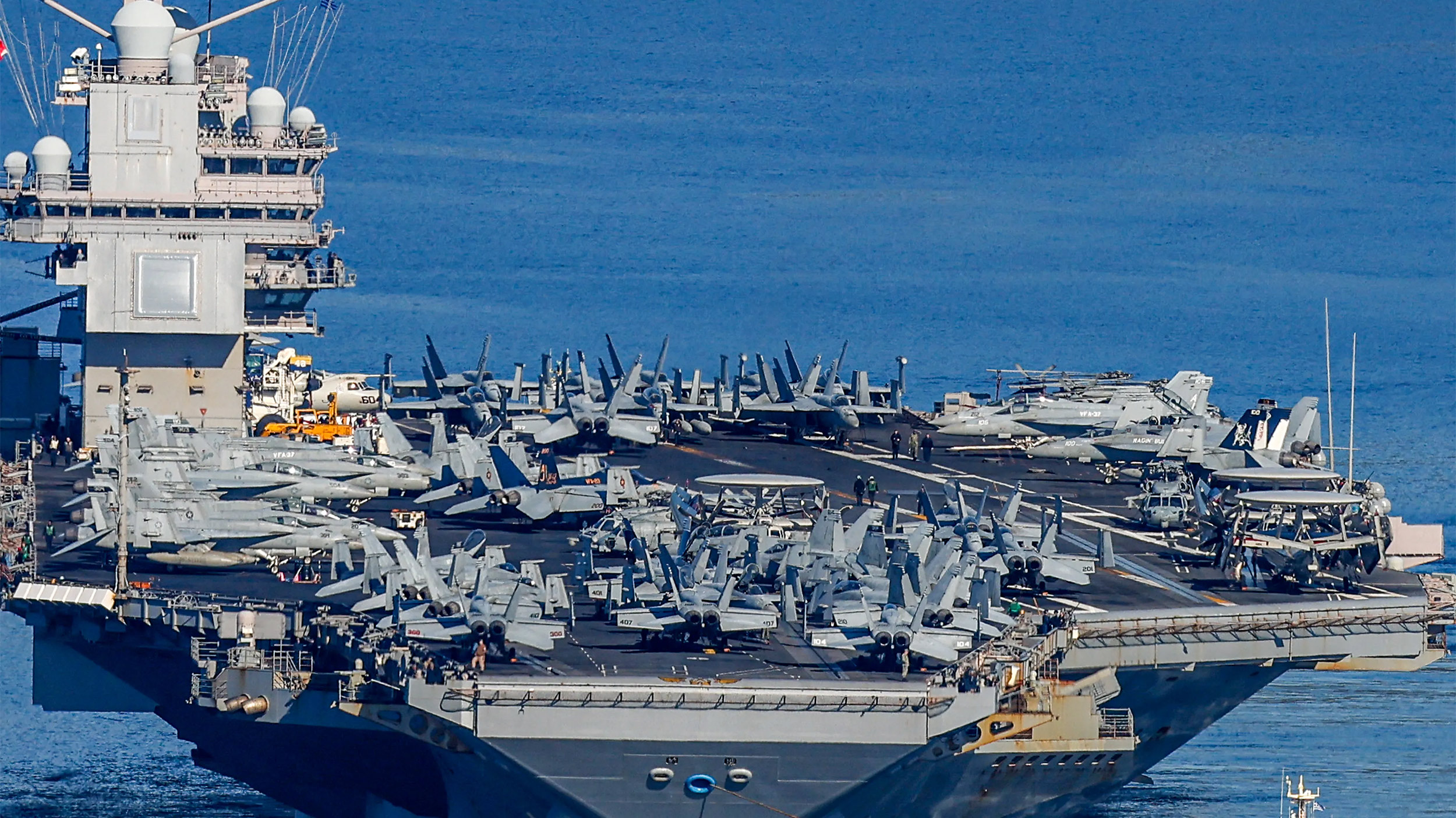
These strikes serve primarily defensive purposes. By degrading Iran’s conventional capabilities, the United States and Israel protect high-value assets such as the aircraft carrier USS Gerald R. Ford and other regional military deployments.
In Warden’s logic, the purpose of attacking this ring is not to win the war directly but to prevent interference while the inner rings are dismantled.
Strategic Synthesis: An Inside-Out Campaign
Viewed through the lens of Warden’s Five Rings theory, Operation Epic Fury appears to be a textbook example of inside-out strategic warfare. The campaign’s sequencing leadership decapitation, infrastructure disruption, energy targeting, and selective military strikes aligns closely with Warden’s model for achieving systemic paralysis. The ultimate objective is not the physical destruction of the Iranian military but the collapse of its operational coherence. If leadership cannot communicate effectively, if energy infrastructure cannot sustain military operations, and if logistical networks cannot connect command with execution, the state’s war-fighting capacity deteriorates rapidly. Under such conditions, fielded forces may remain physically intact but strategically irrelevant.
However, wars rarely remain static, and adversaries often adapt under pressure. Iran is unlikely to remain passive in the face of such systemic targeting. Historically, states subjected to decapitation and infrastructure strategies attempt to compensate through decentralisation, redundant command structures and asymmetric responses. Tehran could shift operational authority to regional military commands, empower IRGC units and proxy networks to act autonomously, or intensify cyber (highly unluckily) and missile operations designed to impose costs beyond the immediate battlefield. In this sense, war is also a learning process: as the campaign unfolds, both sides are likely to adjust their methods, testing the limits of Warden’s theory in a real-world environment where adaptation, improvisation, and strategic resilience often shape the trajectory of conflict as much as initial doctrine.
Policy Implications
- For policymakers, Operation Epic Fury illustrates both the potential effectiveness and the inherent risks of systemic warfare. The campaign demonstrates how modern airpower, cyber operations and precision strikes can be integrated to target the structural foundations of a state rather than its military formations alone.
- However, the strategy also introduces significant uncertainty. Leadership decapitation can produce succession struggles rather than immediate strategic paralysis, while infrastructure disruption may generate humanitarian and economic consequences that complicate international support for the campaign.
- Moreover, Iran retains significant asymmetric capabilities, including regional proxy networks and cyber warfare assets that could extend the conflict beyond its initial geographic boundaries.
- Understanding the logic of Warden’s Five Rings is therefore essential not only for analysing the campaign itself but also for anticipating its potential regional and global consequences.
- Lastly, Operation Epic Fury demonstrates that modern warfare is increasingly fought not on the battlefield’s periphery, but at the strategic centre of gravity where leadership, systems and legitimacy intersect.