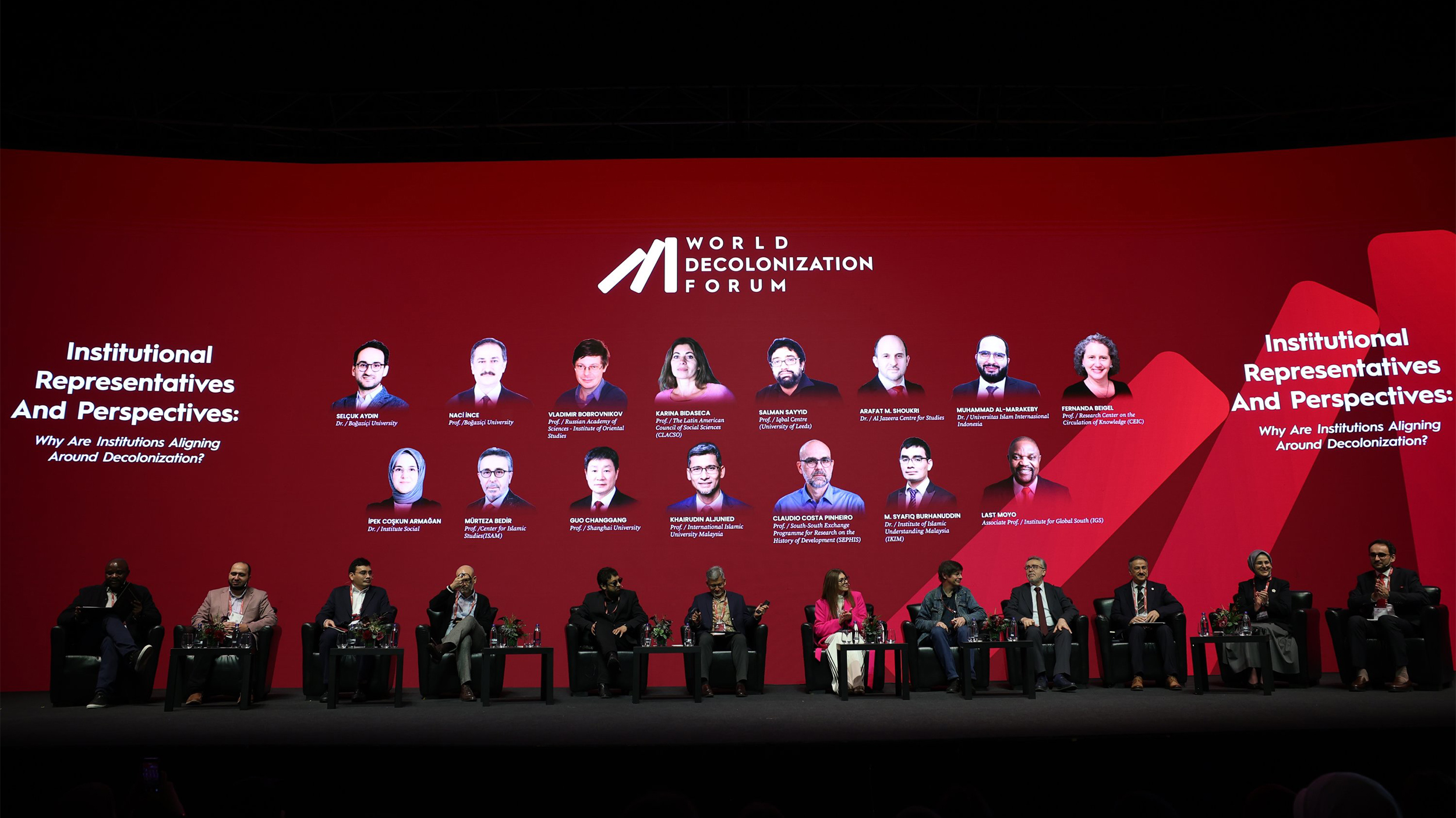
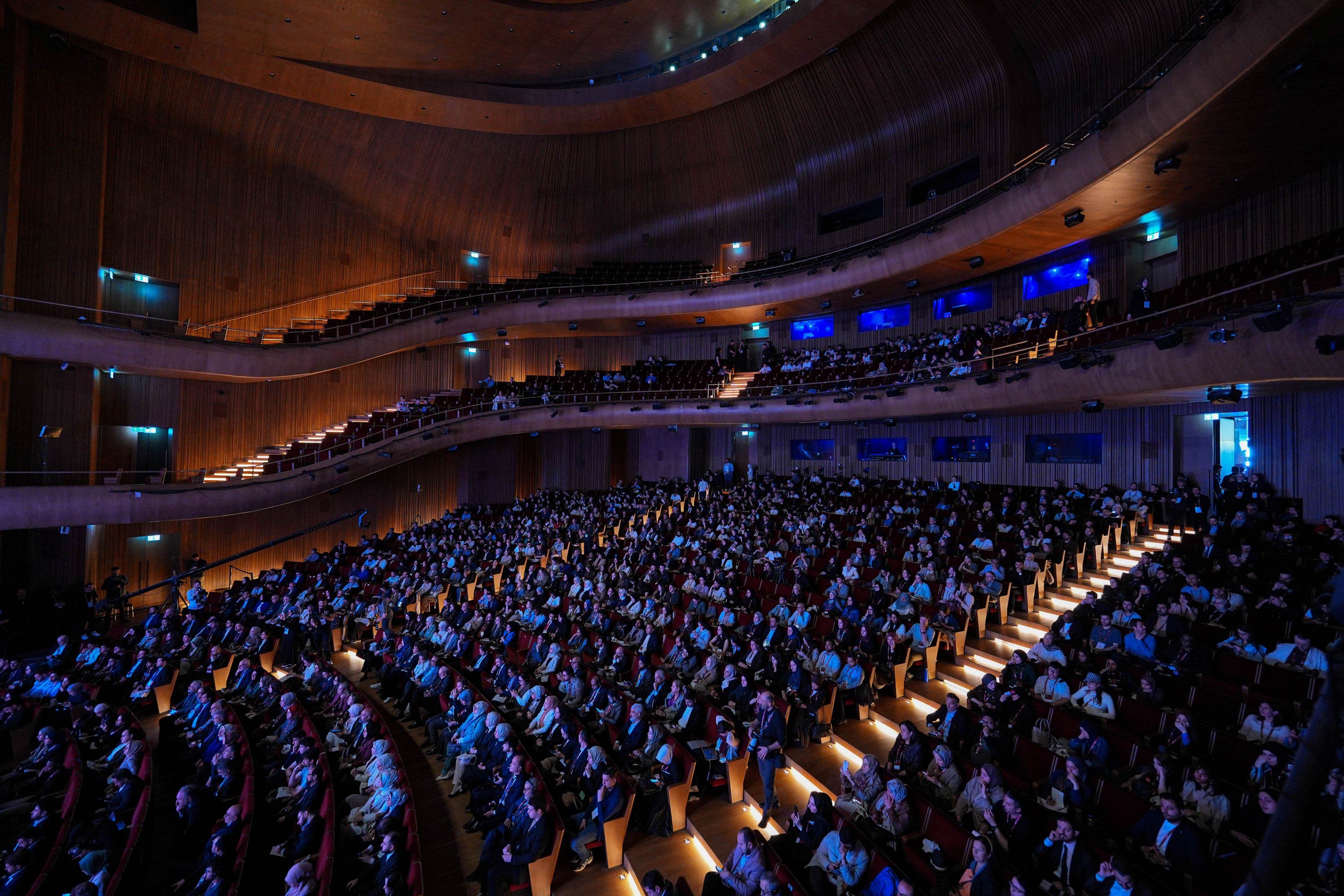
The World Decolonization Forum, held in Istanbul, came to a close after two days of intellectual and academic discussions addressing the problems of Western epistemic dominance and the mechanisms of knowledge production and dissemination in the contemporary international system, with the participation of academics and researchers from around 40 countries.
The forum was held on 11 and 12 May 2026 at the Atatürk Cultural Centre under the title “Decolonizing Knowledge Production and Circulation”, and was organised by Institute Social in cooperation with Al Jazeera Centre for Studies and the NÛN Education and Culture Foundation, with the participation of international academic and research institutions including the Center for Islamic Studies (ISAM), Fudan University, University of Leeds, Shanghai University, and the International Islamic University Malaysia.
The forum’s proceedings were based on the intellectual premise that colonialism did not end with the withdrawal of traditional colonial powers from their colonies, but rather that its structures continued within systems of education, economy, media, law, universities and technology, through the entrenchment of Western epistemological models presented as the only global standards for producing and evaluating knowledge. In this context, participants discussed how Eurocentrism has shaped what is considered “legitimate knowledge” and marginalised intellectual and historical experiences from societies of the Global South.
Dr. Esra Albayrak, Chair of the Board of Trustees at the NÛN Education and Culture Foundation and a member of the forum’s scientific committee, stated that decolonisation requires revisiting the epistemological and institutional structures historically shaped under Western dominance, noting that history-writing and knowledge production have often been framed from the perspective of dominant powers, affecting how the world is understood and its political and cultural concepts are formed. She also argued that current artificial intelligence (AI) systems reproduce this imbalance due to their near-total reliance on Western sources and standards in training and processing.
Dr. Arafat Shoukri, representative of Al Jazeera Centre for Studies, stated in his speech that decolonisation is no longer limited to the political or historical dimension, but is now directly linked to the knowledge structures that control the production, legitimation and global circulation of knowledge.
He explained that prevailing knowledge and media systems still reflect structural imbalances that privilege certain institutions, languages and geographies, while marginalising other perspectives and experiences, noting that media is no longer merely a means of transmitting information but has become part of the structure through which perceptions of reality and global narratives are formed.
He added that Al Jazeera Media Network has sought, within its institutional approach, to address this imbalance by providing greater space for underrepresented voices and contributing to a more pluralistic and diverse global discourse.
He also warned that AI systems, despite their expanding role in producing, filtering and disseminating knowledge, are not neutral systems, as they are shaped by the data, languages and intellectual frameworks used in their training. This, he said, may lead to the reproduction of existing knowledge hierarchies and the reinforcement of dominance over narratives and sources.
At the same time, he noted that AI offers opportunities to expand access to knowledge, amplify marginalised voices and enhance multidirectional knowledge flows, arguing that the real challenge is not the existence of these technologies, but how they are used: whether to reproduce historical inequalities or to help build a more just and pluralistic global knowledge system.
He emphasised that addressing epistemic inequality requires rethinking which actors set research agendas, how knowledge is granted legitimacy, and how it travels across linguistic, cultural and institutional boundaries, calling for the creation of cooperative networks and shared platforms for research, publication and dissemination to help achieve a more sustainable global epistemic balance.
The main sessions focused on the relationship between knowledge and power, as thinkers and researchers discussed the continued Western dominance within global universities, and the hegemony of the English language and academic publishing and classification systems in the production and circulation of knowledge. Salman Sayyid, Professor of Social Theory at the University of Leeds, argued that thousands of universities around the world operate within Western epistemic and discursive models, calling for a rethinking of the modern university so that it becomes a space for producing public knowledge rather than merely a credential-granting institution tied to market logic.
In a related context, the forum discussed the concepts of “data colonialism” and “technological colonialism”, examining how algorithms and major digital corporations reproduce old relations of domination in new technical forms, through control over data, global digital infrastructures and knowledge flows. Questions were also raised about the impact of AI in entrenching power imbalances between the Global North and South.
Extensive discussions were held on translation, literature, psychiatry and media, where academics and translators criticised the continued dominance of cultural and intellectual production from the Global North, alongside the marginalisation of languages and intellectual traditions in non-Western societies. Specialised sessions also examined the impact of Western models in the humanities and social sciences, and what some participants described as “epistemic violence” resulting from the imposition of Western cultural and psychological frameworks on societies with different historical and value-based structures.
The Palestinian issue featured prominently in the forum’s proceedings, through sessions addressing settler colonialism and international media narratives, where participants discussed how law, media and political discourse are used to reproduce relations of domination, emphasising that Palestine has become one of the central arenas of global debate on colonialism and epistemic justice.
A number of thinkers, academics and cultural figures participated in the forum, including Walter Mignolo, Joseph Massad, Mireille Fanon-Mendes, Anne Norton, Yusuf Islam, Iranian filmmaker Majid Majidi, and former French national football player Lilian Thuram. The forum included plenary sessions, roundtables and more than 100 research papers addressing issues in economics, media, education, law, the environment and Islamic knowledge systems.
The forum concluded with the launch of an intellectual and institutional roadmap extending to 2030, consisting of three phases: beginning with discussions on knowledge production and circulation, moving to examining “decolonization” within institutions and organisations in 2028, and culminating in practical and community-based applications in 2030. Participants emphasised that the debate on decolonisation is no longer limited to revisiting the past, but is now tied to reshaping the intellectual and institutional structures that govern the contemporary international system.