
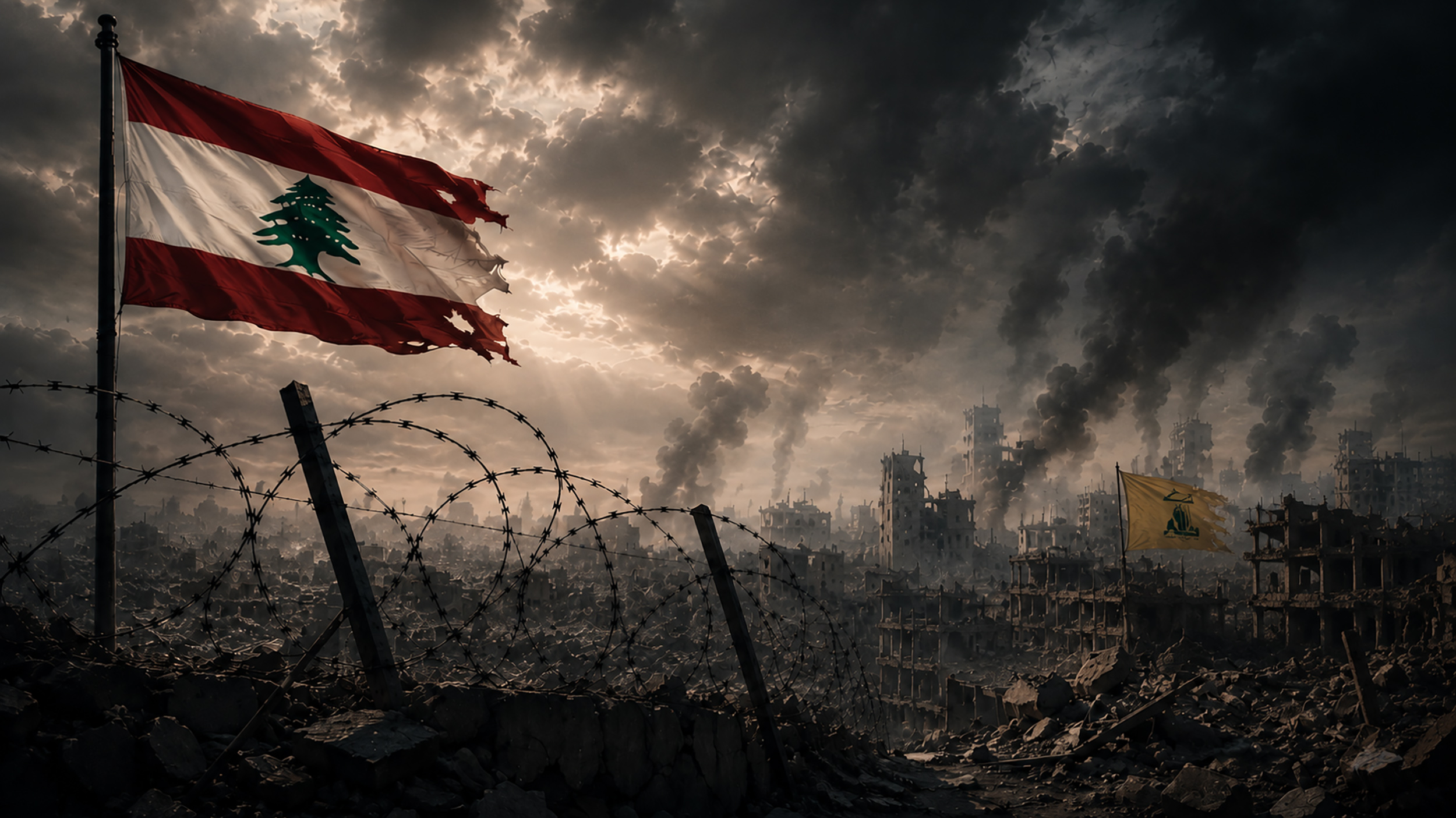
A newly announced framework for negotiations between Lebanon and Israel highlights the fundamental contradiction that has long shaped Lebanon’s security and political landscape: the Lebanese state conducts diplomacy and negotiates agreements, while Hezbollah remains the country’s principal military actor in confronting Israel. This disconnect continues to complicate efforts to reach a durable settlement and raises questions about the viability of any agreement that lacks the support of both actors.
The announcement came after months of negotiations under US sponsorship and was presented as a framework for stabilising the Israeli-Lebanese front after successive rounds of conflict. Yet the terms that became public appeared to place greater emphasis on Israeli and American priorities than on addressing Lebanese concerns. Hezbollah is expected to cease military operations, withdraw its forces from south of the Litani River, and allow the Lebanese army to assume control of the area. The declaration also stressed separating Lebanon’s situation from the broader Iranian-Israeli confrontation and emphasised the absence of hostile intentions between Lebanon and Israel.
At the same time, the framework provided few concrete assurances regarding issues of central importance to Lebanon. It did not clearly require a simultaneous Israeli cessation of military operations, establish a timetable for a full Israeli withdrawal from occupied Lebanese territory, guarantee the return of displaced residents, or outline a reconstruction process for war-damaged areas. This imbalance fuelled criticism that the arrangement imposed obligations on Lebanon while leaving Israeli commitments vague or unenforceable.
The declaration also exposed deep divisions within Lebanon’s political system. Hezbollah rejected both the negotiations and their outcome, insisting that any ceasefire must be accompanied by a complete Israeli withdrawal and a halt to Israeli attacks. Similar positions were expressed by parliamentary speaker Nabih Berri, who maintained that withdrawals and ceasefire commitments should occur simultaneously on both sides. In contrast, President Joseph Aoun and Prime Minister Nawaf Salam endorsed the negotiations as a necessary step toward restoring stability and reducing Lebanon’s entanglement in wider regional conflicts.
These divisions reflect a broader shift in how the Lebanese state views Hezbollah’s role. For decades, successive governments tolerated a dual structure in which Hezbollah maintained an independent military capability while participating in the political system. Many Lebanese leaders regarded the party’s military strength as a strategic asset that improved Lebanon’s position in its confrontation with Israel, even as Hezbollah remained closely aligned with Iran.
The current leadership, however, appears to have adopted a different assessment. Rather than viewing Hezbollah’s military capacity as a source of leverage, it increasingly sees it as a burden that exposes Lebanon to repeated conflicts and international pressure. This approach has translated into efforts to consolidate weapons under state authority, limit Hezbollah’s military activities, and gradually extend government control over areas traditionally dominated by the movement.
Such policies carry significant risks. By moving toward negotiations while simultaneously seeking to curtail Hezbollah’s military role, the Lebanese state may have weakened one of its few sources of leverage before securing meaningful concessions from Israel. The strategy also rests on the assumption that Lebanon’s situation can be separated from the wider regional confrontation involving Iran, Israel and the United States. Given the extent to which Hezbollah is integrated into Iran’s regional network, that assumption remains difficult to sustain.
Questions also persist regarding implementation. Israel has been accused repeatedly of violating previous ceasefire arrangements, raising doubts about whether external guarantees alone can ensure compliance. Reliance on American mediation may therefore prove insufficient if the underlying balance of power and strategic interests remain unchanged.
At the same time, the prospect of disarming Hezbollah appears highly uncertain. The party retains significant support within Lebanon’s Shiite community, and neither the Lebanese army nor other domestic political forces appear capable of compelling it to surrender its weapons. Any attempt to do so by force risks destabilising the country and deepening internal divisions. Israel, meanwhile, is unlikely to undertake the political and military costs associated with a prolonged effort to dismantle Hezbollah directly.
As a result, the central issue remains unresolved. Lebanon continues to face a situation in which the state seeks accommodation and diplomatic normalisation while a powerful armed actor maintains a doctrine of resistance. Unless broader regional tensions are addressed and a framework emerges that accommodates the realities of power inside Lebanon, attempts to impose a settlement from above are likely to encounter significant resistance. The result could be a prolonged period of political deadlock, recurring confrontation, and growing pressure on the already fragile Lebanese state.
*This is a summary of a policy brief originally written in Arabic available here.