Summary
The US-Israeli war on Iran has significantly influenced the European Union's (EU) perception of the Gulf region’s strategic importance, particularly concerning energy security and regional stability. Europe's dependence on external energy sources has been underscored by recent geopolitical events. Russia's attack on Ukraine in 2022 initiated a gradual reduction in EU imports of Russian energy resources between 2022 and 2026, highlighting the necessity of diversifying energy suppliers. While the United States (US) and Norway emerged as major partners in this diversification strategy, the Gulf states also became increasingly important as alternative sources of energy, particularly as European countries sought to compensate for reduced imports from Russia. However, the war in Iran has exposed a new vulnerability within this diversification strategy. Disruptions to energy supplies from the Gulf, together with the resulting volatility in global energy markets, demonstrate the risks associated with Europe's growing reliance on a region affected by persistent geopolitical instability.
For the EU, this creates a strategic dilemma. Gulf states have become an important component of Europe's efforts to diversify its energy supplies, yet instability in the Gulf can directly undermine the reliability of these alternative sources. The EU's response to the Iran-US-Israel conflict can therefore be characterised as selective engagement, aimed at limiting exposure to regional instability while preserving its strategic interests in the Gulf. This balancing act reflects the broader challenge the EU faces in maintaining its global relevance while managing its dependence on strategically important but politically volatile regions.
This tension is particularly relevant to Poland, whose efforts to reduce its dependence on Russian energy have led to closer energy ties with individual Gulf states. Saudi Arabia has become an important source of crude oil, while Qatar has emerged as a key partner in the supply of natural gas. Poland therefore provides a concrete example of how the broader European shift away from Russian energy has translated into greater reliance on Gulf suppliers—and, consequently, greater exposure to instability affecting the region.
Introduction
The ongoing conflict between Iran and the US and Israel is profoundly reshaping global geopolitical and economic alliances, forcing key international actors to recalibrate their strategic priorities. For the EU and its member states, this reconfiguration has brought the strategic significance of the Gulf region into sharp focus, particularly in the realms of energy security, trade stability and regional diplomacy. This analysis explores how the US-Israeli war on Iran is reconfiguring the strategic calculations of both the EU and Poland towards the Gulf and examines how these shifts may shape their future relations with the Gulf states.
The analysis first addresses the EU’s evolving perception of the Gulf, arguing that the conflict has accelerated Europe’s energy diversification strategy while simultaneously exposing the vulnerabilities of relying on external suppliers. It then contrasts the broader EU approach with Poland’s distinct calculations, highlighting how Poland’s focus on immediate security, its export-driven economy, and a lack of state-led economic diplomacy have limited its engagement with the Gulf. Finally, the discussion turns to the future, projecting how these dynamics will influence cooperation across energy, security, diplomacy, trade and investment, suggesting that while the EU is moving toward a more pragmatic and multifaceted partnership with the Gulf states. Poland risks missing out on key opportunities if it fails to develop a coherent strategy for closer cooperation with the Gulf states. On the other hand, it is worth noting that focusing on the EU and US markets, which absorb about three-quarters of Polish exports, may be a rational way to use limited diplomatic opportunities in a frontline state.
The EU's Perception of the Gulf's Strategic Importance
As a continent with highly developed economies, Europe has limited domestic energy resources and is heavily dependent on oil and gas imports.
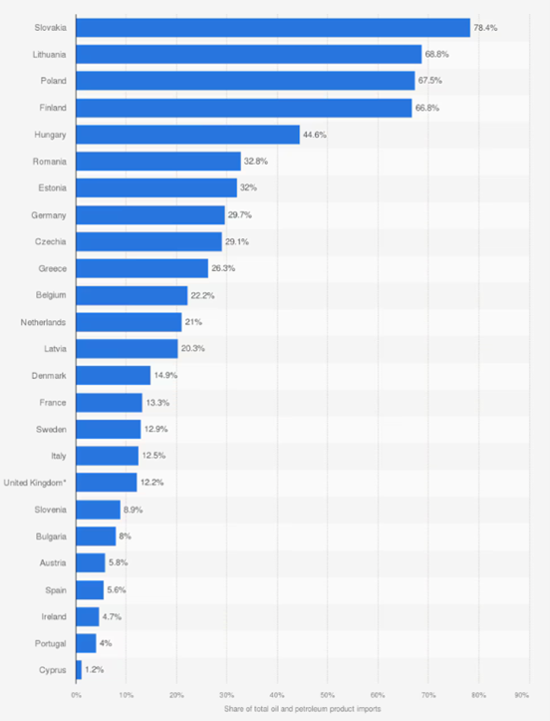
Additionally, the countries of Central and Eastern Europe, which share a common communist history, were particularly dependent on Russian energy supplies. Slovakia was among the most dependent, with Russian oil accounting for almost 80% of its oil imports. By contrast, countries in Western and Southern Europe recorded levels of dependence below 5%.
Before the war on Ukraine, Russia was the EU's largest supplier of crude oil, accounting for 16.5% of EU oil imports, followed by the United States (8.2%), Norway (7.5%), Iraq (4.5%) and Libya (3.7%). (1)
In 2019, Russia was also the EU's largest supplier of natural gas.
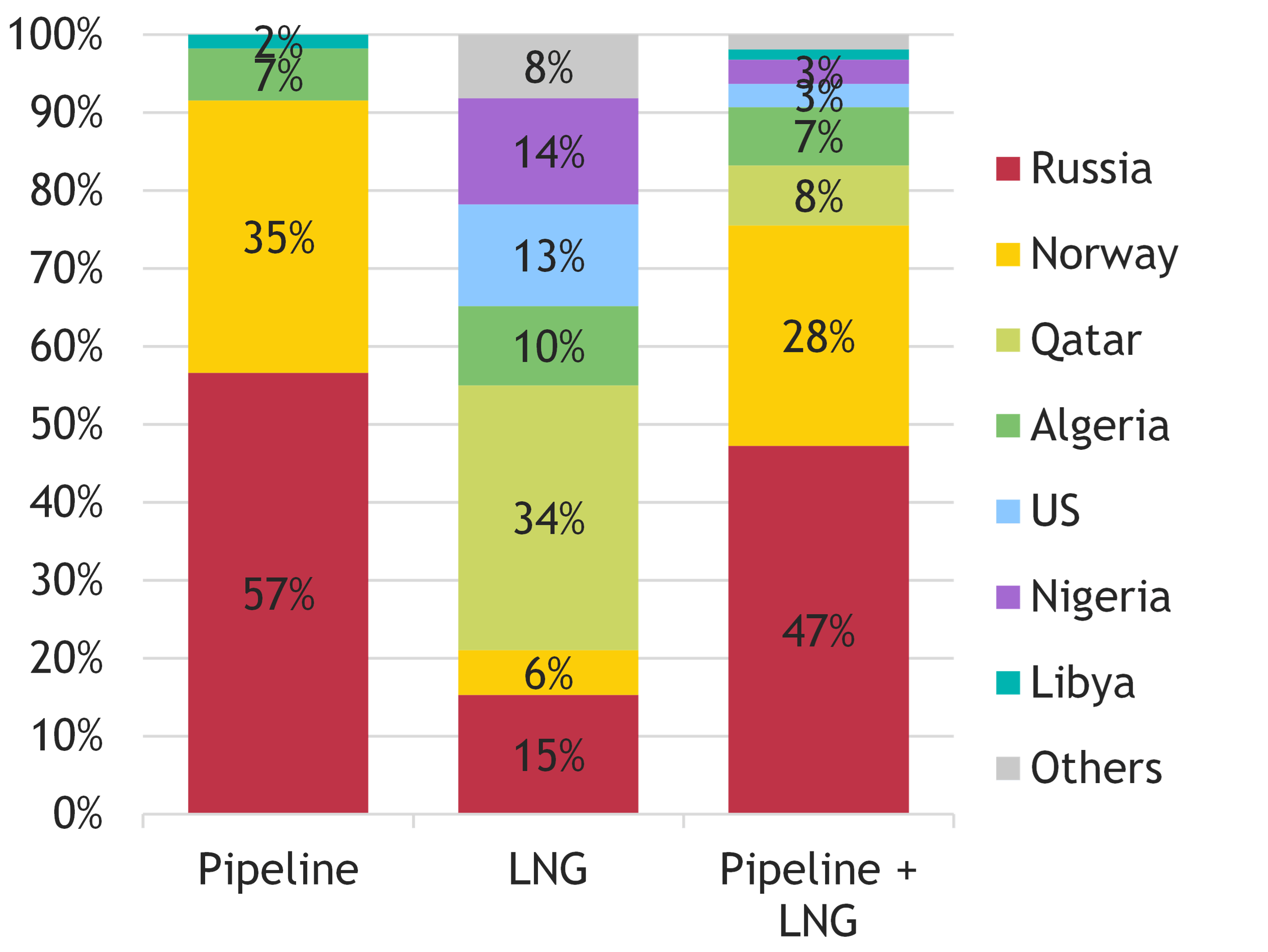
Europe therefore finds itself in a strategic dilemma. The third decade of the 21st century has been marked by a series of unexpected geopolitical developments that have fundamentally altered the EU's strategic approach to energy security. In 2021, Russia's use of energy supplies as a tool of political pressure on the EU, (2) followed by the outbreak of the war in Ukraine in 2022, prompted the EU to reduce its dependence on Russian oil and gas as rapidly as possible. In response, the EU adopted a strategy centred on securing reliable and diversified energy supplies as a key component of its energy security. (3) In May 2022, the European Commission introduced the REPowerEU Plan, which called for an end to Europe's dependence on Russian energy imports through energy savings, the accelerated deployment of renewable energy, and the diversification of energy supplies. (4)
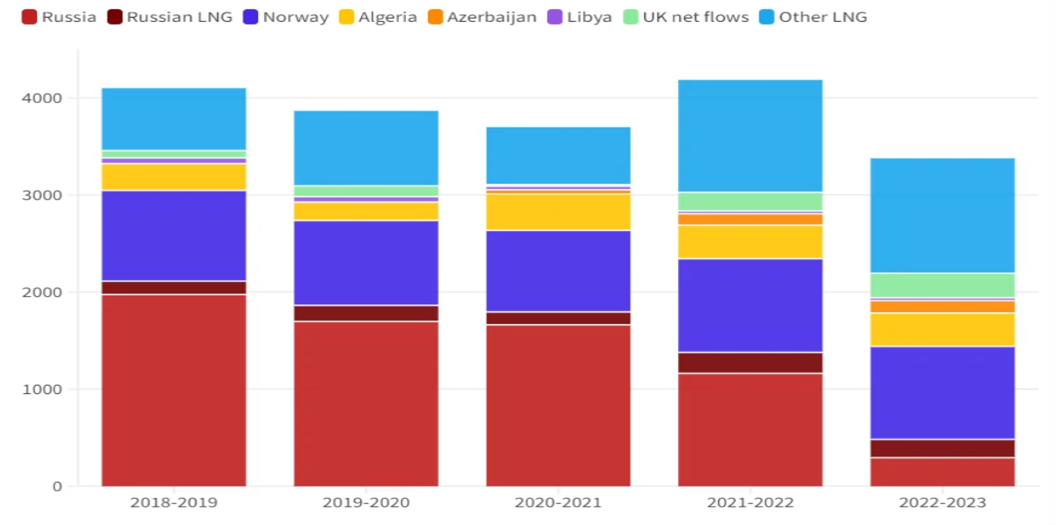
The figure above illustrates Russia's importance as a gas supplier to the EU in the late 2010s. In 2018–2019, Russia accounted for nearly 50% of the EU's gas supplies. In 2021–2022, gas supplies from the Russian Federation began to decline as Russia reduced its exports to Europe. In the subsequent period, EU purchases of Russian gas fell drastically as European countries sought to reduce their dependence on Russian energy following Russia's war on Ukraine. A similar pattern emerged in the oil market, as shown in the following figure.
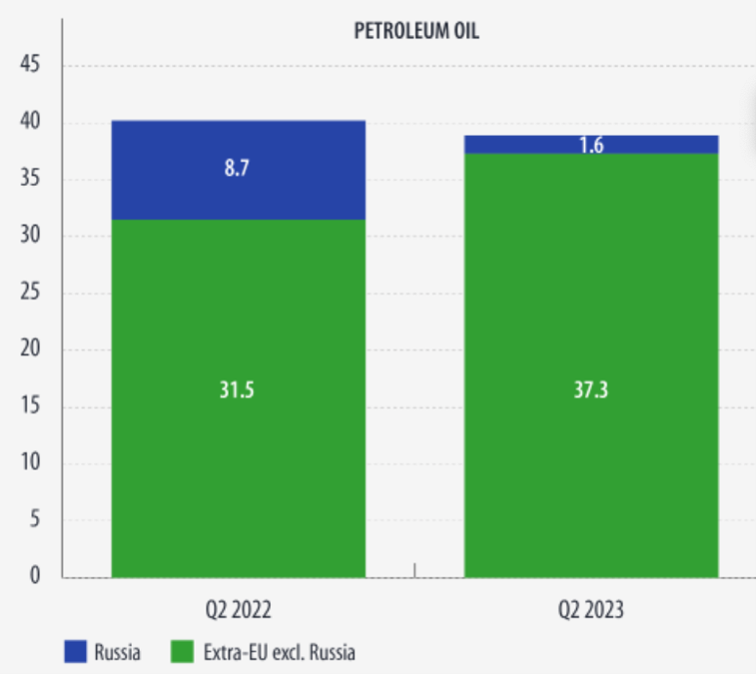
Alongside the reduction in energy imports from Russia, European countries increasingly redirected their energy purchases towards alternative suppliers. The US gained a key position in this process, followed by Norway and, increasingly, the energy-producing Gulf states. However, the extent to which individual European countries shifted their energy policies varied, with different countries relying on alternative sources to different degrees depending on their existing energy infrastructure, geographical position and available supply options.
The war in Iran highlighted the vulnerabilities associated even with this shift towards alternative energy suppliers. Although diversifying energy supplies reduces the risks associated with reliance on a single supplier, it does not eliminate Europe's dependence on external sources of energy. In fact, it shifts this dependence towards other suppliers and regions that may themselves be exposed to geopolitical instability. This has contributed to a growing recognition within the EU that long-term energy security cannot be achieved solely through the diversification of external suppliers. Increasing emphasis is therefore being placed on transforming the European energy system through the accelerated development of renewable energy and nuclear power, with the aim of reducing dependence on external energy sources. (5) Energy security is increasingly being understood not only in terms of diversifying external supplies, but also in terms of the ability to meet a greater share of energy demand from domestic and EU sources. This shift should be taken into account when considering the future of energy relations between the EU and the Gulf.
However, this transformation will yield results only in the long term. In the meantime, Europe remains heavily dependent on stable global energy flows and secure maritime trade routes. The conflict in the Middle East has highlighted the vulnerability of some of the world's most important energy and trade corridors, particularly the Strait of Hormuz and the Bab el-Mandeb Strait. In November 2023, the Houthis launched attacks on commercial shipping in the Red Sea, disrupting maritime traffic along a route that is crucial to global trade and to EU trade through the Suez Canal. These attacks led to a significant reduction in maritime traffic along the route, forcing vessels to adopt longer and more costly alternative routes. Although the situation temporarily stabilised in 2025, the Houthis became involved again in the ongoing conflict in March 2026, further increasing the risks to maritime trade.
These developments pose a significant threat to the economic stability of EU member states, extending beyond the direct implications for oil and gas supplies. Disruptions to major maritime routes can affect supply chains, transport costs, inflation, trade flows and broader economic activity. The situation in the Middle East is therefore of crucial importance to the EU, alongside its transatlantic relations, as it seeks to maintain its position and interests in the international system. A multidimensional crisis is unfolding in the Gulf region, with implications for global energy markets, maritime security, supply chains, inflation, defence spending, political stability and the future structure of international alliances. GCC member states have themselves come under attack from Iran, with some attacks targeting critical energy infrastructure. These developments demonstrate that the security of the Gulf is increasingly inseparable from Europe's own economic and energy security.
Poland’s Approach
Amid geopolitical changes, Poland is currently focused primarily on its own security, which has been under its greatest threat since 1989. Consequently, political activity outside the Euro-Atlantic area has generally not been a priority.
Poland differs from many other EU member states in the extent to which its foreign-policy priorities are concentrated on the Euro-Atlantic area. The country's main partners are the US and the EU, while cooperation with the rest of the world has traditionally been of secondary importance. Poland's current economic policy, including the concept of an active role for the state in international cooperation, has developed more slowly than might be expected given the country's economic strength and international position. Poland has largely based its economic development on a liberal model in which the market plays a significant role, while the state has generally maintained a relatively limited role in direct economic intervention.
After the political transformation in 1989, and particularly following Poland's accession to the EU in 2004, the country became deeply integrated into the European market and, given its strong transatlantic orientation, developed significant economic relations with the US. As a result, Polish exports have increased nearly thirtyfold over the past 35 years. Since joining the EU 22 years ago, Poland's exports have increased more than sixfold, while exports of agri-food products have increased twelvefold. Poland has also increased the share of high-technology products in its exports fourfold, surpassing Austria, Spain and Sweden. More than 60% of Polish exports are directed to the European Union. Poland ranks first in the EU in transport services, accounting for nearly 20% of EU road freight transport, ahead of Germany and Spain. (6) Poland has also maintained its position as one of Europe's largest food exporters. The main pillars of Polish food exports include meat, grains, tobacco, sugar, dairy products and fish. (7)
Poland also leverages exports as an important source of economic growth. Since a substantial share of export revenues comes from trade with the EU and the US, it is unsurprising that Poland remains strongly focused on these markets. They are geographically closer and more familiar to Polish producers and importers, while Polish companies are already deeply integrated into their supply chains. This helps explain Poland's comparatively limited engagement with other markets.
Following the political transformation, Poland began developing its own brands, primarily through the private sector. Today, several Polish companies have developed internationally recognised brands, including InPost; the BLIK cashless payment system; Inglot cosmetics; CD Projekt, a software and gaming company; Asseco, a provider of software solutions for banks; LPP in the clothing industry; and WB Electronics, which produces advanced defence technologies, including drones. Poland is now entering a stage of development in which its domestic companies and brands are becoming strong enough to pursue wider international expansion.
Poland still lacks a comprehensive national development strategy. In relation to the Middle East, Polish security strategies have accurately identified threats arising from the country's immediate surroundings, particularly those associated with Russia, while challenges originating from more distant regions have received comparatively less attention. (8)
One of the periods in which Polish diplomacy directed greater attention towards the Middle East was during Jacek Czaputowicz's tenure as Minister of Foreign Affairs from 2018 to 2020. During this period, Poland, together with the US, co-organised the Middle East Conference, which took place in Warsaw in February 2019. The conference was attended by foreign ministers from several important Arab states and as well as the Prime Minister of Israel. During the deliberations, the so-called Warsaw Process was initiated, marking the beginning of an international dialogue at the expert level. During Czaputowicz's tenure, he also expressed an interest in Poland becoming more engaged in the development and promotion of economic cooperation with Middle Eastern countries. Successive foreign ministers, however, addressed the Middle East only marginally. (9)
It therefore appears that Poland's foreign policy lacks a broad and consistent strategy towards the Middle East, with many reactions and initiatives towards the region taking the form of ad hoc responses to emerging challenges and threats. Economic diplomacy, trade promotion and investment policy also remain areas requiring further development. Despite efforts to modernise its structure and functions, Poland's economic diplomacy continues to face problems of organisational coherence and measurable business impact. (10) Support for Polish businesses seeking to enter foreign markets, as well as policies aimed at attracting foreign direct investment, including investment from the Gulf states, remains relatively weak. The promotion of Poland's national economic brand has also been limited. Although the Polish Investment and Trade Agency (PAIH) operates Foreign Trade Offices in Riyadh and Dubai, their resources remain limited in relation to the scale of the opportunities available in these markets. An audit by the Supreme Audit Office (NIK) concerning the economic promotion of Poland identified, among other issues, the lack of a coherent system for promoting the Polish economy. (11) The largest Polish economic mission ever sent to Saudi Arabia, involving approximately 70 companies and led by the Minister of Finance and Economy, took place in Riyadh on 7–9 February 2026. The organisation of such a mission demonstrates the growing interest in the Saudi market, although questions remain regarding the effectiveness and strategic coordination of Poland's economic diplomacy. Similarly, the existence of instruments such as the state brand programme and the export credit agency KUKE has not yet translated into results commensurate with their intended objectives. Poland's economic development continues to rely primarily on market forces. While this approach has contributed to considerable export growth, it has also meant that many of Poland's international successes have been driven primarily by individual companies rather than by a coordinated state strategy.
Regarding the Gulf, Poland's policy has traditionally placed particular emphasis on the Gulf states as suppliers of energy resources, which is understandable given their importance to Poland's energy security. At the same time, insufficient attention has been given to the broader economic transformation taking place in the Gulf and to the opportunities it creates for investment, technology cooperation, joint ventures and trade. It can therefore be argued that Poland has not yet fully developed the potential of its economic relations with the Gulf states. In its international policy and economic cooperation, Poland continues to focus primarily on its alliance with the US and its relations with the EU. Its close alliance with the US, together with its efforts to maintain a balanced position towards Israel and conflicts in the Middle East, may at times complicate the development of deeper economic relations with Gulf states. Poland also seeks to ensure that Gulf investment contributes to its economic development without resulting in excessive foreign control over strategically sensitive assets. These concerns were reinforced by the transaction involving the sale of a stake in the state-owned Lotos refinery to Saudi Aramco, (12) which took place under the Law and Justice government and generated considerable political and economic controversy regarding the protection of Poland's strategic interests.
Unlike the political class, the Polish private sector is increasingly beginning to perceive the Gulf states as an attractive area for economic cooperation. However, without stronger support from the state and its institutions, which have a mandate to promote Polish exporters, many Polish entrepreneurs face difficulties navigating the region's diverse markets and business environments.
One of the main problems arises when companies attempt to transfer their Western operating models directly to the Middle East, treating the Gulf as a single market. In reality, the six Gulf states differ significantly in their legal frameworks, economic structures, regulatory environments and business practices. Polish companies must therefore adapt their strategies to individual markets rather than treating the Gulf as a homogeneous economic space. Differences in decision-making processes, relationship-building, negotiation practices, and expectations regarding business communication can also create barriers for companies unfamiliar with the region. Approaches that are common in European business environments may not always be equally effective in Gulf markets.
Another barrier is the insufficient understanding of the need to adapt sales models and negotiation strategies to the business practices prevailing in individual Gulf markets. Successful market entry therefore requires not only a competitive product or service but also an understanding of local commercial practices and long-term relationship-building.
Selecting the right local partner and establishing a strategic alliance can also pose significant difficulties. A well-chosen partner can shorten the market-entry process by years, whereas an unsuitable partner can significantly delay or even prevent access to potential business opportunities. (13)
Following the outbreak of the war in Ukraine, Poland significantly expanded its hydrocarbon trade relations with Saudi Arabia, with the share of Saudi oil in refinery supplies reaching approximately 46–60% during 2024–2025, (14) and with Qatar, which accounted for approximately 20% of Poland's LNG supplies. (15) This diversification reduced Poland's dependence on Russian energy supplies, but it also increased the importance of developments in the Gulf to Poland's energy security. Consequently, as in other EU member states, instability in the Gulf can affect Poland through its impact on energy supplies, fuel prices, inflation and, ultimately, economic growth.
Poland is simultaneously pursuing an energy transition aimed at strengthening its long-term energy security, broadly in line with the EU's policy objectives. Over time, Poland's dependence on hydrocarbons is expected to decline as a result of the rapid development of renewable energy sources, the planned construction of nuclear power capacity, and the development of small modular reactors (SMRs). These developments may gradually reduce Poland's demand for imported natural gas, including gas supplied by Qatar. Although major nuclear and SMR projects are expected to become operational primarily from the mid-2030s onwards, their long-term effect should be to increase Poland's energy independence by reducing reliance on imported fossil fuels.
Poland is also developing its hydrogen sector and has approved a framework for the development of national hydrogen infrastructure, creating the basis for the development of a low-emission economy. An important element of this process is the Nordic-Baltic Hydrogen Corridor (NBHC), which is intended to facilitate the development of regional hydrogen infrastructure. As with nuclear power, the development of a hydrogen transmission system is expected to extend into the mid-2030s. In the longer term, the expansion of hydrogen and other low-carbon energy technologies could contribute to a reduction in oil demand and, consequently, potentially reduce Poland's dependence on crude-oil imports from Saudi Arabia. (16)
Taken together, these developments illustrate an important tension in Poland's relationship with the Gulf states. In the short and medium term, Saudi Arabia and Qatar have become increasingly important partners in Poland's energy diversification following the war in Ukraine. At the same time, Poland's energy transition is likely to reduce the relative importance of oil and gas in its future relations with the Gulf. This makes it increasingly important for Poland to broaden its economic engagement with Gulf states beyond hydrocarbons and to develop cooperation in areas such as investment, technology, infrastructure, digitalisation, green energy and other sectors associated with the economic transformation of the region.
Future EU-Gulf and Poland-Gulf Relations
As mentioned, the war highlighted the importance of the Gulf region for Europe's energy supplies, while energy security has been treated as a strategic priority for the EU since 2022. At the same time, the Houthi attacks in the Red Sea have threatened an important route for EU trade, increasing freight and insurance costs.
Europe has discovered that it cannot indefinitely outsource its strategic interests in the Middle East to Washington while remaining insulated from the consequences of regional instability. (17)
Regarding energy resources, recent events have demonstrated the critical importance of maritime chokepoints to the global economy and international trade. This is likely to encourage greater interest from the EU and NATO in protecting maritime routes and potentially increasing the presence of European and NATO naval forces in high-risk regions.
In terms of security and diplomacy, cooperation has intensified through existing channels, including intelligence cooperation concerning threats from Iran, the safety of navigation and terrorist threats, as well as cybersecurity, the protection of critical infrastructure and maritime security. France, Italy and Germany play particularly important roles in these efforts. In 2020, EU member states launched the European Maritime Awareness in the Strait of Hormuz (EMASOH) programme, which aims to ensure the safety of navigation, facilitate access to shipping in the Gulf, and support the de-escalation of tensions in the region. The mission involves the navies of Denmark, Belgium, France, Germany, Italy and Portugal, and remains operational. An important component of EMASOH's activities is its diplomatic track, which seeks to complement military efforts by promoting de-escalation, regional stability and inclusive dialogue. (18)
In 2024, EU structures initiated a defensive naval operation known as Operation ASPIDES. Its aim is to protect commercial shipping from Houthi attacks in the Red Sea, the Indian Ocean and surrounding maritime areas. (19) Poland does not participate in either Operation ASPIDES or EMASOH, primarily due to its regional defence priorities, limited blue-water naval power-projection capabilities, and its policy focused on deterring threats closer to home. (20)
The EU has also acknowledged the different roles played by Gulf states in mediation, conflict resolution and the provision of humanitarian assistance.
Regarding trade, there is no clear single trend. On the one hand, a slowdown in trade can be expected due to rising transport costs, more expensive insurance, increased risk and potential transport disruptions. (21) On the other hand, the economic transformation of the Gulf states creates opportunities for increased cooperation in sectors such as infrastructure, energy, digitalisation, defence, food and medicine. In 2024, the total value of EU foreign direct investment in the Gulf amounted to EUR 163.1 billion, while investment from the Gulf countries in the EU amounted to EUR 189.8 billion. (22) Gulf sovereign wealth funds have invested extensively across European economies, including in real estate, sports, energy and other strategic sectors. For example, Qatar has invested significantly in Europe's automotive industry; Saudi Arabia's Public Investment Fund (PIF) is the majority shareholder of Lucid Motors, a manufacturer of luxury electric vehicles; and UAE sovereign wealth funds, including Mubadala and ADIA, have made substantial investments in European aerospace and biotechnology sectors. (23)
Since 2018, the EU-Gulf Cooperation Council Dialogue on Economic Diversification project has sought to strengthen EU-GCC relations by drawing on EU experience to support GCC member states in diversifying their economies away from dependence on the hydrocarbon sector. (24) The EU is the Gulf's second-largest trading partner, accounting for 10.9% of the Gulf's total trade in goods with the world in 2025. For the Gulf, the EU is its sixth-largest trading partner, sixth-largest export destination, and eleventh-largest source of imports. (25)
Despite the limitations identified above, the lack of a comprehensive strategy and, at times, sufficient political commitment to deepen Polish-Gulf cooperation, Poland and the Gulf states still have considerable scope to improve their economic relations. Poland is developing dynamically in several sectors that correspond with the priorities of the Gulf's economic transformation. This creates potential for closer cooperation in areas such as logistics; food security; new technologies, including IT, FinTech and cybersecurity; as well as energy, including hydrogen.
Some Polish companies are already successfully operating in Gulf markets. One example is Comarch, which has been present in the region since 2004 and operates in the UAE and Saudi Arabia, including through two local data centres established to meet customer requirements concerning data storage. Another example is Sunreef Yachts, a builder of luxury catamarans, which launched a new shipyard in Ras Al Khaimah in 2024, with a total investment of approximately PLN 100 million. Inglot provides another example. The cosmetics company entered the Gulf market in 2010 through a partnership with Apparel Group, a major regional retail group that obtained franchise rights for the brand across all Gulf countries. As a result, Inglot stores have been established in major shopping malls, with more than 50 stores currently operating across the region. (26)
In political and economic terms, the Gulf should become increasingly important to Poland's political and economic decision-makers, and Poland should therefore develop a more coherent strategy towards the Middle East. Poland should view the Gulf countries not only as energy suppliers but also as partners for multidimensional investment, economic and trade cooperation, particularly in expanding the export of Polish goods and services. (27)
Conclusion
The ongoing US-Israeli war on Iran has further highlighted the strategic importance of the Gulf for both the EU and Poland. For the EU, the conflict has reinforced the importance of energy security, maritime security, trade stability and cooperation with the Gulf. The analysis demonstrates that the relationship is increasingly multidimensional, extending beyond energy supplies to include trade, investment, security and regional diplomacy.
For Poland, however, the opportunities arising from the growing strategic importance of the Gulf remain only partially developed. Poland's strong focus on Euro-Atlantic security, combined with the absence of a coherent strategy towards the Middle East and limited state-led economic diplomacy, has constrained deeper engagement with the Gulf states. At the same time, the growing presence of Polish companies in Gulf markets and Poland's expanding economic and energy ties with the region demonstrate that significant potential already exists. Poland should therefore move beyond an approach centred primarily on energy and develop a more comprehensive strategy towards the Gulf, with greater emphasis on trade, investment, technology, infrastructure, digitalisation and other sectors linked to the economic transformation of the region. Such an approach would allow Poland to better align its economic interests with the growing strategic importance of the Gulf and strengthen its position within the changing geopolitical environment.
- “EU imports of crude oil”, European Parliamentary Research Service (EPRS), https://tinyurl.com/2tyfbzhm (accessed 25 August 2026).
- Mitchell Orenstein, “Putin the Green? The Unintended Consequences of Russia’s Energy War on Europe”, Foreign Policy Research Institute, 15 February 2023, https://tinyurl.com/edsrbuxz (accessed 25 August 2026).
- Lisa Basquel, “How the Iran war could trigger a European energy crisis”, Atlantic Council, 17 March 2026, https://tinyurl.com/3zvxkzzx (accessed 25 August 2026).
- “REPowerEU - 4 years on”, European Commission, https://tinyurl.com/5h5e7wtv (accessed 24 August 2026).
- Zia Weise, “Fossil fuels? No thanks. Why Trump’s Iran war is pushing EU toward renewables.”, Politico, 18 March 2026, https://tinyurl.com/49efkpum (accessed 23 August 2026).
- “Poland's 22 years in the European Union. Success in figures”, Ministry of Foreign Affairs Republic of Poland, 1 May 2026, https://tinyurl.com/5cthfwdn (accessed 25 August 2026).
- “Poland as a Leader in Food Exports in Europe”, WorldFood Poland, https://tinyurl.com/mu2wbr22 (accessed 23 August 2026).
- Katarzyna Czornik, “Strategia bliskowschodnia RP na przełomie drugiej i trzeciej dekady XXI w. [Poland’s Middle East Strategy at the Turn of the Second and Third Decades of the 21st Century]”, Sprawy Międzynarodowe, Vol. 78, Issue 4, 30 December 2025, https://tinyurl.com/2j8t8aku (accessed 23 August 2026).
- Ibid.
- Edward Molendowski and Wojciech Polan, “The evolution of the model of Poland’s economic diplomacy in the early 21st century”, Przegląd Europejski (European Studies Quarterly), Vol. 2025, Issue 2, June 2025, https://tinyurl.com/mr4cysab (accessed 6 September 2026).
- Ibid.
- “Lotos trafiony i zatopiony. NIK miażdży fuzję z Orlenem, wytykając miliardowe straty [LOTOS Hit and Sunk: NIK Slams the Merger with Orlen, Pointing to Losses Running into the Billions]”, Bankier.pl, 15 April 2025, https://tinyurl.com/p9cjyh9a (accessed 23 August 2026).
- Maciej Truchanowicz ,“Zatoka Arabska w czasach napięć. Dlaczego GCC pozostaje jednym z najatrakcyjniejszych kierunków ekspansji dla europejskiego biznesu? [The Arabian Gulf in Times of Tension: Why Does the GCC Remain One of the Most Attractive Destinations for European Business Expansion?”]”, Business Impact Review, 10 June 2026, https://tinyurl.com/ytma28xr (accessed 23 August 2026).
- “Prawie 60% ropy importowanej do Polski pochodzi z Arabii Saudyjskiej [Nearly 60% of Poland’s Imported Oil Comes from Saudi Arabia]”, Biznes24, 2 March 2026, https://tinyurl.com/473sw565 (accessed 23 August 2026); Bartłomiej Supernak, “Polskie rafinerie przerobiły 28,9 mln ton ropy w 2025 [Polish Refineries Processed 28.9 Million Tonnes of Crude Oil in 2025]”, Inwestycje.pl, 14 April 2026, https://tinyurl.com/mueaa3ya (accessed 23 August 2026).
- “Najwięcej LNG Polska sprowadziła z USA, a resztę z Kataru [oland Imported the Most LNG from the United States, with the Rest Coming from Qatar]”, PortalMorski.pl, 13 May 2026, https://tinyurl.com/yntd85xz (accessed 22 August 2026); Karolina Kurek, “Dostawy gazu z Kataru pod presją. Minister ma ważną deklarację dla Polaków [Qatar’s Gas Supplies Under Pressure: Minister Makes Important Declaration to Poles]”, InnPoland, 1 March 2026, https://tinyurl.com/4t79hyxt (accessed 22 August 2026).
- “GAZ-SYSTEM buduje ekosystem dla rozwoju rynku wodoru w Polsce [GAZ-SYSTEM Is Building an Ecosystem to Develop Poland’s Hydrogen Market]”, Ministry of Energy Republic of Poland, 24 July 2026, https://tinyurl.com/36pcnyfm (accessed 22 August 2026).
- Christian Koch, “A Pivotal EU-GCC Summit”, Gulf Research Center, 20 May 2026, https://tinyurl.com/yez6pmb3 (accessed 22 August 2026).
- “European Maritime Awareness in the Strait of Hormuz (EMASOH)”, Danish Ministry of Defence, https://tinyurl.com/ysfd3m46 (accessed 22 August 2026).
- “EUNAVFOR Operation ASPIDES”, European Union, https://tinyurl.com/nhkph52v (accessed 22 August 2026).
- “Poland willing to discuss Trump call for action on Strait of Hormuz but has no plans to send forces”, Notes from Poland, 16 March 2026, https://tinyurl.com/2hjdnhmc (accessed 21 August 2026).
- “Strait of Hormuz disruptions: Implications for global trade and development”, UN Trade & Development, https://tinyurl.com/5ebdvkuz (accessed 22 August 2026).
- “EU trade relations with the Gulf Cooperation Council”, Official Website of the Council of the EU and the European Council, https://tinyurl.com/mr34atjw (accessed 20 August 2026).
- Khalifa Al Suwaidi, “A Critical Evaluation of the GCC-EU Strategic Partnership”, Anwar Gargash Diplomatic Academy, February 2026, https://tinyurl.com/yp8kcpbn (accessed 25 August 2026).
- “The EU-GCC Dialogue on Economic Diversification”, European Union External Action, https://tinyurl.com/55k7tu3y (accessed 22 August 2026).
- “Gulf region”, European Commission, https://tinyurl.com/2rmn2e2j (accessed 20 August 2026).
- Maciej Truchanowicz, “GCC - new direction for Polish companies”, Infinity MENA, 15 January 2026, https://tinyurl.com/ydefbhxf (accessed 22 August 2026).
- Katarzyna Czornik, “Strategia bliskowschodnia RP na przełomie drugiej i trzeciej dekady XXI w. [Poland’s Middle East Strategy at the Turn of the Second and Third Decades of the 21st Century]”, Sprawy Międzynarodowe, Vol. 78, Issue 4, 30 December 2025, https://tinyurl.com/2j8t8aku (accessed 23 August 2026).