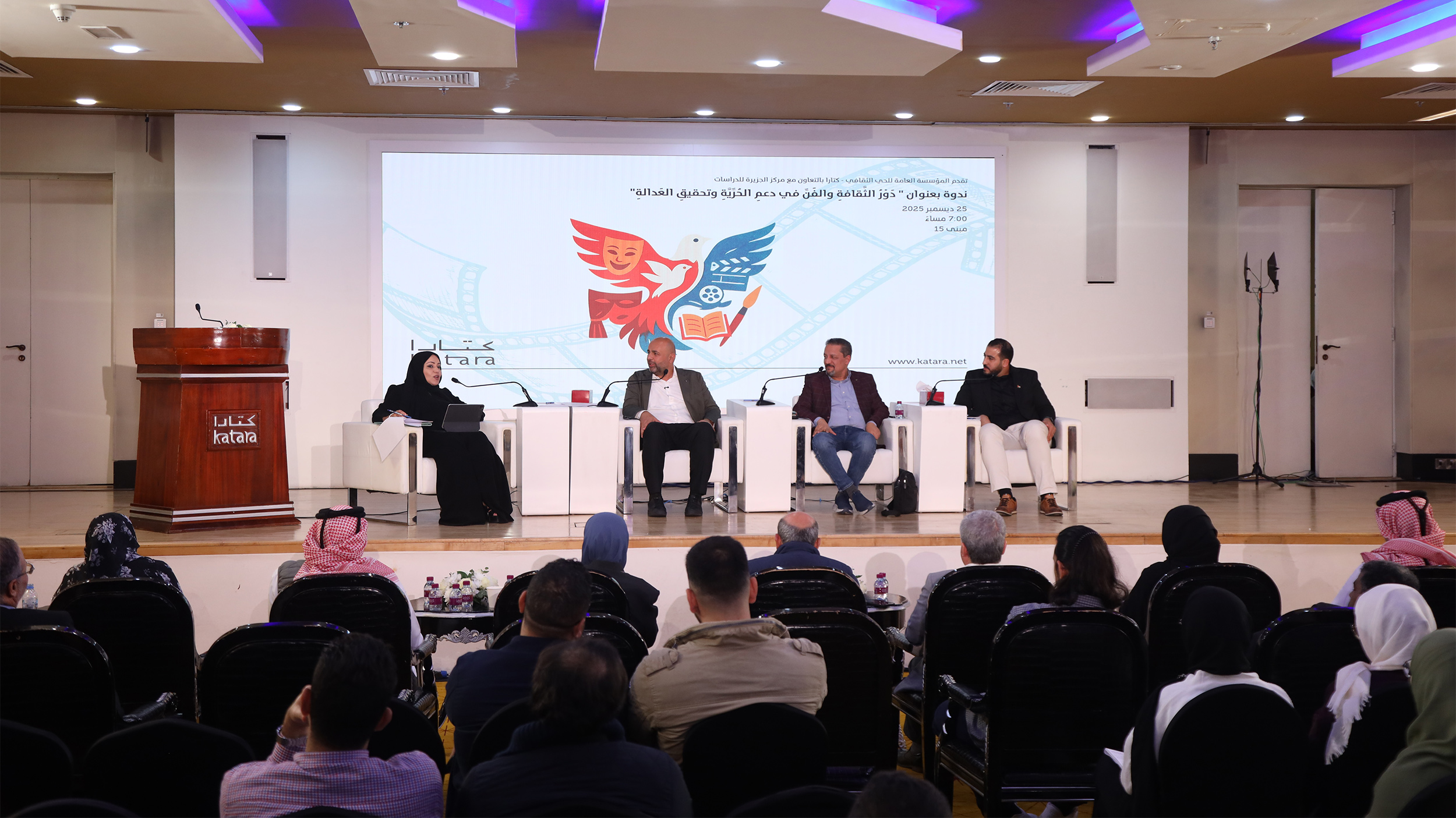
Al Jazeera Centre for Studies, in collaboration with the Cultural Village Foundation – Katara, hosted an extensive intellectual seminar on Thursday, 25 December 2025, titled “The Role of Culture and Art in Supporting Freedom and Achieving Justice”, featuring distinguished group of intellectuals, researchers and media professionals.
The seminar opened with an in-depth discussion of the struggle between competing narratives in a world where the voices of the Global North and South intertwine in a battle over meaning and influence. Speakers explored the role of culture and the arts as one of the most important arenas for expressing public concerns and as central tools for questioning reality and shaping awareness. Participants included Awad Joumaa, journalist, documentary filmmaker and researcher on issues of identity, memory and authority; Hussein Jelaad, poet, journalist and deputy editor-in-chief of Al Jazeera Net; and Mahmoud Hamed Al-Eila, poet and researcher specialising in conflict studies and humanitarian work.
The presentations emphasised that research, writing, media and artistic work represent intersecting paths in engaging with public issues. Research helps deconstruct language and question assumptions, media engages with reality and communicates with the public, while art opens symbolic avenues of expression that go beyond direct or factual representation. Participants highlighted that the essence of the struggle lies not only in events themselves, but in the narratives built around them, and in questions of who is believed first and who must provide proof, all within a context where politics permeates various aspects of life.
The seminar also addressed the role of artists, poets and filmmakers in expressing their issues and experiences. It was emphasised that these groups do not aim to achieve justice in a strictly legal sense, but rather contribute to establishing symbolic justice by expressing oppression, preserving memory, and transmitting human experiences to the public sphere. Speakers explained that a poet, for example, emerges from their environment, experiences, fears and challenges, and that creativity arises from the interplay of feelings of injustice, oppression or hope with cultural and human heritage, transforming moments of inspiration into poetry, film or narrative works that give individual experiences a collective dimension.
A significant portion of the seminar was devoted to the Palestinian cause as a concentrated example of narrative struggle. Participants discussed how the profound and ongoing sense of injustice, particularly in Gaza, has inspired artistic and literary creativity, transforming daily suffering into poetry, film and narratives that communicate the Palestinian experience to the world and help construct a narrative capable of confronting attempts at erasure and marginalisation.
Dr. Nadia Al Madhahka, Director of Research and Studies at Katara, noted that organising this event is part of an intellectual partnership with Al Jazeera Centre for Studies, aiming to promote cultural and intellectual development and strengthen societal awareness. She highlighted that the seminar’s title reflects the institutions’ belief in the pivotal role of culture, the arts and various means of expression in shaping awareness, building meaning and promoting values of freedom and human dignity, emphasising that culture and art are essential levers for addressing humanitarian issues and embedding justice in public consciousness.
The seminar reflects the institutions’ ongoing efforts to deepen discussion on the role of culture and the arts in supporting the values of freedom, justice and human dignity, and to highlight the ability of creativity to influence collective consciousness and craft an alternative humanitarian discourse in a time of competing narratives. The seminar was moderated by Mona Al Kuwari, consultant at Qatar’s Ministry of Education and Higher Education, and presented by Mostafa Ashoor, broadcaster at Al Jazeera Mubasher.