
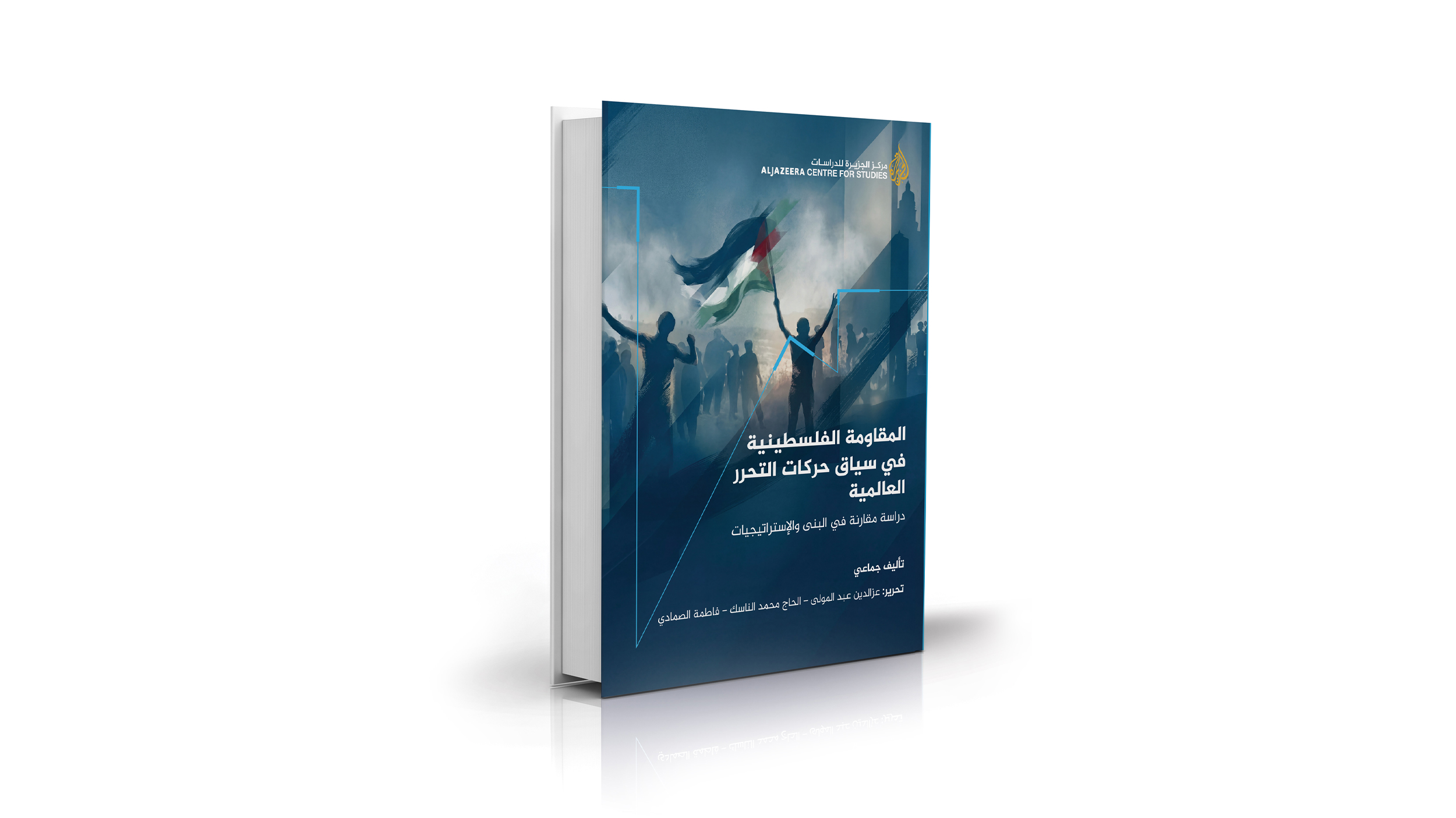
Al Jazeera Centre for Studies has published a new edited volume titled al-Muqawama al-Filastiniya fi Siyaq Harakat at-Tahrur al-‘Alamiya: Dirasa Muqarina fi al-Buna wa al-Istratijiyat [Palestinian Resistance in the Context of Global Liberation Movements: A Comparative Study of Structures and Strategies] supervised and edited by Ezzeddine Abdelmoula, Lhaj Mohamed Nacik and Fatima Alsmadi.
The book offers an in-depth analytical reading of Palestinian resistance within the broader framework of global liberation movements, using a comparative historical approach that connects the Palestinian experience with resistance movements in Asia, Africa and Latin America.
The volume begins from Tufan al-Aqsa, which it describes as a pivotal moment that brought the Palestinian issue back to the centre of global attention and influenced regional interactions as well as global geopolitical shifts, moving beyond reductive readings that detach the event from its extended historical roots. It also seeks to reintegrate Palestinian resistance into a global context linked to the history of anti-colonial liberation movements and resistance to settler colonialism and international domination.
The book relies on the method of comparative history as an analytical tool for understanding resistance phenomena across different contexts, by comparing social and political structures and struggle strategies in various experiences. It emphasises that the intellectual value of comparison does not lie in generalising similarities, but in revealing structural differences that explain the divergence of resistance trajectories according to historical and social contexts.
The book is divided into ten chapters covering various global liberation experiences. It examines the trajectory of Palestinian resistance from the era of Sheikh Izz ad-Din al-Qassam up to Tufan al-Aqsa, and discusses Palestinian resistance strategies in the recent war, as well as the symbolic and media dimension in the statements of the military spokesperson Abu Obaida.
It also presents comparative studies with resistance to European colonialism in the Americas, the Algerian revolution against French occupation, the rural resistance led by Abdelkrim El Khattabi, as well as the Vietnamese guerrilla warfare experience, South Africa’s struggle against apartheid, and independence movements in Latin America. This diversity aims to deconstruct patterns of colonialism and resistance and uncover similarities and differences in structures of conflict and liberation strategies.
The book argues that Palestinian resistance, despite its unique historical context tied to the nature of the Zionist settler-colonial project, falls within the broader context of global anti-colonial struggles. It shares dynamics of asymmetrical conflict, including the combination of armed struggle, mass mobilisation and external support, while being distinguished by the intensity of its symbolic and media presence in today’s global space.
It further examines the deep structure of settler colonialism, highlighting similarities between European colonial practices in the Americas, Africa and Asia and Israeli practices in Palestine—particularly land confiscation, population replacement, dismantling of indigenous society, and the use of systematic violence to reshape demographic and political space.
The book also discusses transformations in Palestinian resistance tools, whether military, media-related or moral, noting that the digital environment and modern communication tools have given the resistance greater capacity to produce narratives and shape global consciousness, making the “battle of image and meaning” a central component of contemporary conflict.
The study concludes that situating the Palestinian experience within global liberation movements enables a deeper understanding of the nature of the conflict and of the Palestinian cause’s position within ongoing transformations in the international system and the balance of power and legitimacy. It further argues that comparative analysis helps move beyond narrow readings and opens the way for a broader interpretive framework that understands resistance as a complex historical phenomenon transcending geography and local contexts.