
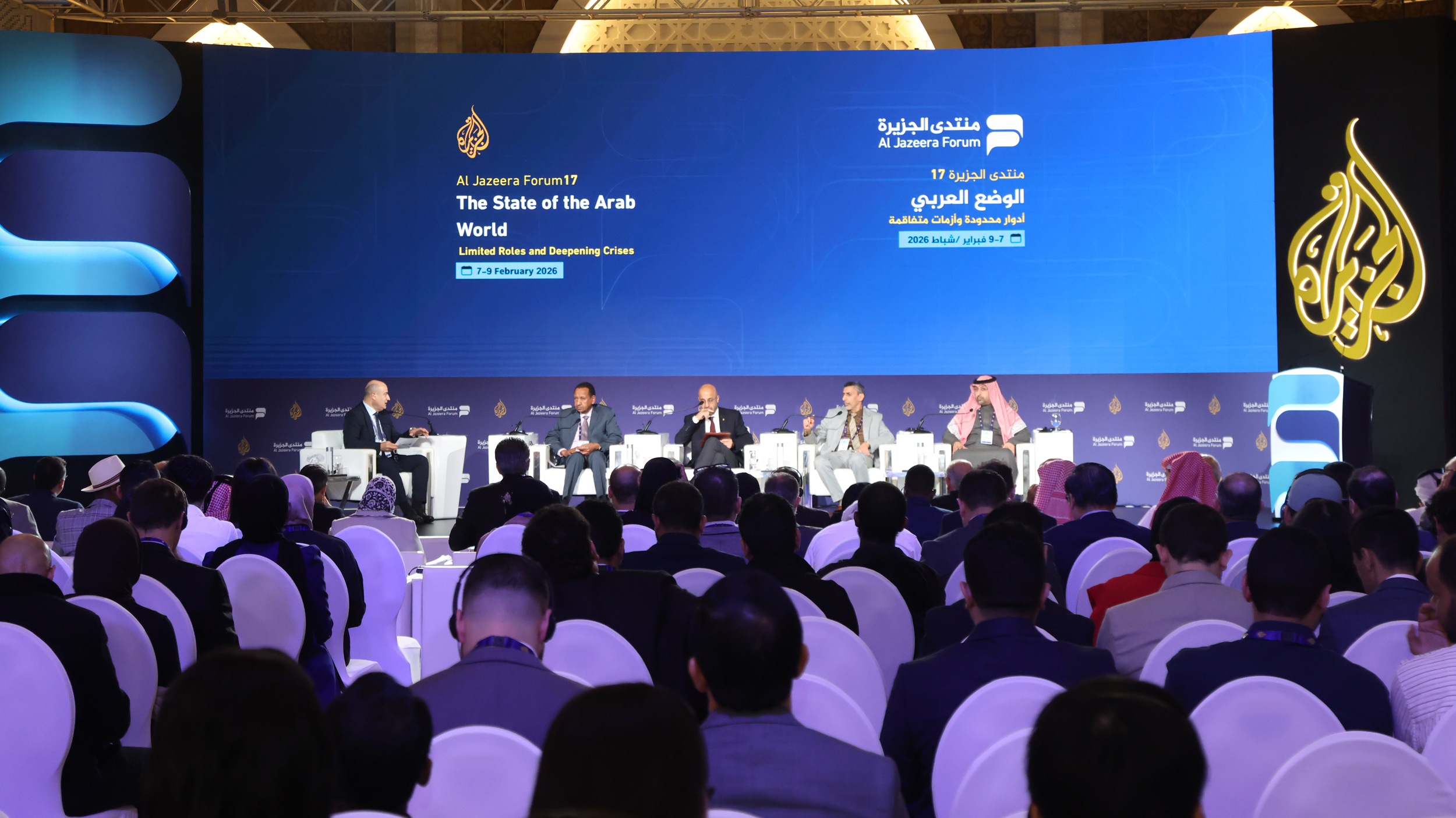
The 17th Al Jazeera Forum was held in Doha from 7 to 9 February 2026, with participation from a diverse group of policymakers, researchers, experts and media professionals. The forum focused on the Palestinian cause within the context of rapid regional and international transformations. Its sessions took place amid complex political and security developments that have reshaped regional priorities and sparked extensive discussions on the future of regional balances and the Middle East’s place in an evolving international system.
In his opening remarks, Sheikh Hamad bin Thamer Al Thani, Chairman of the Board of Al Jazeera Media Network, emphasised that the forum convened at a highly sensitive moment of accelerating regional and international changes. He noted that the forum’s theme reflects a new reality in which power intersects with law along shifting international trajectories. He highlighted that the forum’s value lies in its discussions of major issues with balanced perspectives, intellectual courage and integrity.
He touched on the transformations experienced by the Palestinian cause during the war on Gaza, describing it as a turning point amid attempts to reoccupy the Gaza Strip, displace its population, and annex what remains of the West Bank. He noted that the war brought the cause back to the forefront of global attention and sparked widespread solidarity, making recognition of the Palestinian state an increasingly prominent demand. He also affirmed that hosting the forum continues Al Jazeera’s mission to ensure access to knowledge and responsible debate, honouring the sacrifices of its correspondents who lost their lives while reporting the truth, and reaffirming the network’s commitment to its professional mission despite challenges.
Sheikh Nasser bin Faisal Al Thani, Director General of Al Jazeera Network, speaking through Mohammed Mukhtar Al Khalil, Director of Al Jazeera Centre for Studies, stated that the forum extends a path established by the network over more than three decades, positioning it as a platform for dialogue and a meeting point for policymakers and media figures. He emphasised that Al Jazeera was built on the principle of “opinion and counter-opinion”, valuing plurality and celebrating human cultures, while shaping editorial policies that uphold human dignity and recognise diverse perspectives. The 17th edition of the forum continues a tradition spanning more than two decades, bringing together researchers and decision-makers in a communicative space extending from television screens to digital platforms under the network’s unifying slogan.
He described the current international moment as a phase dominated by global instability, the dominance of power, and the weakening of rules governing international relations. He called for prioritising truth and reinforcing human values to prevent further wars and crises, stressing that humanity has historically overcome hardships by adhering to justice and rejecting the law of might. He concluded by affirming that Al Jazeera will continue its mission with professional rigour and thoughtful awareness, remaining a unifying platform for dialogue and diverse perspectives in a world undergoing profound change.
Somali President Hassan Sheikh Mohamud warned that the world faces a crossroads threatening the rules-based international order, with the resurgence of power politics and declining respect for international law. He linked developments in Gaza to the risks of global fragmentation, stressing that the absence of a just solution to the Palestinian question undermines international peace and security. He also highlighted the implications of regional moves in the Horn of Africa and the Red Sea, emphasising the need to protect state sovereignty and secure vital passages.
Iranian Foreign Minister Abbas Araghchi asserted that Palestine has become an ethical benchmark for the international system amid the erosion of international law and the rise of power politics. He argued that impunity and the normalisation of violence threaten the foundations of global justice and called for a coordinated strategy based on activating international legal mechanisms, imposing restrictions on military cooperation, and creating a political pathway to end the occupation.
Similarly, Burhanettin Duran, Head of the Directorate of Communications of the Republic of Türkiye, emphasised that the ongoing transformation goes beyond traditional power balances, targeting the very nature of conflict, as information warfare has become integral to confrontation. He noted that the post-war phase is as strategic as the war itself, and that Gaza and Syria illustrate conflicts that do not end with ceasefires but through the reconstruction of governance systems, infrastructure and political pathways.
Yemeni Deputy Foreign Minister Mustapha Ahmed Noman stressed that the region faces complex challenges requiring the restoration of state authority and institutions, warning of the risks posed by armed groups operating outside state control. He linked Yemen’s stability to restoring security, unifying military formations under a disciplined national doctrine, and ensuring the continuity of services and salaries, arguing that disarmament and adherence to the political process are prerequisites for any sustainable settlement.
Khaled Meshaal, Head of Hamas abroad, described the Palestinian people as facing a complex historical moment, noting that ending the war does not equate to ending the conflict. He affirmed that resistance is linked to the existence of occupation and declared the movement open to approaches based on political and security guarantees. He viewed thwarting displacement projects as a central achievement at this stage and called for leveraging international transformations to reaffirm the essence of the Palestinian cause as one of occupation and the right to self-determination.
Victor Gao, Vice President of the Center for China and Globalization, argued that the international system is at a historic turning point and that 2026 may mark the beginning of the end of unipolar dominance. He highlighted the limited prospects for economic decoupling from China given its industrial and economic weight and reaffirmed his country’s commitment to UN principles and international law, in contrast to the increasing use of unilateral sanctions outside legal frameworks.
Following these speeches, the forum moved into dedicated sessions addressing interconnected themes related to the Palestinian issue, regional transformations and the reshaping of the international system.
A key focus of the discussions was the political and legal trajectories of the Palestinian cause post-war. Gaza was examined as a focal point where the resistance project intersects with occupation plans and internationalisation proposals, with attention to ongoing challenges of displacement and geopolitical restructuring. Political initiatives, including the Trump peace plan, were analysed in terms of consistency with international law and the right to self-determination, amid continued occupation, settlement expansion and Palestinian division. Discussions also addressed accountability and the rule of law, highlighting the gap between clear facts and implementation, and stressing the need for legal tools to be accompanied by political will to consolidate the principle of accountability.
The sessions also explored regional transformations and shifts in regional power balances following the Gaza war, noting that declining Arab influence is linked to ongoing internal crises and economic and security fragility, underscoring the need to rebuild national institutions and develop more effective coordination mechanisms. The discussions concluded that the region is undergoing strategic repositioning, where security calculations intersect with broader international shifts.
On a broader scale, the sessions examined changes in the international system amid rising multipolarity and evolving competition patterns, emphasising the Middle East’s growing role in shaping global balances. The impact of the digital revolution on power redistribution was also explored, discussing how modern technologies reshape deterrence and dominance, with cyberspace emerging as a central arena in contemporary conflicts.
The forum also gave attention to the battle of narratives and influence in the digital environment, discussing the emergence of influencers and content creators as key actors in shaping public opinion, along with the associated professional and ethical challenges related to verification and trust-building. The effect of digital platforms and their algorithms on the public sphere was analysed, highlighting the importance of translating “digital sympathy” into tangible political and humanitarian impact.
Cultural and human rights dimensions were also highlighted. The film Madleen was screened, illustrating the use of AI techniques to reconstruct scenes lacking field coverage, prompting discussion on the limits of this type of documentation. The film The Last Doctor Standing was also shown, serving as a human testimony to the realities faced by medical teams amid the collapse of the healthcare system, examining the targeting of the health sector and the role of cinematic documentation in preserving memory and reinforcing accountability.
In his closing remarks, Dr. Al Khalil affirmed that the forum continues its long-standing tradition of providing a platform for dialogue that brings together researchers and policymakers, recognising diverse perspectives and celebrating differences. He described the current international moment as characterised by the dominance of power and weakening of the rules governing international relations, urging the use of thought and dialogue to prevent further wars and crises. He expressed confidence in humanity’s ability to overcome its challenges if truth, justice and human values are upheld, reaffirming the network’s ongoing professional mission and its commitment to remaining a unifying platform for dialogue and pluralism.