
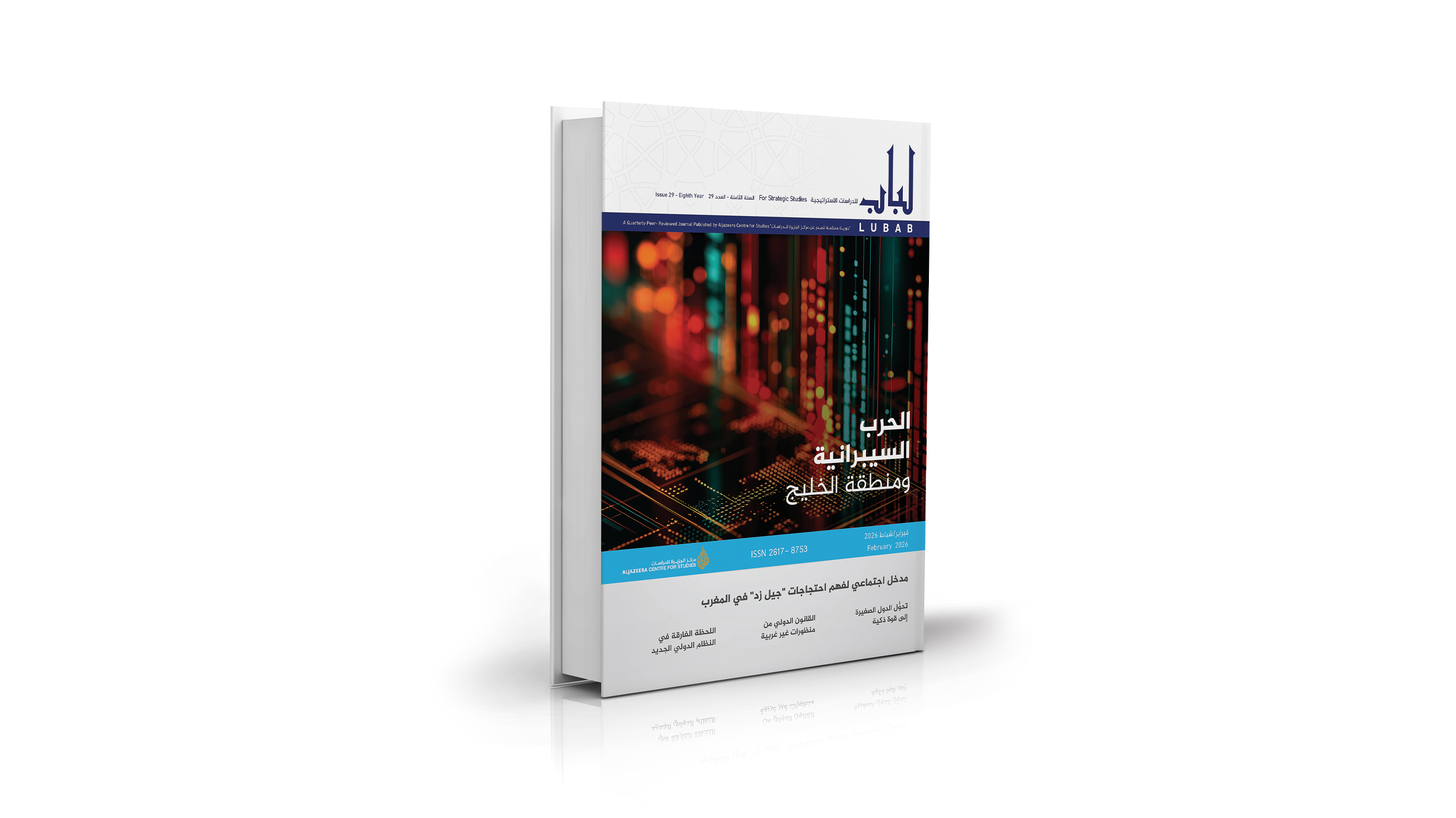
The 29th issue of Lubab Journal for Strategic Studies was released in early February 2026. It examines transformations in power, competition and protest within an emerging international system, against a backdrop of rapidly accelerating structural changes at the international, regional and national levels.
This issue analyses the state of structural fluidity currently shaping the international system and the disruptions accompanying it – most notably the instability of alliance patterns, shifting priorities among major powers, the widening strategic divide across the Atlantic, and the shrinking consensus between the United States and its traditional partners. These developments coincide with rising tensions in Washington’s relations with its immediate surroundings and deepening polarisation in US-China relations. At the same time, protracted regional crises in the Middle East and Africa persist, where armed conflicts intersect with political coups and entrenched structural fragility.
The issue adopts an analytical framework that traces the ongoing reconfiguration of the international system and the gradual redistribution of power and its instruments. It raises critical questions about the position of small and medium-sized states in a changing global landscape, the emergence of new threats linked to technology and cyberspace, and the capacity of the international legal system to keep pace with transformations that extend beyond the post–World War II order. It also examines the societal implications of these shifts, highlighting the rise of new forms of social action and protest led by younger generations employing digital tools and alternative modes of mobilisation.
The studies featured in this issue are organised around seven interrelated themes that collectively offer a comprehensive analytical picture of change in a world characterised by multiple centres of power and rapid transformation. The issue opens with a social approach to understanding Gen Z protests in Morocco, presented in the study, “A Social Approach to Understanding the Gen Z Protests in Morocco”. This study analyses protest activity from a social and generational perspective, viewing Gen Z as a new political actor emerging amid a crisis of institutional mediation. It emphasises this generation’s reliance on decentralised mobilisation and digital spaces, with a strong focus on social and service-related demands. The study concludes that the government’s approach, combining social containment policies with security control, has failed to produce sustainable institutional integration, while digitally driven protest remains likely to persist in flexible and evolving forms.
This social analysis is complemented by an institutional perspective examining the impact of electoral engineering on the reconfiguration of Morocco’s party system, through the study, “The Electoral System and the Reshaping of Morocco’s Party System: An Analytical Study of Influence Mechanisms and Electoral Outcomes”. The study demonstrates that legal amendments have contributed to the fragmentation of party representation and the redistribution of parliamentary seats, reshaping the balance of the legislative landscape. This process has deepened the crisis of political mediation between parties and society and weakened parties’ capacity to fulfil their representative roles, underscoring the need to link party system reform to the renewal of political roles, discourse and modes of engagement. Together, the two studies illustrate how transformations in political representation and the rise of protest outside traditional frameworks reflect a broader reconfiguration of state-society relations.
From internal social and institutional dynamics, the issue turns to cyber conflict as one of the most sensitive arenas of contemporary competition, explored in the study, “Cyber Warfare in the Age of Artificial Intelligence and Security Stakes in the Gulf”. The study highlights a qualitative shift in the nature of cyber conflict, showing how digital space has become an autonomous arena for threat production, defined by speed, complexity and concealment. It underscores the growing risks facing digital infrastructure, particularly in contexts heavily dependent on smart systems. In the Gulf region, the study notes that digital transformation in energy, smart cities, and the digital economy has generated new security challenges, necessitating comprehensive strategies that integrate legislative, institutional and cooperative dimensions, alongside sustained investment in specialised human capital.
Analysis of technological and security transformations leads to a reassessment of the concept of power within the international system, as addressed in the study, “Shifting from Small State to Smart Power: A Case Study of Singapore”. This study redefines power by emphasising a state’s position within regional and international networks rather than traditional metrics such as size or material resources. It illustrates how Singapore has built influential leverage by integrating education, governance, economic openness and diplomacy into a cohesive institutional framework, enabling it to play effective intermediary roles and strengthen its presence in decision-making circles. The study thus presents a model of smart power grounded in institutional efficiency and deliberate network design.
This discussion is further enriched by an epistemological inquiry into the foundations of international law, presented in the study, “International Law from Non-Western Perspectives: Epistemic and Contextual Approaches”. The study critiques the dominant epistemological underpinnings of international law, arguing that they reflect historical experiences and political contexts shaped by Western centrism. It calls for incorporating non-Western perspectives into legal interpretation by situating legal texts within their civilisational, social and historical contexts, thereby contributing to epistemic rebalancing and the development of legal norms more attuned to the realities of the Global South, particularly in matters of sovereignty, development and peoples’ rights.
Within the broader transformation of the international system, the issue examines the US withdrawal from Afghanistan in the study, “The American Withdrawal from Afghanistan and the Pivotal Moment in the New International Order”. The study interprets this event as a signal of shifting US strategic priorities and argues that it accelerated the emergence of a more multipolar international system. It highlights the growing roles of regional and international actors in strategic vacuums and the direct impact of the withdrawal on alliance credibility and deterrence dynamics, compelling small and medium-sized states to reassess their security strategies.
The issue concludes with an exploration of competition in postmodern geopolitics, presented in the Book Review section through a critical reading of Catapultas de la geopolítica posmoderna by Édgar Revéiz. This review deconstructs the concept of geopolitical competition in a global context marked by the erosion of traditional boundaries between war and peace, and between internal and external domains. It shows how contemporary geopolitics is increasingly shaped by control overflows, such as information, energy and capital, alongside territorial control, giving rise to new forms of indirect competition, including hybrid warfare, media influence and economic pressure.
Overall, the issue concludes that the world is undergoing a simultaneous redefinition of power, security, competition, protest and political representation. Understanding these shifts requires multidimensional analytical approaches that connect deep social transformations with network positioning and institutional efficiency. In this regard, the 29th issue of Lubab offers a significant scholarly contribution that engages with the formation of a new international system and its accelerating complexities.
The issue is available in Arabic here.