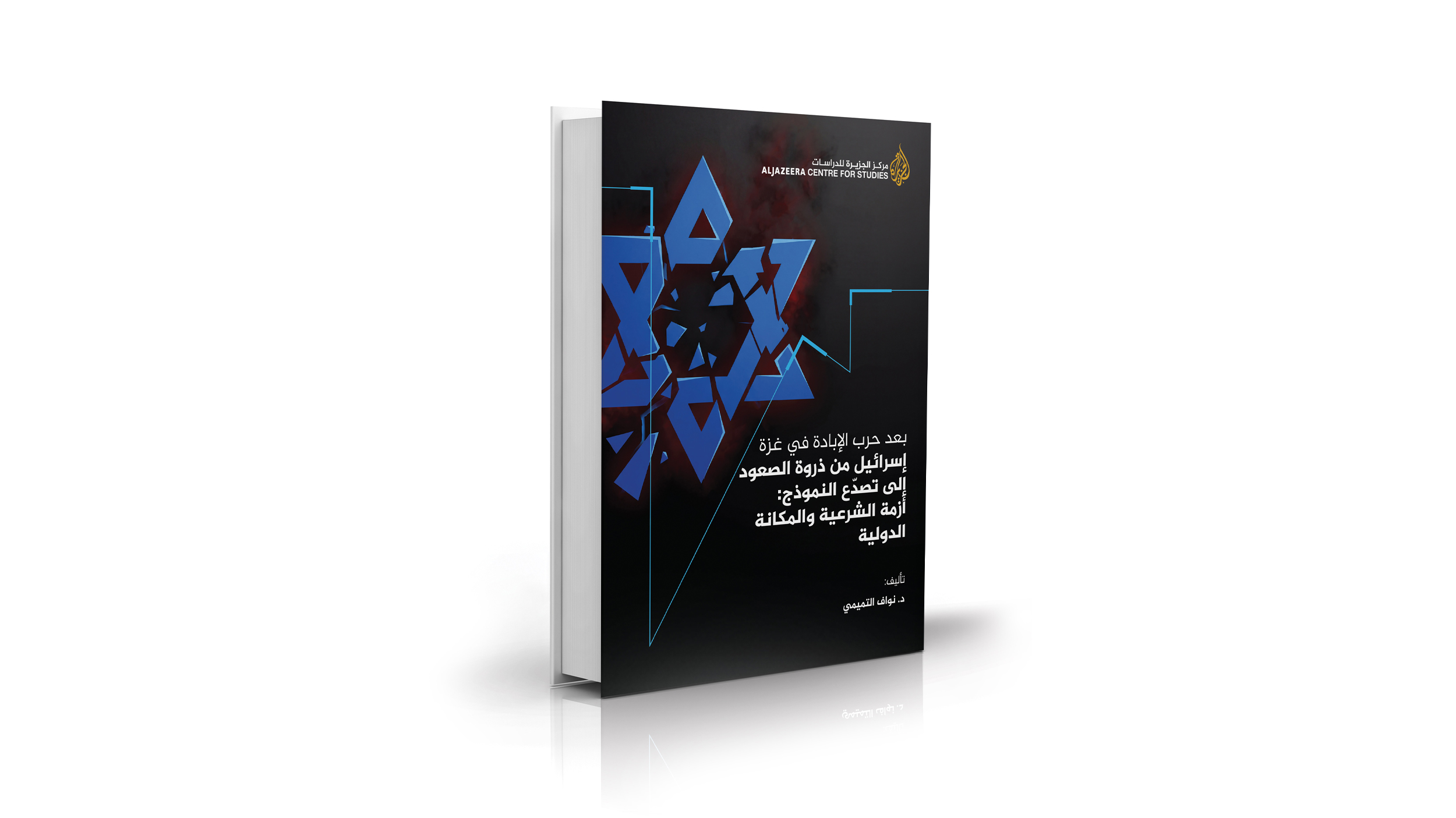
Al Jazeera Centre for Studies has published a new book titled Israel min Dhurwat as-Su‘ud ila Tasaddu‘ an-Namudhaj: Azmat ash-Shar‘iya wal-Makana ad-Dawliya ba’da Harb al-Ibada fi Ghazza [Israel: From Rising Power to a Fractured Model — The Crisis of Legitimacy and International Standing After the Gaza Genocide], by Nawaf al-Tamimi. The book offers an in-depth analytical reading of the transformations that have affected Israel’s image and international standing following the 2023–2025 war on the Gaza Strip. It presents this moment as a turning point that accelerated the erosion of Israel’s international legitimacy and the breakdown of the “Brand Israel” campaign, which since 2005 has aimed to present Israel as a modern, democratic global model state.
The book traces the formation of Israel’s international image from the early Zionist project, through the development of Zionist propaganda tools and Israeli public diplomacy, up to the structural exposure that followed the war on Gaza. The author argues that this phase redefined Israel’s position in the international system, shifting it gradually from a “morally shielded actor” to an “actor subject to international scrutiny and accountability”.
It further argues that the common Israeli interpretation—that Israel “won militarily but lost strategically”—hides a deeper flaw concerning the relationship between power and legitimacy. Military superiority, the book contends, is no longer sufficient to generate international acceptance or maintain status in a global environment that increasingly imposes stricter ethical and legal standards. The war on Gaza, it adds, exposed the limits of Israel’s ability to convert military dominance into lasting political influence or sustainable moral legitimacy.
The book is divided into three main sections. The first examines the conceptual and theoretical foundations of Israel’s national branding, including public sphere theory, opinion formation, and transformations in international status-building. The second addresses the institutional structure of the Zionist propaganda project, from early propaganda tools to the concept of “hasbara” (Israel’s strategic communication and public diplomacy system aimed at justifying policies and shaping global opinion), and finally the “Brand Israel” campaign and mechanisms for global image-making. The third focuses on the crisis of Israel’s national brand after 7 October 2023, and the resulting collapse of its image, legitimacy and ability to sustain its traditional narrative in Western discourse.
The book employs a structural analysis combining quantitative and qualitative approaches to study Israel’s national branding components, tracking changes in governance, moral legitimacy, economy, international relations, and cultural and media space. It concludes that what Israel is experiencing is not merely a passing media crisis or temporary image decline, but a structural fracture in the symbolic foundation of the state. This has reshaped global public perception of Israel from a “miracle state” to a “rogue settler-colonial state” subject to increasing moral and legal accountability.
It also examines shifts in the Western environment, particularly among younger generations, universities, and academic and human rights institutions. The war, it argues, has weakened the narrative immunity Israel long enjoyed in the West, prompting wide sectors to reassess the Zionist project through the lens of human rights, international law and settler colonialism. The author highlights the decisive role of the digital space and the information revolution in accelerating this shift by turning images of war and violations into an open digital memory that is difficult to contain or reframe.
The book revisits the concept of the “Iron Wall,” formulated by Zionist theorist Vladimir Jabotinsky, arguing that the Gaza war has created deep cracks in this model, which is based on deterrence and psychological and political resilience. The crisis, it suggests, is no longer about military capability itself, but about Israel’s ability to legitimise the use of force and convince the world of a moral and political horizon for its project.
A significant section is devoted to the question “What is to be done for Palestinians?”, proposing a strategic vision to transform the moral momentum generated by the war into long-term institutional pressure across legal, media, academic, economic and rights-based fields. It suggests reframing the conflict from a “security question” to a “legitimacy question”, increasing the cost of association with Israel politically, academically and economically, while investing in digital space and documenting violations in legally usable formats for international forums.
The book also discusses environmental, social and governance (ESG) risks, arguing that Israeli violations increasingly constitute institutional and investment risks for companies and states supporting Israel, in terms of reputation, legal compliance and sustainability standards. This opens the door to new forms of political and economic pressure beyond traditional boycott tools.
In conclusion, the book argues that the war on Gaza was not merely a military confrontation but a historical moment that brought the Palestinian issue back to the centre of global consciousness, exposing the limits of military power when separated from political and moral legitimacy. The post-war period, it suggests, is fundamentally different from what came before, both in Israel’s image and in global debates about the Zionist project and its place in the contemporary international order.