
Introduction
The issue of Syrian territorial unity is one of the most important priorities of the Syrian state, which inherited a fragmented geography following years of civil war. The Syrian Democratic Forces (SDF) have posed the most significant challenge to reunification efforts, maintaining separate administrative, military, and security structures from the Syrian state since 2015. Furthermore, the SDF has controlled some of Syria’s most strategically important regions in the north and east, which hold key resources such as oil, gas, and wheat, granting it a considerable degree of economic autonomy.
In the first year following the leadership change, the SDF approached Damascus as a counterpart—or even as an alternative—to the Syrian government. It emphasized its military’s inclusion of diverse Syrian factions and advanced its own constitutional vision, claiming to represent the demands of “Syrian minorities.” In this context, the SDF held a conference in Hasakah in August 2025 titled “Unifying the Position of the Components of Northern and Eastern Syria”. It also opened its ranks to former regime officers and wanted individuals who had fled from the coastal region. Throughout negotiations with Damascus, the SDF insisted that government forces remain out of areas under its control. (1)
Following the clashes between tribal and Druze factions in the Suwayda Governorate in July 2025, and the subsequent intervention of government forces, the SDF adopted an escalatory rhetoric against the Syrian government. Media and political figures close to the SDF emphasised the difficulty of dismantling of SDF forces and asserted that its weapons would remain to “defend” the Kurds.
The SDF adopted a hardline stance toward the Syrian government, particularly during the nearly ten-month negotiations on the implementation of the 10 March 2025, agreement, which stipulated its integration into the Syrian state. This approach ultimately led to military confrontation, beginning with attacks carried out by SDF-affiliated elements on government forces in Aleppo in early January 2026, later spreading to the Jazira region, the SDF’s main stronghold. As a result, relations between the two parties entered a new phase combining military pressure with negotiation.
This paper aims to analyse Damascus’s approach to the SDF as an entity demanding autonomy and refusing national reunification in accordance with the central government’s vision. It also seeks to assess the outcomes of nearly three weeks of military confrontations, their economic, political and security implications, their potential repercussions at the local, regional and international levels, and their expected effects on the process of state reconstruction.
First: The Outcome of Three Weeks of Military Confrontation
The recent confrontations between the Syrian government and the SDF, which lasted from 7 to 21 January 2026, unfolded in three phases. In the first phase, government forces succeeded in taking control of three neighbourhoods in Aleppo where the SDF had been deployed: Ashrafieh, Sheikh Maqsoud and Bani Zeid. Subsequently, government forces extended operations to Deir Hafer and the Tishreen Dam near Manbij, to eliminate SDF forces from Aleppo entirely, except for the area of Ayn al-Arab (Kobane), which remains under SDF control.
The second phase took the form of a tribal uprising in Raqqa and Deir Az Zor against SDF control. During the initial days of this uprising, government forces avoided direct intervention, particularly in areas east of the Euphrates River, which for years had served as a dividing line between areas of US influence and the rest of Syrian territory. (2)
The third phase began after tribal forces gained control over the entirety of the Raqqa and Deir Az Zor Governorates. Government forces moved east of the Euphrates and began to take over areas vacated by the SDF and entered the Al-Yaarubiyah crossing on the Iraqi border. At the same time, the government tightened the siege around the remaining SDF-controlled areas inhabited by hundreds of thousands of Kurds, including Qamishli, Darbasiyah, al-Malikiyah and certain neighbourhoods in the city of Hasakah, as well as Ayn al-Arab (Kobane) in the Aleppo countryside. However, these areas were not stormed, apparently in order to avoid providing the SDF with an opportunity to incite clashes under the pretext of defending Kurdish areas. The two sides then shifted to a phase of de-escalation without the declaration of a comprehensive ceasefire.
The Syrian government was able to fully secure the city of Aleppo by removing SDF elements from elevated neighbourhoods overlooking the rest of the city, such as Ashrafieh. This security operation was completed after government forces took control of Deir Hafer and Maskana, from which SDF drones had been launched to strike targets in Aleppo.
The government’s control over Raqqa and Deir Az Zor unified decision-making related to security under a single authority, thereby closing potential security gaps that could arise from poor coordination among multiple security actors. Furthermore, securing the Syrian-Iraqi border significantly reduced smuggling operations, including, at times, the trafficking of weapons.
At the political level, recent military operations eroded the legitimacy of the SDF. On the one hand, the Arab component withdrew and aligned itself with the government, as demonstrated by the clear rejection of SDF rule among local communities, particularly in Arab-majority areas. On the other hand, the SDF demonstrated its willingness to abandon one of its principal tasks under the international coalition, namely the protection of prisons holding former members or suspected affiliates of the Islamic States (IS). For instance, the SDF withdrew from Shaddadi prison in the countryside of Hasakah without coordination with coalition forces, leading to the escape of dozens of detainees, only some of whom were later recaptured by government forces. On 20 January 2026, US envoy Thomas Barrack announced the end of the SDF’s primary mission to combat ISIS. This development represents a form of political delegitimisation and signals a shift in the international coalition’s support away from the SDF toward the Syrian government, which is bolstering its international legitimacy through counterterrorism efforts. (3)
Economically, the Syrian government has achieved substantial gains through territorial expansion and restored control. These gains include the recovery of areas containing most of Syria’s oil and gas reserves, as well as major fields such as al-Hol, al-Omar, Conoco and al-Tanak. Conversely, the SDF has lost critical economic resources that, over nearly eleven years, had enabled it to consolidate its self-administration across an area estimated at roughly one quarter of Syrian territory and to finance volunteer expenditures within its ranks.
Second: Possible Implications of Developments between Damascus and the SDF
Recent developments between Damascus and the SDF are expected, in the short and medium terms, to produce a number of implications that can be categorised into three main levels.
On the domestic level, the military achievements of the Syrian government at the expense of the SDF have generated renewed popular momentum, similar to that experienced when the government led military operations to overthrow the Assad regime.
These achievements followed a period of increasing criticism of the government, particularly from Arab tribal communities, which accused it of excessive leniency in negotiations with the SDF at the expense of Arab populations living under SDF control. However, following the government’s takeover of Raqqa and Deir Az Zor, security and military recruitment centres recorded a significant increase in enlistment from local populations, reflecting growing public confidence in state institutions.
After demonstrating its ability to break the SDF’s intransigence and significantly undermine the project of “independent self-administration” through a combined political and military approach, expectations regarding the establishment of autonomous regions, previously advocated by Alawite and Druze actors linked to religious authorities such as Ghazal Ghazal and Hikmat al-Hijri, who participated in the SDF-sponsored Components Conference in August 2025, have likely diminished.
Military operations against the SDF generated heightened tensions within certain Syrian Kurdish circles, particularly due to SDF propaganda portraying the operations as collective attacks on Kurds. In response, the Syrian government sought to de-escalate tensions and limit the SDF’s ability to exploit them by issuing Decree No. 13 of 2026, which recognised the cultural and civil rights of the Kurdish component in Syria. This decree contributed to a more positive atmosphere among segments of Kurdish political forces and civil society, which interpreted it, along with government measures facilitating the return of displaced Kurds to areas they had left nearly eight years earlier, such as Afrin, as evidence of the government’s seriousness in rebuilding the Syrian state on inclusive foundations. (4)
In parallel, the government worked to enhance public reassurance by demonstrating concern for humanitarian consequences during its military operations. It opened safe corridors for civilians to evacuate conflict zones and provided shelter for displaced populations, as seen in the accommodation of residents from Ashrafieh and Sheikh Maqsoud in shelters in the Afrin area, followed by their facilitated return after the conclusion of operations. This approach conveyed an image of ongoing institutional development within the military and security apparatuses, marked by stronger central control and a reduction in violations during operations. This stands in contrast to the situation in Suwayda Governorate in mid-2025, where violations occurred following the entry of newly integrated factions and irregular tribal forces. (5)
On the regional level, the SDF possesses regional extensions, given that the People’s Protection Units (YPG), the dominant Kurdish component within the SDF, maintains ideological and political ties with Kurdish parties in neighbouring countries, particularly Iraq and Turkey. This regional dimension is further reinforced by the fact that many of the unit’s leaders are originally affiliated with the Kurdistan Workers’ Party (PKK). These links became evident following the outbreak of confrontations with the Syrian government, as the Kurdistan Democratic Party (KDP), which governs the Kurdistan Region of Iraq, intervened to sponsor mediation efforts. In parallel, both the PKK and the Patriotic Union of Kurdistan (PUK) encouraged their affiliates to fight alongside the YPG, while a delegation from Turkey’s Peoples’ Equality and Democracy Party (DEM Party) visited Syria. (6)
The YPG’s loss of oil and gas revenues, previously generated from sales either to Syria or to entities within the Kurdistan Region of Iraq, has reduced its capacity to finance the PKK, which had benefited from a portion of these funds. Moreover, the Syrian government’s control over much of the Iraqi border has disrupted communication between the YPG and PKK strongholds in the Sinjar region, weakening the party’s position and limiting the room for manoeuvre of leaders opposed to a political settlement led by the imprisoned PKK leader Abdullah Öcalan.
These developments have expanded regional involvement, particularly Turkey’s, due to concerns over border security. This coincides with repeated attempts by PKK-linked actors to link the fate of Turkey’s domestic peace process, initiated in early 2025, to developments in northern and eastern Syria, using the SDF issue as leverage against Ankara.
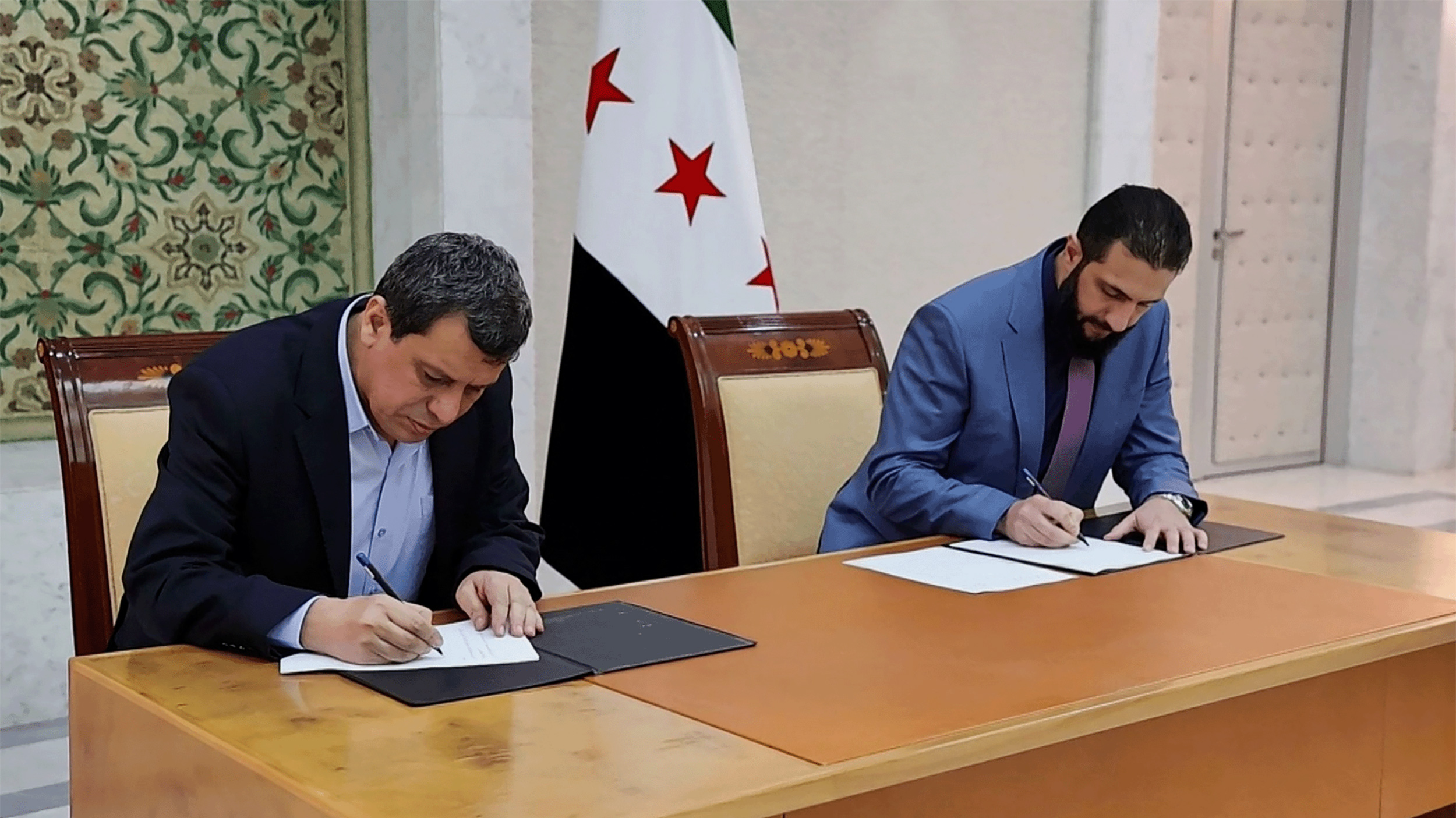
Additionally, the Kurdistan Regional Government (KRG) became involved the Syrian issue by leveraging its relations with the United States and the Syrian government’s openness to mediation by a Kurdish party not affiliated with the PKK’s hardline movement. This enabled Erbil to sponsor mediation between Damascus and the SDF and to host talks involving Barrack and SDF commander Mazloum Abdi, culminating in an 18 January 2026 agreement that included a ceasefire and provisions outlining mechanisms for SDF integration into the Syrian state.
Moreover, the deployment of Syrian government forces to the Iraqi border appears to have influenced, to some extent, the Iran-backed Iraqi Coordination Framework’s decision to nominate Nouri al-Maliki for premiership as a “hawkish” option. This reflects concerns among Iranian and Iraqi Shiite actors over the shifting balance of influence amid accelerating regional changes, including the consolidation of Syrian government control under an Islamist-oriented leadership aligned with a Turkish-Arab axis and the strengthening of ties with the Trump administration. These concerns are further heightened by the potential impact of such changes on Iraq’s internal dynamics, particularly among Sunni political and tribal forces recently organised within the National Political Council.
It is also likely that the erosion of the SDF and its loss of US political cover will diminish Israel’s interest in investing in the group, especially following months of indirect signalling and the SDF’s overt appeals for Israeli support.
On the international level, international repercussions quickly followed developments in northeastern Syria, most notably a significant decline in US support for the SDF alongside clear indications of growing confidence in the Syrian government. This shift is attributable to the SDF’s conduct during negotiations, its failure to implement US-brokered integration agreements, and its reduced commitment to securing detention facilities holding IS fighters.
US forces have already begun transferring IS detainees to Iraq, amid reports that Washington is considering a full military withdrawal from Syria. Consequently, the United States may limit its role to security coordination with the Syrian government through advisers, rather than maintaining a direct military presence. (7)
The Syrian government’s control over most of the country, except for a small enclave in the Aleppo countryside and a narrow strip in Hasakah, has also prompted Russia to reassess the viability of maintaining its base in Qamishli under SDF control. The transfer of personnel from that base to Khmeimim Air Base, under government control, has reportedly begun.
Third: The Future of the SDF Issue and Its Impact on State Reconstruction
Based on current internal and external indicators, it is no longer feasible for the SDF to continue operating under its previous exceptional status within the Syrian state. The group has lost extensive territory and international legitimacy as a counterterrorism actor, and cannot indefinitely rely on cross-border Kurdish support, as such ties also invite increased political, security and military backing for the Syrian government from regional and international actors concerned about the activities of these parties.
The international community broadly supports the integration of the SDF into the Syrian state, including countries that maintain relatively positive relations with the group, such as France, which has recently emphasised the necessity of Kurdish integration within Syria.
Accordingly, the SDF appears to face a decisive juncture: integration into the Syrian state under an acceptable formula for all parties, whether through negotiation or following further military pressure that would compel concessions and the abandonment of demands for an ethnically based self-administration or decentralisation.
The government is likely to continue pursuing an inclusive approach that recognises the particularities of Syria’s components, as demonstrated by Decree No. 13. This may include allowing Kurdish participation in local governance in areas where they constitute a demographic majority and entrusting security responsibilities to Kurdish personnel, provided this occurs under the authority of the central state and does not result in independent administrative or security structures.
The mechanism employed by the government in addressing the issue of the SDF, i.e. allowing local participation while maintaining central authority, is likely to be replicated as a model for resolving other outstanding issues, such as the situation in the Suwayda governorate. In this sense, the SDF case may establish a framework for decentralised administrative governance that accommodates local participation without undermining state unity, thereby enhancing domestic and international confidence in the government’s capacity to manage the country. This approach is reinforced by the government’s demonstrated reluctance to engage in direct confrontation with Kurdish communities, its emphasis on civilian protection, and its efforts to evacuate populations and open humanitarian corridors prior to military operations.
Conclusion
Throughout months of negotiations, the Syrian government demonstrated a degree of flexibility aligned with internationally mediated political solutions, subsequently reinforcing this approach through disciplined conduct during military operations in Aleppo and humanitarian assistance to displaced Kurds from Ashrafieh and Sheikh Maqsoud. This contributed to projecting an image of a government capable of managing a diverse society.
Conversely, the broad participation of Arab tribes in the uprising against the SDF in Raqqa and Deir az Zor highlighted widespread dissatisfaction with the group’s governance of multi-ethnic areas. The confrontations also exposed SDF involvement in abuses against Arab populations, extrajudicial killings of former detainees, and the detention of minors with no links to IS. These factors influenced the US position and undermined confidence in the viability of continued support for the SDF outside the framework of the Syrian state.
Although the YPG retains limited territorial control, it has effectively lost the broader SDF umbrella through which it portrayed itself as a multi-component force. This has reinforced the ethnic dimension of the YPG’s approach, particularly as the SDF has increasingly relied on PKK support, including the deployment of fighters from Iraq. As a result, the YPG has effectively confirmed its association with an organisation listed internationally as “terrorist” after years of denial.
Finally, recent developments underscore the consensus among influential international actors on preserving Syrian territorial integrity, regardless of the administrative mechanisms ultimately adopted. The successful integration of the Kurdish component into the Syrian state could pave the way for addressing remaining unresolved issues, including that of the Suwayda Governorate.
- Mounir Rabie, “كواليس ما قبل وبعد اتفاق الشرع-عبدي.. وانهياره [Behind the scenes before and after the al-Sharaa–Abdi agreement and its collapse]”, Al Modon, 20 January 2026, https://h7.cl/1iwPG (accessed 25 January 2026).
- “المتحدث باسم الداخلية للإخبارية: انتفاضة العشائر سرّعت عملية التحرير بالرقة ودير الزور [Syrian Interior Ministry spokesperson: The tribal uprising accelerated the liberation process in Raqqa and Deir Az Zor]”, Al Ikhbariah, 20 January 2026, https://h7.cl/1iwY9 (accessed 25 January 2026).
- Laith Al-Jnaidi, “واشنطن: مهمة "قسد" انتهت والحكومة السورية مستعدة لتولي الأمن [Washington: The SDF’s mission is over and the Syrian government is ready to take on security]”, Anadolu Agency, 20 January 2026, https://h7.cl/1nx44 (accessed 25 January 2026).
- “المجلس الوطني الكوردي: مرسوم الشرع حجر أساس لبناء سوريا ديمقراطية لامركزية وإنهاء عقود من المظالم [Kurdish National Council: The al-Shara Decree is a cornerstone for building a democratic, decentralised Syria and ending decades of injustices]”, Kurdistan 24, 18 January 2026, https://h7.cl/1ix4C (accessed 26 January 2026).
- “عودة آخر العائلات إلى الأشرفية والشيخ مقصود بعد إغلاق آخر مركز إيواء بحلب [Last families return to Ashrafieh and Sheikh Maqsoud following the closure of the final shelter in Aleppo]”, Syrian Arab News Agency (SANA), 14 January 2026, https://h7.cl/1nx6O (accessed 26 January 2026).
- “وصول عناصر من "بي كي كي" إلى الحسكة لمؤازرة “قسد” [Arrival of PKK members in Hasakah to support the SDF]”, Al Khabour, 25 January 2026, https://h7.cl/1nx7S (accessed 26 January 2026).
- واشنطن تدرس انسحابا عسكريا كاملا من سوريا بعد انهيار "قسد" [Washington considers full military withdrawal from Syria following the collapse of the SDF], Al Jazeera, 23 January 2026, https://h7.cl/1nx9Q (accessed 26 January 2026).