
The US–Israeli military campaign launched against Iran on 28 February 2026 produced a range of unexpected consequences for regional security and alliance structures. As US and Israeli air strikes targeted significant civilian and military infrastructure inside Iran, Tehran retaliated against the Gulf states. (1) The attacks came as a major shock to Gulf governments, many of which had long assumed they were insulated from direct attacks threatening their territorial security and national unity.
The second major consequence of the crisis was economic. The temporary closure of the Strait of Hormuz, first by Iran and later through a United States naval blockade, triggered one of the most severe global economic disruptions in recent history. The resulting insecurity created widespread instability across Gulf cities, leading to a mass exodus of tourists and large numbers of expatriates. Beyond these immediate effects, the perceived inaction of the United States — long regarded as the principal security guarantor for many Gulf states — marked a critical turning point. It shifted the regional balance of power and undermined the strategic logic that had shaped Middle Eastern security arrangements for nearly fifty-five years.
What made this moment strategically significant was what it revealed about the architecture of Middle Eastern security, which had been quietly deteriorating for years. Gulf states had long felt relatively secure from direct Iranian attacks. Many pursued cautious foreign policies aimed at reducing tensions while simultaneously decreasing their dependence on the United States for security protection. Following the 2019 Abqaiq-Khurais attacks, Saudi Arabia and other Gulf countries had already begun questioning the reliability of US security guarantees. The events that unfolded after October 2023, and especially after 28 February 2026, deepened these concerns further.
When Iranian missiles struck Saudi energy infrastructure, US military bases in Bahrain, and Qatar’s Ras Laffan gas facilities, Gulf governments expected protection from the United States and its Western allies. This protection did not materialize. (2) As a result, the attacks undermined long-standing confidence in the regional security architecture. (3)
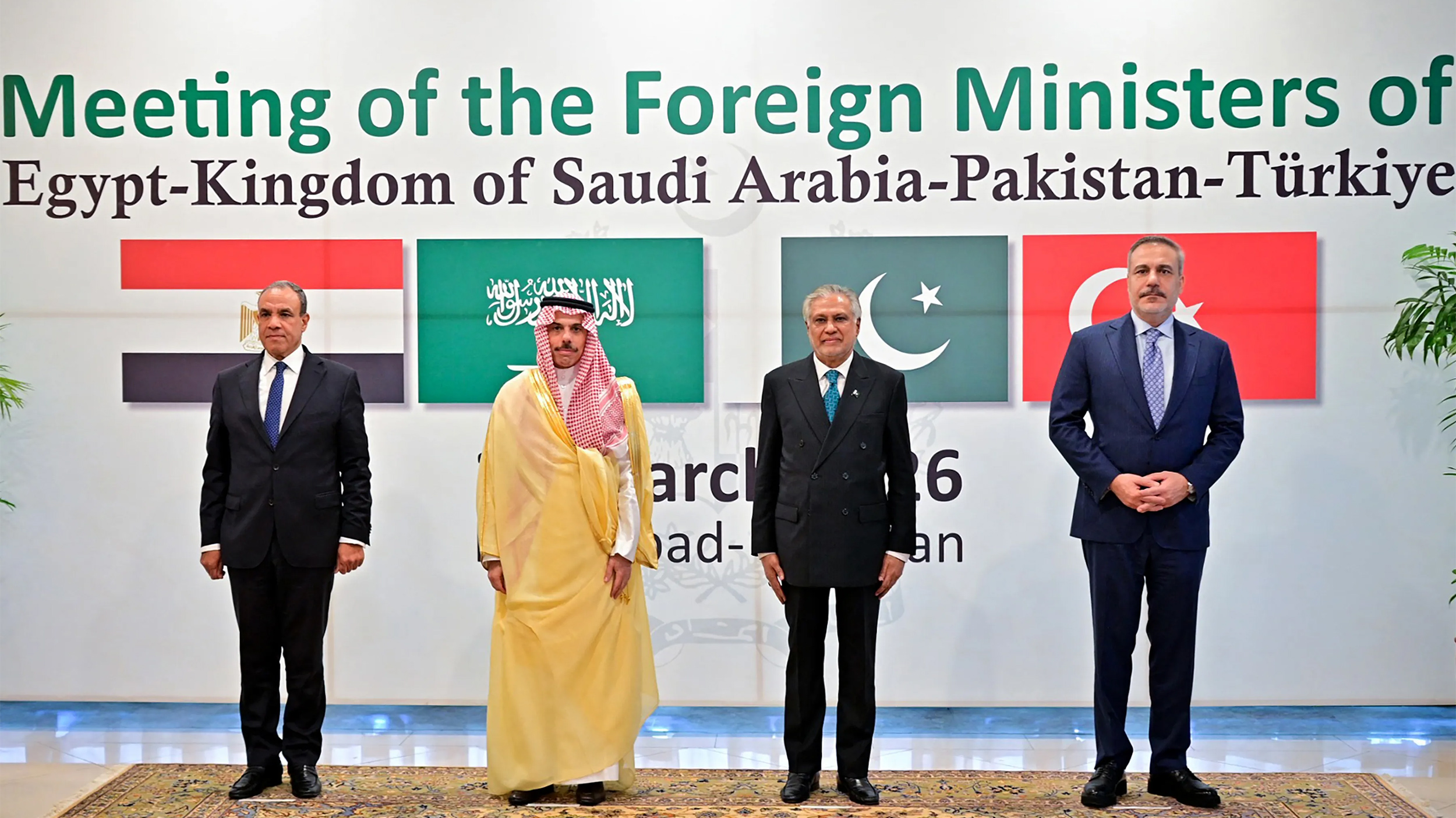
Amid this growing uncertainty, the idea of a new regional security collaboration began to emerge. On 19 March 2026, the foreign ministers of Türkiye, Pakistan, Saudi Arabia, and Egypt met in Riyadh during an Islamic summit. (4) During the meeting, they discussed the possibility of combining their capabilities within a joint security framework. (5) The meeting represented an early step toward the creation of a new regional security platform centred on cooperation and stability. Prior to this, Saudi Arabia and Pakistan had already signed a Strategic Mutual Defence Agreement in September 2025. (6) Meanwhile, Türkiye and Saudi Arabia had been steadily improving relations since 2022, including cooperation in the defence sector. (7) A similar rapprochement had also been taking shape between Ankara and Cairo after a decade of strained relations.
As the regional security order undergoes fundamental reassessment, this initiative points toward a future in which US strategic primacy is increasingly contested.. Yet an important question remains: is this emerging cooperation the foundation of a lasting regional order, or merely a temporary response to crisis?
The answer will depend less on diplomatic goodwill than on whether these four countries can manage the structural contradictions that undermined previous attempts at regional security cooperation, and whether the current crisis generates enough sustained pressure to keep them aligned once the immediate threat subsides.
The Crisis of Existing Security Frameworks
The emerging security alignment among Türkiye, Pakistan, Saudi Arabia and Egypt reflects a broader and more complex transformation in the Middle Eastern regional order. The growing perception that existing external security guarantees have become increasingly unreliable has encouraged regional actors to reassess their strategic dependencies. (8) This shift is closely tied to the political experiences of the past decade, which have exposed the limitations of externally provided security frameworks. As a result, new forms of cooperation are emerging, driven less by ideological alignment than by pragmatic security concerns and the pursuit of greater strategic autonomy within an evolving international system.
Existing security architectures, both Western and regional, have failed to adapt to the region’s changing threat environment. (9) Although NATO has never served as a formal security provider in the Middle East, its broader strategic posture — particularly through US-led deterrence and partnership frameworks — has long been perceived by regional actors as an important source of stability. Over time, however, patterns of selective engagement and inconsistent intervention have generated increasing uncertainty rather than reassurance.
The 28 February attacks on Iran reinforced this perception. The United States initiated military action that exposed its Gulf partners to retaliation, yet its subsequent response was widely viewed in the region as insufficient to absorb the resulting security costs. In this context, the US-led attacks emerged as a central factor contributing to the destabilisation of the Gulf states in the post–28 February period.
At the same time, regional institutions demonstrated only limited capacity to respond effectively to escalating crises. Organisations such as the Arab League, (10) the Gulf Cooperation Council (GCC) (11) and the Organisation of Islamic Cooperation continue to face structural constraints that hinder collective decision-making. Within 24 hours of the 28 February attacks, the GCC convened an emergency extraordinary session via videoconference. However, the meeting suffered from limited high-level participation and produced little beyond a condemnatory communiqué without any enforcement mechanism. (12)
Reliance on consensus-based procedures has frequently resulted in delayed or constrained responses, particularly during major conflicts in Syria, Yemen, Libya, Sudan and most recently the Gulf. In many cases, their interventions have remained confined to political statements lacking implementation capacity. For example, the Arab League’s response to the Iranian attacks against the Gulf states amounted only to a communiqué. These organisations were designed primarily for diplomatic coordination rather than collective defence, and the gap between those two functions became especially visible in the weeks following 28 February.
Compounding these challenges, strategic competition among the United States, China and Russia across the Middle East has produced interference without stability. Rather than resolving conflicts, each power has often reinforced existing regional divisions through overlapping and contradictory spheres of influence. For regional states, this increasingly multipolar environment has made external alignment less a guarantee of security than a source of additional strategic entanglement.
Rather than constituting a rigid alliance system, the emerging quadrilateral framework appears to function as a pragmatic coordination mechanism, allowing participating states to preserve strategic autonomy while selectively deepening cooperation in areas of shared interest. Such arrangements reflect a broader trend toward flexible multipolar regionalism, in which states prioritise issue-based collaboration over formal bloc politics. The real test of this framework, however, will come not during moments of crisis but after them — particularly if Saudi and Pakistani threat perceptions diverge once the immediate external pressure subsides.
Türkiye occupies a central and increasingly multidimensional role within this emerging framework. Over the past two decades, it has significantly expanded its defence capabilities by developing indigenous systems in areas such as drone technology and naval production. (13) At the same time, Türkiye’s NATO membership introduces an additional layer of strategic complexity, requiring Ankara to balance alliance commitments with independent regional engagement.
Recent geopolitical developments — including the consolidation of a national government in Syria and evolving energy and connectivity initiatives such as the Development Road linking Iraq and Türkiye — have further strengthened Ankara’s position as a strategic transit hub connecting Europe, Asia and the Middle East. (14) This dual positioning enables Türkiye to engage simultaneously with Western institutions and regional partnerships in a calibrated and pragmatic manner.
Saudi Arabia, meanwhile, is undergoing a significant recalibration of both its domestic and foreign policy orientation. As part of its broader transformation agenda, Riyadh has increasingly sought to diversify its security partnerships and reduce its overdependence on traditional external guarantors, particularly the United States. Recent regional tensions and perceived shortcomings in external security responses have accelerated the reassessment of Saudi defence strategy. (15)
This shift has encouraged deeper cooperation with regional actors such as Türkiye, Pakistan and Egypt. The Saudi-Pakistani Strategic Mutual Defence Agreement signed in September 2025 (16) — the first formal bilateral defence pact Riyadh concluded outside its traditional Western security relationships — represents the clearest institutional expression of this recalibration. It suggests that Saudi Arabia’s diversification strategy has moved beyond rhetoric into the realm of concrete security architecture. Rather than replacing existing partnerships, however, this approach seeks to hedge against strategic uncertainty through a more diversified security portfolio aligned with long-term national objectives.
Pakistan contributes substantial military capabilities, including nuclear deterrence, as well as extensive operational experience, joint production initiatives, technology transfers, and expanding diplomatic engagement across the Islamic world. Pakistan’s deployment of military trainers to Saudi Arabia — formalised through bilateral arrangements predating the September 2025 defence agreement — demonstrates that this cooperation rests on operational foundations rather than symbolic declarations alone. Its growing defence cooperation with Saudi Arabia and Türkiye further underscores Islamabad’s emerging role as both a security and diplomatic actor. (17)
At the same time, Pakistan’s ability to maintain functional relations with diverse regional and global powers positions it as a potential bridge-builder capable of facilitating dialogue and reducing tensions in an increasingly fragmented geopolitical environment.
Egypt, by contrast, approaches the emerging framework more cautiously and from a structurally grounded perspective shaped by its demographic weight, military capacity and control of the Suez Canal. This geographic advantage provides the alignment with something no other member can offer: influence over one of the world’s most critical maritime chokepoints. Cairo’s participation therefore signals to external powers that the framework possesses genuine geostrategic significance. (18)
Egypt’s gradual normalisation of relations with Türkiye — driven by converging interests in regional stability and expanding economic ties — has removed one of the principal fault lines that previously undermined cooperation among potential regional partners. (19) This rapprochement has created an important diplomatic foundation upon which a broader security alignment can now be built. Beyond their bilateral normalisation, Türkiye, Egypt and Pakistan collectively provide the framework with its strongest mediation capacity. Ankara’s established channels with multiple regional actors, Cairo’s historical role as an Arab interlocutor, and Islamabad’s involvement in US-Iran mediation efforts together create complementary diplomatic tools that give the alignment conflict-management potential extending beyond its immediate security objectives.
Converging Interests and Emerging Contradictions
The emerging discussion surrounding a quadrilateral security framework involving Türkiye, Pakistan, Saudi Arabia and Egypt is largely driven by converging interests shaped by intensifying regional instability and the perceived inadequacy of existing security mechanisms. Since 28 February 2026, disruptions and deliberate blockades affecting the Strait of Hormuz have exposed the fragility of regional trade and energy routes, producing immediate consequences for both producer and transit states. Egypt’s Suez Canal revenues — already reduced to approximately $7.2 billion during the 2023–2024 fiscal year following disruptions in Red Sea shipping — came under renewed pressure as insurers redirected cargo away from the Eastern Mediterranean corridor.
Pakistan’s already fragile economy faced additional strain from rising energy costs, while Saudi Arabia’s critical infrastructure became increasingly exposed to direct security threats, reinforcing perceptions of vulnerability. For Türkiye, strategic connectivity initiatives depend heavily on stable transport corridors linking Asia and Europe, making regional instability a direct obstacle to long-term economic and geopolitical planning. (20) At the same time, growing doubts regarding the reliability of traditional external security guarantees — particularly those associated with the United States — have encouraged regional actors to search for more autonomous and regionally grounded arrangements.
Another major driver behind the emerging alignment is the accumulation of security concerns both before and after 28 February, which forced Gulf states to confront the reality that Washington was unwilling or unable to absorb security costs on their behalf. The attacks of 28 February accelerated a crisis of confidence that had already been developing for years. (21) Since at least the 2003 invasion of Iraq, and more visibly after the limited US response to the 2019 Abqaiq-Khurais attacks, regional actors had gradually begun reconsidering their expectations regarding the scope and reliability of American security commitments.
Mistrust toward the United States deepened further as many regional actors came to view Washington’s responses to regional crises as inconsistent, selective or insufficiently deterrent. Simultaneously, the expansion of Israeli military operations across the region — particularly after 7 October 2023 — contributed to a broader sense of insecurity and reinforced perceptions that regional power balances were becoming increasingly volatile and unpredictable.
The perceived weakening of international law and the declining effectiveness of multilateral institutions further intensified the search for alternative security arrangements. The rules-based international order — to the extent that it ever constrained conflict in the Middle East — is now increasingly disregarded by both regional and global actors when politically inconvenient. (22) Consequently, the push for closer regional coordination is driven not only by material security concerns, but also by the broader erosion of trust in international governance structures previously expected to provide stability and predictability.
Despite these converging interests, the transformation of this alignment into a coherent and sustainable security architecture remains constrained by several structural and political contradictions. One of the most important challenges concerns historical precedent, particularly earlier attempts at regional security cooperation such as the Baghdad Pact, which included both Türkiye and Pakistan but ultimately failed to sustain meaningful collective action. When Pakistan confronted India militarily in 1965 and 1971, its Pact partners provided little meaningful support. Similar concerns continue to shape contemporary regional calculations.
In the current context, diverging threat perceptions among the proposed members remain a major obstacle. Saudi Arabia continues to view Iran as its principal regional security challenge, (23) whereas Pakistan maintains a pragmatic and functional relationship with Tehran. Islamabad’s border-security coordination, trade relations and counterterrorism cooperation with Iran make any explicitly anti-Iranian collective deterrence posture structurally problematic from Pakistan’s perspective. (24)
This divergence became particularly visible following Iranian strikes on Saudi territory in early 2026, when Pakistan refrained from any direct military response despite existing defence agreements. Such asymmetry highlights a deeper strategic dilemma: in any future escalation involving Iran, Pakistan would likely face an extremely difficult choice between its Gulf partnerships and the imperatives of stability along its western border. At present, the emerging framework offers few mechanisms capable of resolving this contradiction in advance.
Beyond differing threat perceptions, broader political and institutional differences further complicate the prospects for sustained cooperation. The four countries operate under distinct governance models and strategic cultures, which inevitably shape their foreign-policy priorities and decision-making processes. Türkiye appears to favour a flexible, issue-based framework centred on defence coordination, intelligence sharing and military training cooperation. Saudi Arabia, meanwhile, seeks to diversify its strategic partnerships without fully abandoning its longstanding relationship with the United States. Egypt maintains a cautious and stability-oriented posture shaped by regional responsibilities and economic constraints, while Pakistan continues to balance deepening ties with Gulf partners alongside its strategic relationship with China and its own complex security environment.
Conclusion: An Evolving Security Architecture
The emerging alignment between Türkiye, Pakistan, Saudi Arabia and Egypt has gained momentum in a relatively short period, largely under conditions of heightened regional uncertainty. Historical experience suggests that security arrangements formed under crisis conditions often face their most serious test once immediate threats subside, when underlying divergences in priorities and expectations become more visible. In this sense, the current framework reflects more a convergence of necessity than a fully consolidated strategic vision.
Nevertheless, the structural limitations of existing regional and international security systems continue to push these states toward deeper coordination, as they increasingly perceive that reliance on external actors alone is insufficient to guarantee stability. However, a rapid move toward a formal alliance structure would likely undermine the momentum of this initiative more than external pressures would. Given persistent differences in strategic outlooks — particularly on sensitive regional issues — an overly rigid framework risks generating friction rather than cohesion.
Against this backdrop, confidence-building measures represent a more realistic starting point. Regular diplomatic consultations, structured dialogue mechanisms and enhanced intelligence sharing can serve as foundational elements for a more stable cooperative environment. The growing frequency of meetings across regional capitals suggests that such an informal architecture is already taking shape. While these interactions do not yet constitute a formal institution, they nevertheless contribute to the gradual normalisation of coordination among actors previously divided by political distance and competing regional agendas.
Defence and economic cooperation are likely to play complementary roles in reinforcing this emerging structure. However, military collaboration will need to remain carefully calibrated to avoid premature institutional rigidity. Rather than adopting a strict mutual defence obligation model — which would expose underlying strategic asymmetries — a more pragmatic approach centred on joint exercises, training initiatives and defence-industrial cooperation represents the most realistic starting point given current trust deficits. In parallel, economic interdependence through energy corridors, infrastructure development and trade facilitation may provide a stabilising foundation by aligning material interests.
Ultimately, if sustained, this initiative could contribute to a gradual reconfiguration of the regional order by enhancing the autonomy of regional actors vis-à-vis global powers. This does not imply a rejection of relations with major external actors such as the United States, China or Russia, but rather a recalibration of those relationships within a more balanced and diversified strategic framework. At the same time, the potential for these countries to act as mediators in regional crises represents an emerging dimension of their cooperation, offering new possibilities for conflict management in fragile environments across the Middle East and beyond.
However, the flexibility that currently characterises this arrangement remains both its principal strength and its key vulnerability. Its future will depend on whether it can withstand leadership changes, shifting geopolitical pressures and diverging national priorities. Even so, its gradual emergence already signals a subtle but meaningful transformation in the logic of regional diplomacy, where incremental cooperation has historically tended to outlast more ambitious institutional designs attempted in the region.

(1) Tahir Azad, “Winning an Unpopular War? The United States–Israel War Against Iran: Strategic Miscalculation, Escalation Dynamics, and a Lose–Lose Dilemma”, Small Wars Journal, 4 March 2026, https://shorturl.at/RevfG (accessed 22 April 2026).
(2) Sahar Khan, "How massive US footprint in the Gulf became a bullseye overnight", Responsible Statecraft, 3 April 2026, https://shorturl.at/FZ9xp (accessed 22 April 2026).
(3) David Roberts, “The Gulf's evolving security mosaic: balancing the manifest retrenchment and latent influence of the United States”, International Affairs, Vol. 101, Issue 6, November 2025, pp. 2193–2214.
(4) “Minister of Foreign Affairs Holds Meeting with the Foreign Ministers of Egypt, Türkiye and Pakistan”, Saudi Press Agency, 19 March 2026, https://shorturl.at/zhz7k (accessed 22 April 2026).
(5) “Turkish, Saudi, Egyptian and Pakistani FMs meet in Riyadh amid Ankara's push for security pact — report”, Arab News, 22 March 2026, https://shorturl.at/oUYlb (accessed 22 April 2026).
(6) Usaid Siddiqui, “Saudi Arabia signs mutual defence pact with nuclear-armed Pakistan”, Al Jazeera, 17 September 2025, https://shorturl.at/kRp5c (accessed 22 April 2026).
(7) Ismail Numan Telci, “From Cooperation to Consolidation: The Future of Turkish-Gulf Relations”, Al Jazeera Centre for Studies, 4 October 2023, https://tinyurl.com/427uf66v (accessed 22 April 2026).
(8) Tom Hussain, “The Middle East's new power brokers? Pakistan, Turkey, Saudi Arabia, Egypt unite”, South China Morning Post, 25 April 2026, https://tinyurl.com/4bsbp86p (accessed 25 April 2026).
(9) Khalid Al-Jaber, “Reframing the Gulf Regional Security Architecture”, Middle East Council on Global Affairs, 30 March 2026, https://tinyurl.com/4357ywru (accessed 25 April 2026).
(10) Abdulwahab Al-Qassab, Khalil E. Jahshan, Tamara Kharroub, Imad K. Harb, Radwan Ziadeh, Nabeel A. Khoury and Sheila Carapico, “The Arab League's Many Failures”, Arab Center Washington DC, 8 October 2020, https://tinyurl.com/448vy46b (accessed 25 April 2026).
(11) Kristian Coates Ulrichsen, “Missed Opportunities and Failed Integration in the GCC”, Arab Center Washington DC, 1 June 2018, https://tinyurl.com/2ync6uus (accessed 25 April 2026).
(12) Mehran Haghirian, “The GCC Will Not Unify on Iran”, Middle East Council on Global Affairs, 14 April 2026, https://tinyurl.com/3ubzr4ca (accessed 25 April 2026).
(13) “From Roots to Horizons: The Story of Türkiye's Rising Defence Industry”, Turkish Presidency’s Directorate of Communications, February 2025, https://tinyurl.com/4crb4ue2 (accessed 26 April 2026).
(14) Bilgehan Ozturk, “Development Road Project: Transforming Türkiye-Iraq Relations”, Centro Studi di Politica Internazionale, https://tinyurl.com/3fts6ep9 (accessed 26 April 2026).
(15) Ron Matthews, Hafeez Iskandar bin Romainor and Irfan Ansari, “Saudi Arabia's defence industrial transition: from vision to reality?”, Defence and Peace Economics, 19 September 2025, https://tinyurl.com/3h4mu4h7 (accessed 27 April 2026).
(16) Rabia Akhtar, “Beyond the Hype: Pakistan-Saudi Defense Pact Is Not a Saudi Nuclear Umbrella”, Belfer Center for Science and International Affairs, 18 September 2025, https://tinyurl.com/5eze59vs (accessed 28 April 2026).
(17) Tim Chattell, “Talk of a Turkish military alliance with Saudi Arabia and Pakistan reflects Ankara's opportunistic 'hedging' strategy”, Chatham House, 30 January 2026, https://tinyurl.com/v6tnaa2d (accessed 28 April 2026).
(18) Mohammed Soliman, “There Is No Indo-Pacific Without Egypt and the Suez Canal”, Middle East Institute, 20 April 2021, https://tinyurl.com/yc5se6cw (accessed 28 April 2026).
(19) Ismail Numan Telci, “Türkiye and Egypt's path toward strategic synergy”, Daily Sabah, 3 September 2025, https://tinyurl.com/3zb9mnh5 (accessed 28 April 2026).
(20) Burak Elmalı, “Rethinking Connectivity in a Multipolar World: Türkiye's Development Road”, TRT World Research Centre, 7 August 2025, https://tinyurl.com/mr2wcsnm (accessed 29 April 2026).
(21) M. Rauhan Rasheed, “America's Gulf Bases Are No Longer Shields: The Limits of U.S. Military Power”, Modern Diplomacy, 23 March 2026, https://tinyurl.com/3wwz7e2e (accessed 29 April 2026).
(22) “What New Middle East Will Emerge? A Statement from the Arab Reform Initiative”, Arab Reform Initiative, 4 March 2026, https://tinyurl.com/3ks7je46 (accessed 29 April 2026).
(23) Juan Jose Escobar Stemmann and Gonzalo Arana, “Saudi Arabia and Iran in the Shadows of a Regional War”, Harvard Kennedy School Belfer Center, September 2024, https://tinyurl.com/3vky4zhe (accessed on 29 April 2026).
(24) Ali Nejat, “The 'Development Road' project and Iran's strategic dilemma: What are the possible scenarios?”, Rosa Luxemburg Stiftung, 22 November 2025, https://tinyurl.com/8akstepa (accessed 29 April 2026).