
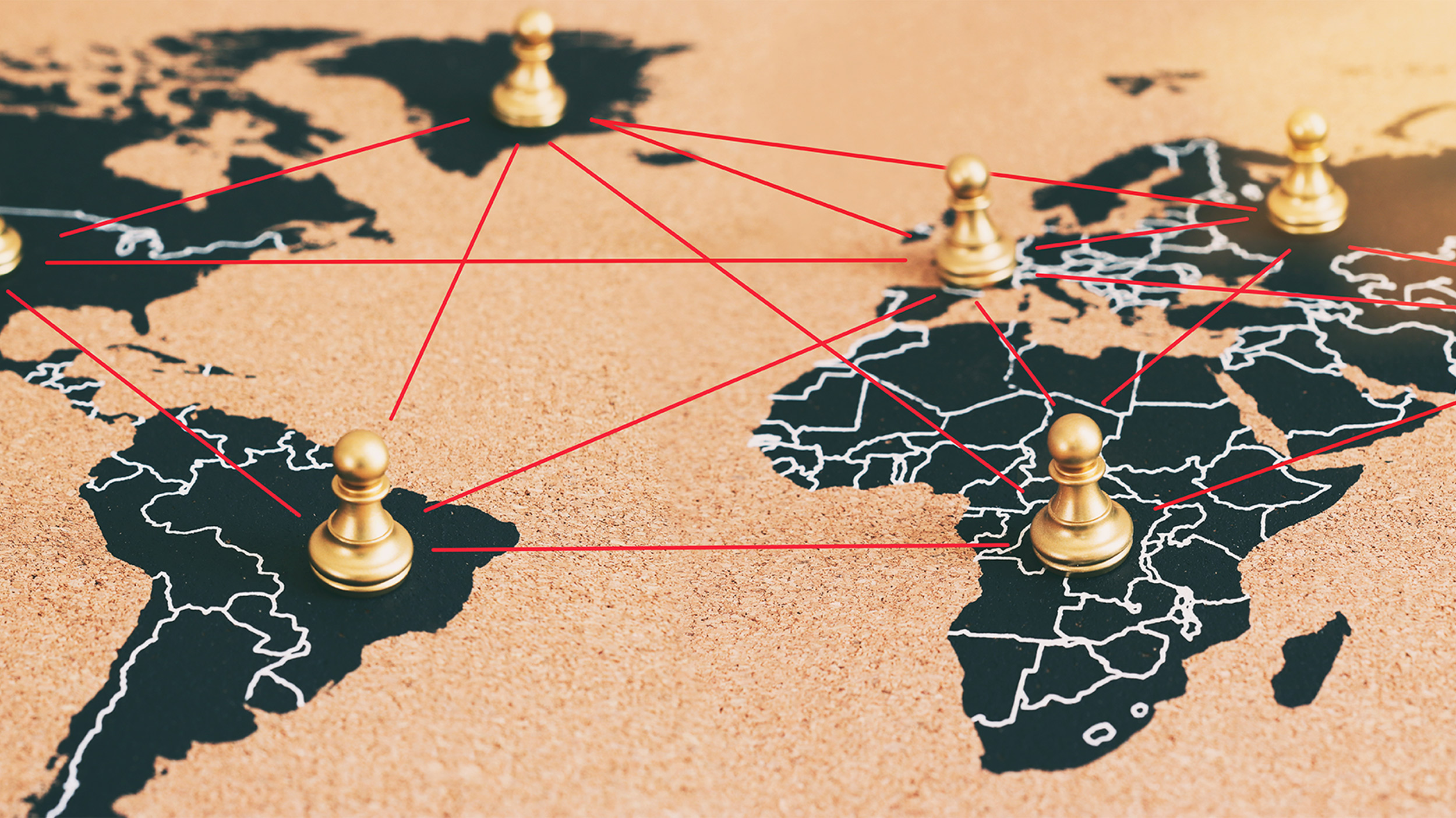
Although no one agrees on where the world is heading, there is growing recognition that we are experiencing a profound transformation. The question is no longer whether the global order is changing, but how—and more importantly, whether a new form of consensus can emerge in an increasingly fragmented world. If the very idea of a single universal consensus has been challenged by decolonial thought, can we still speak of global agreement? Or should we instead ask whether we need a decolonial consensus, or a decolonisation of consensus itself?
From Universalism to Pluriversality: The Crisis of a Single World
Decolonial scholarship has long rejected the notion of a singular, universal framework organising the world. Concepts such as pluriversality (1) emphasise the coexistence of multiple traditions, cultures, epistemologies and lifeworlds. Paradoxically, however, global politics continue to be shaped by ideas that claim universality—whether expressed through the language of “civilisation” from the 19th century to contemporary discourses on “democracy”, “free markets”, “human rights” or “collective security”, which have historically served to legitimise the interventionist policies of Western states.
This tension traces its roots to the 15th century, when European maritime expansion began. Early modern globalisation was not immediately characterised by total domination; as the historical literature suggests, European expansionist policies initially operated as an “empire of the weak”. (2) From the late 15th century onward, European powers established footholds in the Americas, parts of East Asia, and coastal Africa, deliberately avoiding direct confrontations with the formidable land-based powers of the era—the Ottomans, Safavids, Russians and the Chinese of the Ming and Qing dynasties.
By the late 18th and specifically the 19th century, however, this dynamic underwent a seismic shift. (3) The West established an advanced power mechanism in political economy along with a global epistemic monopoly to justify its colonial subjugation of the rest of the world. We witnessed the rise of purportedly universal colonial approaches in knowledge production, institutionalised under the banner of modern science and philosophy.
This can be seen in Anthropology from a Pragmatic Point of View by Immanuel Kant, in which he analyses “national characters” across the planet, thereby reducing ancient civilisations to “nations” from a Western perspective. (4) This implies that because the rest of the world lacked European-style nation-states, they had not yet reached the necessary civilisational level of development. (5) Similarly, G.W.F. Hegel drew a clear division between ‘civilised’ Western nations and the rest of the world, criticising the architecture, theology and art of non-Western peoples. Based on a progressive, teleological perspective of history, Hegel asserted that the rest of the world was obligated to follow the West. This Eurocentric taxonomy was further reinforced by Charles Darwin’s biological classifications, which directly influenced 19th-century social science to create racial and cultural hierarchies.
Under this framework, to be deemed ‘civilised’ necessitated adopting the specific concepts of civil and political society embedded within the European nation-state.
The Berlin Conference (1884–85) formalised the "Scramble for Africa" as European powers—along with the United States—agreed on rules to divide and control the continent, marking a shift from coastal trade relations with African societies to direct territorial colonisation. Driven by intense competition, economic interests and the ambitions of figures like King Leopold II of Belgium, European states rapidly expanded inland, completely disregarding indigenous authority and violently redrawing Africa's political map. This process intensified geopolitical rivalries within Europe while laying the foundations for long-term colonial exploitation and structural inequality across the African continent.
The logical conclusion of these colonial partition clashes and competition over these lands arrived with World War I. The collapse of empires laid bare the cynical nature of this epistemic order. The Bolshevik publication of the secret Sykes-Picot Agreement (1916) revealed the clandestine plans of the British, French and Russian empires to carve up the Ottoman Empire, as other documents exposed the partition of the Qajar Dynasty between the British and Russian empires. Following the war, the League of Nations was established on the basis of Western principles. Yet, it merely codified old imperial hierarchies, continuing to classify most of the non-Western societies as ‘nations’ requiring the supervision of ‘civilised nations’ under the mandate regime of the League, ostensibly to prepare them for Western-style state and national models.
During the Cold War, global consensus was structured around a bipolar ideological struggle between Western liberalism and Soviet communism. However, movements such as the Bandung Conference (1955) and the Non-Aligned Movement represented a completely different aspiration: not merely to stand neutrally between two rival blocs, but to imagine a world beyond colonial hierarchies. Bandung was not just a geopolitical event; it was an epistemic rupture—an attempt to reframe the global order from the perspective of the colonised.
Notwithstanding, as anti-colonial movements achieved formal independence, this alternative vision lost its momentum. The utopian energy of decolonisation faded as the structural conditions of economic and cultural dependency remained largely intact. Decolonisation, it became clear, was not simply about acquiring sovereignty; it required a deeper, more systemic transformation of knowledge, institutions and global hierarchies.
The Rise and Fall of Competing ‘Consensuses’
The post-Cold War era replaced ideological bipolarity with a new orthodoxy: the Washington Consensus, rooted in market liberalisation, privatisation and deregulation. For a time, it was heralded as the final, universal model of development. Yet its failures—rising inequality, recurring financial crises and profound social dislocation—quickly exposed its structural and moral limits.
This exhaustion has been explicitly acknowledged by its original architects. For instance, in his February 2026 speech at the Munich Security Conference, US Secretary of State Marco Rubio signalled a significant shift: he stated that the United States would no longer follow these past dogmatic trade policies, which he argued had allowed rival powers to exploit the system while eroding the West's civilisational and Christian heritage. Instead, he argued that this identity must be restored, asserting that policies would be pursued to ensure the continuity of American supremacy, regardless of the costs.
Ironically, one of the greatest beneficiaries of the original Washington Consensus era was China. By selectively integrating into the global economy while retaining state sovereignty, Beijing challenged Western economic prescriptions. This gave rise to discussions of a Beijing Consensus, characterised by state-led development, infrastructure investment and pragmatic experimentation. However, this model also reveals significant vulnerabilities: highly centralised decision-making carries the risk of total failure, as evidenced by long-term demographic imbalances originating from the one-child policy or over-centralised economic planning. Interestingly, even Francis Fukuyama, who famously conceptualised the post-Cold War era under the American hegemony of the Washington Consensus, has appreciated the significance and success of the Beijing model, noting in a recent interview that many developing nations are increasingly likely to emulate it.
Today, even the architects of the liberal order have begun to distance themselves from its original tenets. Internal critiques from within the Western policy establishment signal that the Washington Consensus no longer commands universal legitimacy.
A similar exhaustion is visible in Europe. The long-celebrated “European Dream”—as articulated by thinkers like Jeremy Rifkin, (6) who envisioned a post-national arena of peace, sustainability and human rights—now appears increasingly fragile. What was once offered as a normative model for regional unity is currently struggling with severe internal fragmentation, populist backlashes and a precipitous decline in global influence. Furthermore, Europe remains heavily dependent on American military protection, failing to project strategic autonomy and staying largely subordinated to American strategic policies in the wake of the war in Ukraine.
In response to these crises, new attempts to rethink global coordination are emerging. The “London Consensus”, initiated by institutions such as the London School of Economics (LSE), (7) reflects a shift toward economic and social resilience designed to regulate the current capitalist system. But even these alternative frameworks remain embedded within the very global capitalist structures they seek to reform.
Beyond Western models, regional perspectives are asserting a significant place in discussions of global consensus. As Kishore Mahbubani and Amitav Acharya argue regarding the Asian Century, the irreversible shift of power from the West to the East is not a historical anomaly but a restoration. The rise of Asia forces the West to abandon its historical hubris and accept a multipolar reality where its own consensus is merely one voice among many. (8)
Security, Recolonisation, and the Fragmentation of Order in the Context of Multilateralism
As economic models falter, raw geopolitics have returned to the centre of global affairs. While discussions on global civilisation could ideally be built upon pluriversal, mutual respect, the most influential legacy in recent decades remains Samuel P. Huntington's Clash of Civilizations thesis. Diverse counter-narratives have emerged historically: Mohammad Khatami's proposal of a “Dialogue among Civilisations” in late-1990s Iran; the subsequent “Alliance of Civilisations” co-sponsored by Turkey and Spain; and today, China's “Global Civilization Initiative” (GCI).
However, we are also witnessing the weaponisation of civilisational discourse. Whether through the emphasis on the “Judeo-Christian tradition” in the United States by Nial Ferguson, or Russia's alignment of religious-geopolitical state ideology with Orthodox Christian narratives by Alexander Dugin, the ‘civilization’ discourse oscillates between seeking common ground and stoking confrontation. Ultimately, this discursive shift echoes 19th-century colonial binaries that labelled anything outside the Western sphere as ‘barbaric’, creating intellectual justifications for contemporary geopolitical conflicts.
Looking at current warfare, the war in Ukraine has accelerated a profound global shift toward security-oriented policymaking. Defence spending is soaring, alliances are hardening into zero-sum blocs, and strategic competition is intensifying. One might even speak of an emerging ‘Security Consensus’—partly inspired by Washington and Moscow's holistic approach to conflict, which encompasses not only traditional warfare but the securitisation of technology, energy, nuclear capabilities and strategic diplomatic alignments. We are witnessing a world where militarism, territorial sovereignty and hard power once again dominate international relations.
At the same time, other regions reflect more destructive dynamics. In the Middle East, ongoing conflicts, displacement and asymmetrical warfare point toward processes that can only be described as recolonisation consensus. Here, external interventions, internal fragmentation and violent power imbalances reproduce older colonial hierarchies in new forms. This pattern of ordering operates through Israelisation, particularly the continuation of Israeli settler colonial policies in the Palestinian territories. This functions not as a formal diplomatic doctrine, but as a mode of hierarchical domination that prioritises military containment over international law.
At this juncture, if we are to evaluate international law and the international system, the genocide charges brought against the Israeli regime within international judicial mechanisms have exposed the severe limitations of global governance. The UN multilateral system is being profoundly questioned for its inability to halt ongoing systemic violations. Nonetheless, many nations continue to favour diplomatic engagement, and significant critiques have emerged—such as Turkey's persistent calls to reform the UN Security Council against its hijacking by its five permanent members (encapsulated in the slogan ‘The world is bigger than five.’). This keeps the urgent question alive: can an efficiently restructured multilateral system provide the basis for a more legitimate global consensus?
Conclusion: Decolonial Consensus or Decolonising Consensus?
What emerges from this fragmented landscape is not a single, coherent global order, but a multiplicity of competing economic, political, and security frameworks. Each claims universal validity, yet none can achieve it.
The deeper question, then, is whether seeking a new global consensus is itself a misguided endeavour. Decolonial thought suggests that the problem is not the absence of consensus, but the persistent, Eurocentric assumption that there should be one. A truly decolonial world does not require a singular, unified framework imposed from above. In this sense, the urgent task before us is not to build a decolonial consensus to replace older models, but to pursue the decolonisation of consensus itself.
Perhaps we are living in a more opportune time than ever to advance this shift. The West no longer stands as an absolute global exemplar, as it grapples with severe internal crises it cannot resolve within its own borders. Concurrently, global production systems have undergone a profound evolution. The post-Fordist era has dismantled the monolithic mass identities constructed during the Industrial Revolution, giving rise to plural, decentralised structures that are being debated not only globally but within individual nation-states, highlighting the urgent need for new alternatives.
This critical turn was deeply explored in the Decolonial Voices series (9) of the World Decolonization Forum, which hosts prominent scholars including Walter Mignolo, Farish Noor, Syed Farid Alatas, Joseph Massad and Fernanda Beigel. While profound scepticism toward a single universal consensus consistently emerged from these dialogues, scholars such as Souleymane Bachir Diagne, Ebrahim Moosa and Farish Noor also pointed toward areas of meaningful global convergence. Notably, Diagne's emphasis on revising the multilateral system to foster a more peaceful world highlights that decolonisation is equally necessary for the West's own philosophical and conceptual framework.
Ultimately, this requires a fundamental shift away from enforcing global uniformity and toward enabling true pluriversality—a world capable of negotiating difference without resorting to erasure or domination.
- Arturo Escobar, Designs for the Pluriverse: Radical Interdependence, Autonomy, and the Making of Worlds (Durham: Duke University Press, 2018).
- J.C. Sharman, Empires of the Weak: The Real Story of European Expansion and the Creation of the New World Order (Princeton: Princeton University Press, 2019).
- Farish A. Noor, The Long Shadow of the 19th Century: Critical Essays on Colonial Orientalism in Southeast Asia (Petaling Jaya: Matahari Books, 2021).
- Immanuel Kant, Anthropology from a Pragmatic Point of View (The Hague: Springer Dordrecht, 1974).
- Walter D. Mignolo, The Darker Side of Western Modernity: Global Futures, Decolonial Options (Durham: Duke University Press, 2011).
- Jeremy Rifkin, The European Dream: How Europe's Vision of the Future is Quietly Eclipsing the American Dream (Hoboken: John Wiley & Sons, 2013).
- Tim Besley, Irene Bucelli and Andrés Velasco (eds.), The London Consensus: Economic Principles for the 21st Century (London: LSE Press, 2025).
- Kishore Mahbubani, “Can Asians Think?”, The National Interest, No. 52, Summer 1998, pp. 27-35; Kishore Mahbubani, The Asian 21st Century (Singapore: Springer, 2022); Amitav Acharya, “How Ideas Spread: Whose Norms Matter? Norm Localization and Institutional Change in Asian Regionalism”, International Organization, Vol. 58 No. 2, April 2004, pp. 239-275, https://tinyurl.com/uthycf88 (accessed 11 May 2026).
- “Decolonial Voice”, World Decolonization Forum, https://tinyurl.com/mtvwv3jx (accessed 11 May 2026).