Abstract
Over the past 47 years, economic sanctions imposed against the Islamic Republic of Iran have followed a steadily intensifying trajectory. When these sanctions reached their peak, the phenomenon of armed aggression emerged. This raises a critical question: was the attack on the Islamic Republic of Iran by the United States on 28 February 2026 the consequence of the failure of sanctions that had been imposed over decades? Or, alternatively, does the attack represent another phase in the process of completing and bringing those sanctions to their intended outcome?
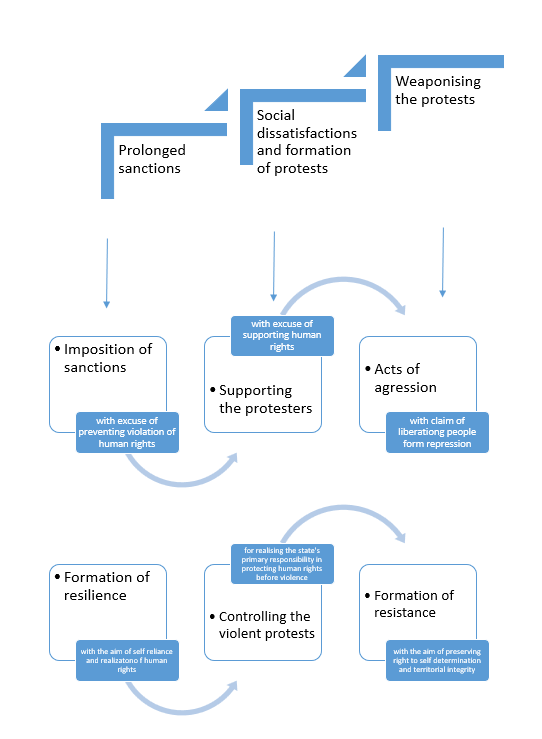
The author argues that aggression constituted the completion of sanctions and that the two phenomena—sanctions and aggression—should be understood as sequential and mutually reinforcing elements within a single continuum. Opposed to the ‘sanctions–aggression chain’ is a parallel process that has also evolved gradually over time. This second chain consists of self-reliance in response to sanctions and national unity in response to aggression. This one, can be called a ‘resilience- resistance chain’.
The element that is significant in arguments of supporters of these two parallel chains is the concept of human rights. According to the current narratives: 1) sanctions have been imposed on Iran with the stated aim of restraining violators of human rights (albeit mixed with arguments around nuclear issues that are not our focus here); 2) aggression on Iran has been carried out under the pretext of protecting populations whose rights are allegedly violated by the government; 3) self-reliance develops as a means of enabling societies to withstand the anti-human rights pressures generated by sanctions; and 4) unity emerges as a mechanism through which the right to self-determination and the right to life—among the most fundamental of human rights—may be safeguarded. Thus, the objective and justification invoked by both parallel chains— sanctions–aggression on the one hand and resilience–resistance on the other—are framed in terms of human rights. These two processes have developed gradually and reactively in relation to one another.
The author contends that, within the parallel formation of these two chains, the actors who ultimately weaken themselves in the discourse on human rights are the advocates and architects of the first chain (sanctions–aggression). This is because that chain ultimately weakens the state within the targeted political system, even though the state remains the primary institution responsible for the promotion and protection of human rights.
Consequently, so long as the majority of the population in the targeted country—exercising its right to self-determination—does not seek to change the existing political system, it will continue to suffer human rights violations resulting from sanctions imposed on that government. In effect, the population is confronted with a dilemma: either to insist on its right to self-determination while enduring sanctions imposed on its preferred political system, or to forgo that right and accept an externally imposed political system that would not be sanctioned and would be more integrated into the global economy, thereby potentially improving living conditions.
Such a forced choice contradicts the principle of the “equality and indivisibility of all human rights”, since people are effectively compelled to choose between their welfare and their right to self-determination.
By contrast, the second chain (resilience-resistance) seeks to strengthen the state or government within the targeted political system. Where a state enjoys legitimacy and public acceptance, strengthening it not only fulfils the people’s right to self-determination but also enhances the capacity of that state to promote and protect human rights. A strong and legitimate state is therefore better positioned to advance the realisation of human rights. The situation in Iran has proved that the political system possesses adequate legitimacy for majority of its people. In this context, the author is of the view that, the imposition of sanctions followed by acts of aggression, has resulted in nothing but the violation of human rights.
Using Iran as a case study, this paper demonstrates how the intensification of sanctions and unilateral coercive measures can lead to further violations of human rights, while increased self-reliance and national unity may contribute to their protection. The analysis is grounded in international human rights instruments, which recognise states as bearing the primary responsibility for the promotion and protection of human rights. It further draws on historical experience to argue that internal unrest often creates conditions conducive to external aggression. From a theoretical perspective, the paper contends that the concept of human rights—largely articulated within the liberal tradition—may, when instrumentalised for political purposes, serve as a vehicle for the pursuit of realist power-political objectives.
Theoretical framework
Human rights, a concept whose intellectual origins lie in the liberal tradition, are theoretically compelling and normatively attractive; yet their practical implementation often proves highly challenging. In practice, the application of principles such as the universality, indivisibility and equality of human rights can be exceedingly difficult. States frequently find themselves compelled, in concrete political circumstances, to prioritise certain rights over others and, at times, even to apply double standards in their interpretation and enforcement.
These difficulties become particularly pronounced when tensions arise between civil and political rights, on the one hand, and economic, social and cultural rights, on the other. The challenge is further compounded when competing legal, political and normative considerations intersect in determining whether a movement should be characterised as one of national liberation or, in stark contrast, as a “terrorist” organisation.
Within contemporary scholarly and political debates, some scholars maintain that human rights possess an inherently universal character and that their normative reach continues to expand over time. Others, however, regard human rights less as a neutral normative framework and more as a political instrument, deployed in the service of national interests or broader bloc-based geopolitical agendas.
The divergence between these two approaches may, at times, shift the analytical framework from interpretations rooted in liberalism toward those associated with realism. The range of interpretations that emerge between these two perspectives is itself as diverse and extensive as the various categories of human rights itself.
States as Primary Duty-Bearers for Human Rights Protection and Promotion
States bear the primary responsibility for the promotion and protection of human rights under international law. This principle derives from the foundational framework of the United Nations and is elaborated in international human rights instruments. The Charter of the United Nations establishes the general obligation of states to promote respect for human rights and fundamental freedoms, identifying the achievement of international cooperation in “promoting and encouraging respect for human rights and for fundamental freedoms for all” as one of the purposes of the United Nations (Article 1(3)). Articles 55 and 56 further require Member States to take joint and separate action in cooperation with the United Nations to achieve universal respect for and observance of human rights.
This responsibility is reinforced in core human rights treaties. Article 2(1) of the International Covenant on Civil and Political Rights obliges States Parties to respect and ensure the rights recognised therein to all individuals within their territory and jurisdiction. Similarly, Article 2(1) of the International Covenant on Economic, Social and Cultural Rights requires States Parties to take steps, individually and through international assistance and cooperation, to achieve the progressive realisation of the rights recognised in the Covenant. Together, these provisions reflect the widely accepted doctrine that states are the primary duty-bearers in the international human rights system, responsible for respecting, protecting and fulfilling human rights.
Within this framework, the international community plays a complementary and supportive role. Through the United Nations system, including mechanisms such as the United Nations Human Rights Council, states may receive technical assistance, advisory services and capacity-building support aimed at strengthening national institutions and legal frameworks. These measures are generally provided with the consent and cooperation of the state concerned, reflecting the principle that international support is supplementary rather than substitutive of state responsibility.
However, the fulfilment of these obligations is closely linked to a state’s material capacity. Economic constraints may limit the ability of states to allocate sufficient resources to essential sectors such as education, healthcare, employment policy and broader socio-economic development, all of which are central to the realisation of rights under the International Covenant on Economic, Social and Cultural Rights. Accordingly, measures that significantly weaken a state’s economic foundations may indirectly affect the enjoyment of human rights by individuals within its jurisdiction.
A counterargument holds that resource allocation remains primarily a matter of domestic policy choice. From this perspective, states are expected to prioritise human rights–relevant sectors over areas such as excessive military expenditure or politically motivated external engagement. However, this view does not fully account for the structural conditions under which states operate in the international system.
Historically, states have prioritised perceived existential threats in their allocation of resources, often placing security concerns above social spending. Where states perceive heightened external pressure—such as through economic sanctions or unilateral coercive measures—they may interpret these as signals of increased security risk. In response, governments may redirect resources toward defence and security sectors in an effort to enhance resilience and deterrence.
Consequently, rather than incentivising greater investment in social and human rights–related sectors, extensive sanctions or coercive economic measures may unintentionally contribute to increased security expenditure. This reallocation can further constrain resources available for education, healthcare, employment and development, thereby complicating the implementation of obligations under international human rights instruments, including the International Covenant on Economic, Social and Cultural Rights.
Sanctions and the Cascading Violation of Human Rights
In international law, sanctions refer to coercive political, economic or diplomatic measures imposed by states or international organisations to influence the behaviour of a target state, entity or individual, or to ensure compliance with international law without resorting to armed force. Within the United Nations framework, such measures are typically adopted by the Security Council under Article 41 of the Charter of the United Nations as part of its mandate to maintain or restore international peace and security.
Sanctions adopted within the United Nations framework are generally regarded as having a clear legal basis and institutional oversight. By contrast, measures imposed outside this framework—often described as unilateral sanctions or unilateral coercive measures (UCMs)—are more contested in international legal and political discourse, particularly where they are perceived to affect sovereignty, non-intervention or the enjoyment of human rights. These measures are also subject to scrutiny within United Nations human rights mechanisms due to their potential humanitarian and socio-economic implications.
A key distinction between these two forms lies in their institutional structure. United Nations sanctions are centrally authorised and accompanied by defined objectives, implementation procedures and monitoring mechanisms, including sanctions committees and periodic reporting. Unilateral measures, by contrast, are dispersed across multiple actors and legal systems. This decentralisation can lead to overlapping restrictions and indirect effects such as over-compliance by private actors, particularly financial institutions and multinational firms seeking to avoid legal or reputational risk. As a result, their aggregate impact may extend beyond the original policy intent and become more difficult to delineate or attribute.
This diffusion of responsibility also complicates the assessment of causal effects, as it becomes increasingly difficult to isolate specific measures from their cumulative economic and social consequences. Over time, the prolonged application of such sanctions may generate structurally embedded and self-reinforcing socio-economic pressures. This process can be described as a cascading impact of sanctions, whereby initial economic constraints propagate across multiple sectors of society.
At the macroeconomic level, sanctions typically reduce external trade and financial linkages, weakening domestic productive capacity and lowering firm revenues. These effects transmit directly to households through reduced wages, employment instability and declining living standards. At the same time, reduced fiscal space limits the state’s ability to sustain public services, affecting education, healthcare, infrastructure and social welfare provision. The combined effect is a gradual deterioration in socio-economic conditions across both private and public spheres.
Beyond material conditions, sustained economic pressure may also influence social behaviour and institutional trust. In contexts of prolonged hardship, perceptions of state inefficiency may increase, particularly where populations lack access to clear information regarding the external origins of economic constraints. This can contribute to the emergence of narratives that attribute responsibility primarily to domestic governance structures, potentially affecting public trust and perceptions of legitimacy.
Empirical observations from Iran illustrate how such dynamics may manifest in practice. Prolonged socio-economic pressure has, in certain instances, coincided with patterns of protest and collective mobilisation. For example, economic grievances linked to currency fluctuations and commercial disruption contributed to sector-based demonstrations in Tehran’s Grand Bazaar in late 2025. Broader protest movements in 2022 also included significant economic dimensions alongside other political and social demands, reflecting underlying material pressures affecting daily life.
As economic grievances accumulate, segments of society may resort to organised protest and civil unrest as a means of expressing dissatisfaction. If not effectively addressed, widening socio-economic and political distance between state and society may contribute to a gradual shift toward a more security-oriented governance framework, in which stability considerations increasingly shape state responses to dissent.
In some cases, peaceful demonstrations may escalate into episodes of violence or vandalism, particularly where external influence or escalation dynamics are perceived. Under such conditions, the political environment may become further securitised, with state responses to social unrest increasingly prioritising control and stability over socio-economic accommodation and dialogue.
Violent Unrest as a Precursor to External Intervention
In complex situations resulting from prolonged unilateral sanctions—which may originate from multiple sources and operate in a largely decentralised manner—a widespread sense of societal dissatisfaction or distrust in the government’s capacity may emerge in the targeted country, a condition that can be described as the “alienation of the people from the state”. This dissatisfaction may manifest in a range of behavioural responses, from peaceful protest to, in some cases, non-peaceful or disruptive conduct. The December 2025–January 2026 uprising in Iran was analysed by some external observers and states primarily through the lens of civil and political rights, with alleged violations attributed to state authorities, including in discussions within multilateral forums such as the 39th session of the United Nations Human Rights Council. However, alternative perspectives within international discourse have emphasised the potential role of external influence or manipulation in shaping or escalating protest dynamics in certain contexts, as suggested by a Fox News interview with Donald Trump. (1)
In such contested situations, where demonstrations may be perceived by authorities as influenced or instrumentalised by foreign actors, state responses often shift toward security-oriented measures. These may include restrictions on public order, limitations on communications infrastructure such as internet access, and other emergency measures justified by states as necessary to protect public safety and civilian lives. From this perspective, governments may argue that such actions fall within their duty to maintain public order and ensure security, particularly in situations perceived as volatile or externally aggravated.
The greater the degree of violence associated with protests, the stronger the argument—within domestic and international legal frameworks, subject to necessity and proportionality—that state measures aimed at restoring public order may be considered legitimate.
The domestic political conditions in Iran leading up to the 28 February attack on Iran demonstrated how, in such contexts, certain external actors may frame internal unrest through narratives such as the “Responsibility to Protect (R2P)” doctrine or broader discourses of supporting oppressed populations, thereby advancing arguments that may be used to justify more interventionist approaches. (2) Such intervention outside the authorisation of the UN Security Council is prohibited under international law and strongly contested.
The case of Iran illustrates how the consequences of UCMs may contribute to conditions in which external military intervention is more easily presented as necessary or justifiable within political discourse. (3)
Acts of Aggression and the Transformation of Narratives
The military attack on Iran by the United States and Israel on 28 February 2026 took place against a backdrop of competing narratives surrounding the January 2026 uprising. Opposition groups, largely based in Western countries, circulated contested accounts regarding casualty figures and portrayed the situation as a brutal state crackdown requiring external intervention. Within this framing, the proposed intervention was initially presented as a “liberation operation” intended to protect the civilian population.
However, this narrative shifted as the operation became increasingly aligned with the strategic interests of its actors. Political considerations, including access to Iran’s natural resources and broader geopolitical objectives, altered perceptions of the intervention among both external observers and segments of the opposition. Reported incidents such as the attack on a girls’ school in Minab, Hormozgan, resulting in significant civilian casualties, and strikes on infrastructure such as the B1 bridge in Karaj contributed to further controversy and narrative fragmentation.
At the domestic level, the escalation of hostilities triggered a convergence of historical memory, nationalist sentiment and regional political perceptions. Long-standing grievances related to territorial history, combined with perceptions of external hostility and shifting regional alignments, contributed to a rapid consolidation of public sentiment and an emergent sense of national unity that had not been clearly visible prior to the conflict.
The targeted killing of military and political officials further undermined initial expectations that segments of the political leadership would disengage under pressure. Instead, their continued presence during the conflict contributed to a contrasting narrative of institutional endurance under attack. In this context, a resilience shaped in part by years of economic pressure and sanctions intersected with wartime mobilisation, reinforcing internal cohesion. At the same time, public narratives began to shift: actors previously framed as potential protectors were increasingly perceived as perpetrators of violence, while those earlier criticised were reinterpreted as primary victims of human rights violations.
As the conflict progressed, street-level mobilisation emerged alongside military escalation and targeted strikes. This growing domestic unity, formed in response to external attack, interacted with pre-existing patterns of societal resilience, producing what may be described as a parallel dynamic of cohesion in response to sanctions and armed aggression.
From Sanctions and Aggression to the Erosion of a Civilisation
UCMs and financial sanctions have far-reaching consequences that extend beyond their stated political objectives. Evidence from international discussions suggests that such measures primarily affect civilian populations rather than specific decision-makers. Over time, they can weaken the social fabric by disproportionately impacting ordinary people, contributing to rising inequality and socio-economic stress. Beyond their effects on economic growth, these conditions undermine human and social development, which are essential to the continuity and vitality of any civilisation.
The sustainability of a civilisation depends on interrelated foundations, including economic stability, institutional capacity, technological progress, cultural exchange and human development. By restricting access to resources, limiting international engagement and introducing systemic uncertainty, UCMs disrupt these conditions. Economically, they constrain growth by reducing access to global markets, investment and financial systems, thereby lowering productivity, increasing inflationary pressures and limiting employment opportunities.
In the case of Iran, prolonged exposure to such measures has been associated with reduced economic growth, declining foreign investment and constrained trade integration. These macroeconomic effects also reduce the state’s capacity to invest in infrastructure, public services and innovation—key drivers of long-term development and civilisational progress.
The impact of such structural constraints was further intensified by episodes of armed conflict. During the military attack initiated by the United States and Israel, several historically significant sites sustained damage. Cultural landmarks such as Chehel Sotoun and Golestan—both recognised as part of the world’s cultural heritage—along with sites in Khuzestan province and the Saadabad Palace complex, were affected by nearby strikes or direct attacks. In addition, statements by senior US officials threatening the destruction of Iran’s civilisation further contributed to perceptions of deliberate cultural targeting. (4)
In this context, the combination of prolonged sanctions and military action can be understood as mutually reinforcing pressures that not only constrain development but also accelerate the degradation of cultural and historical heritage. Together, they pose a dual challenge to both the present vitality and the historical continuity of a civilisation.
Conclusion
The policy of imposing sanctions under the pretext of responding to human rights violations contains an inherent contradiction. While such sanctions are ostensibly directed against alleged violators, they may themselves contribute to the deterioration of the very rights they claim to protect. Prolonged UCMs can gradually disrupt the natural trajectory of societal development that sustains the long-term flourishing of a civilisation. This extends beyond socio-economic effects to broader implications for international law and normative frameworks, which form an integral part of the global order. In their most severe form, sanctions may escalate into acts of aggression, a development that stands in fundamental contradiction with international law and the Charter of the United Nations, including its human rights pillar.
Upon closer examination, sanctions often undermine the human rights they are intended to uphold. While states justify them as non-military instruments aimed at preventing human rights violations within targeted societies, historical experience suggests that periods of intensified sanctions may, in some cases, precede military intervention. This progression can unfold in stages, from economic pressure to internal insecurity and, ultimately, to external intervention. In certain contexts where this sequence is less linear—as in the case of Iran—sanctions may weaken states to the point of increasing dependence on alternative centres of power, thereby contributing to securitised decision-making and drawing the affected society into broader geopolitical confrontation.
Therefore, sanctions cannot be regarded as fully legitimate, insofar as they may culminate in outcomes that contradict their stated purpose, including external intervention and aggression. In doing so, they may also undermine a foundational principle of the international human rights system: the right of peoples to self-determination. From a theoretical perspective, sanctions imposed under the rhetoric of human rights protection—rooted ostensibly in liberal normative discourse—may in practice generate dynamics of insecurity and coercion more closely aligned with realist conceptions of power politics.
Many Western states that impose sanctions maintain that humanitarian objectives are excluded from their scope and have developed regulatory frameworks intended to structure and limit their use. However, the incomplete and uneven implementation of these frameworks raises doubts regarding their effectiveness in mitigating the humanitarian impact of sanctions.
- “Trump says 'Kurds' kept weapons sent for rising up against the regime”, Turkiye Today, 4 April 2026, https://tinyurl.com/mr4spxh4 (accessed 13 May 2026).
- “Trump tells Iran 'help is on its way' and 'the rail deal'”, BBC, 14 January 2026, https://tinyurl.com/26a8f6jt (accessed 13 May 2026).
- “German chancellor defends Israel's ‘dirty work' comments despite criticism”, Anadolu Agency, 18 June 2025, https://tinyurl.com/a9u6amnc (accessed 13 May 2026).
- David Gritten, “Trump condemned over threat that Iran's 'civilisation will die'”, BBC, 8 April 2026, https://tinyurl.com/ye2a2j7a (accessed 13 May 2026).