Abstract
The United States has always presented itself as a secular liberal democracy grounded in the separation of religion and state. However, throughout its modern history, American wartime rhetoric has often incorporated moral and religious language that frames conflicts in ideological or theological terms. The 2026 US-Israeli war on Iran provides a contemporary case through which to examine this contradiction. This analysis looks into United States’ political and military discourse and how it reveals a persistent tension between its formal commitment to secularism and its practical reliance on religious and moral narratives to justify and sustain conflict. By analysing the war on Iran alongside earlier conflicts such as the Cold War, the War on Terror, and the Iraq War, this analysis shows that this pattern is structural rather than incidental. While defenders argue that such rhetoric is symbolic or limited to individuals, this analysis contends that it reflects a deeper inconsistency that undermines the credibility of the United States’ claim of pure secularism and contributes to the moral escalation of worldwide geopolitical conflicts.
Introduction
The United States has long defined itself as a secular political system in which religion and state authority are formally and definitively separated. This identity is embedded in constitutional law and often emphasised in both domestic and international discourse. However, during periods of war, this purely secular self-representation gets put to the test. In such contexts, political and military rhetoric often shifts from secular justification toward moral and sometimes explicitly religious framing.
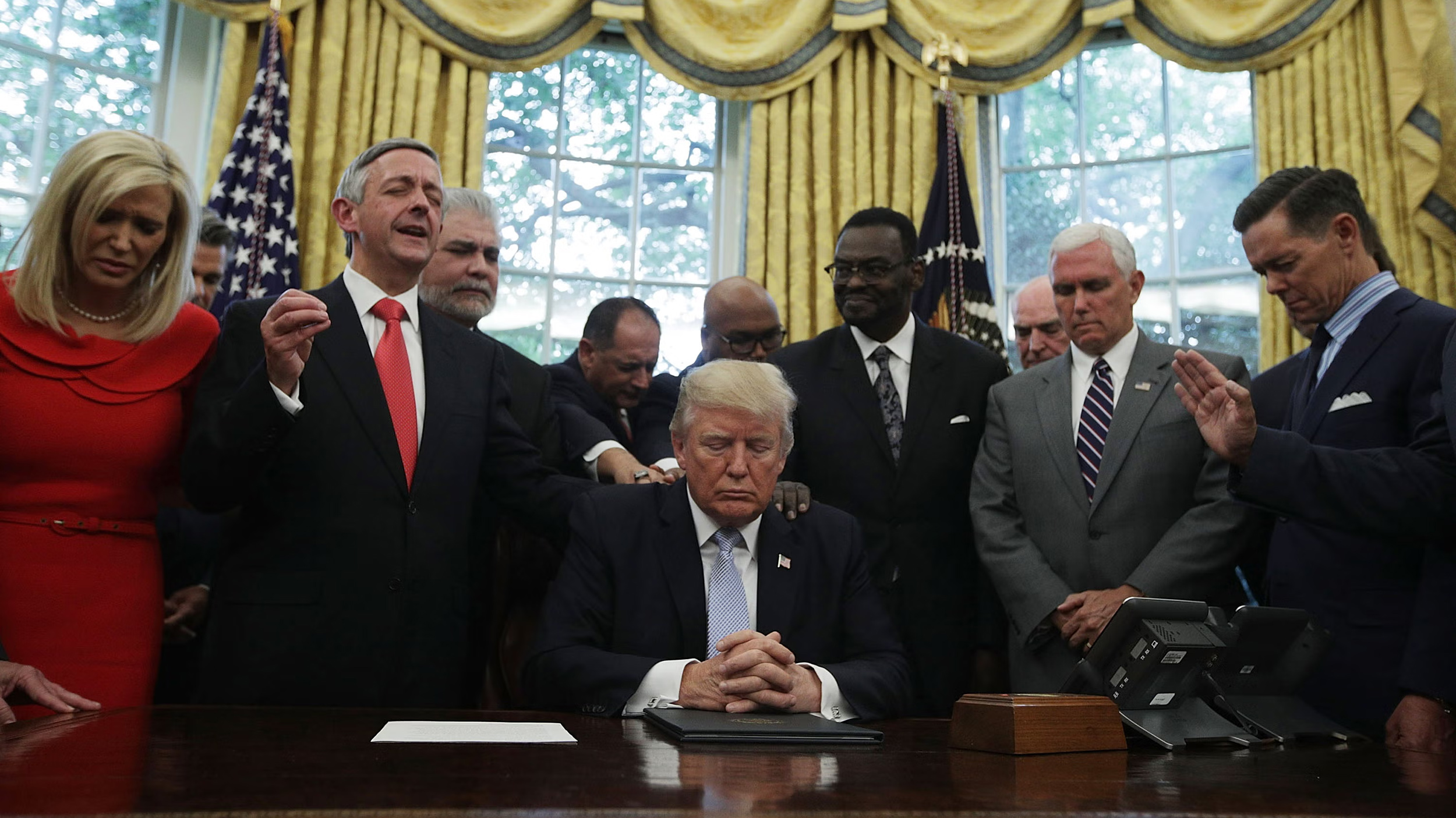
The 2026 conflict between the United States and Iran illustrates this contradiction quite clearly. Official narratives emphasise strategic concerns such as nuclear nonproliferation and regional security. At the same time, credible reporting indicates that elements within US political and military structures have employed religious language, invoking ideas of divine purpose and apocalyptic struggle. This is particularly alarming and important, as it raises a central analytical question, namely whether a state that claims secular neutrality can coherently engage in discourse that frames war in quasi-religious terms.
This analysis argues that the United States exhibits a form of political duality that constitutes a structural contradiction. While it maintains a formal commitment to secularism, it repeatedly relies on religious and moral narratives to mobilise support and legitimise military action. This pattern, evident in the 2026 Iran war and reinforced by historical precedent, challenges the coherence of American secular identity and suggests that its foreign policy discourse is shaped not only by strategic calculation but also by ideological and cultural narratives.
The 2026 Iran War: Strategic Justifications and Religious Undercurrents
The 2026 escalation between the United States and Iran was triggered by coordinated military strikes involving US and Israeli forces, with the justification being that Iran sponsors terrorists worldwide and that Iran refuses to “renounce their nuclear ambitions”. (1) Later developments included expanded military operations and increased troop deployments across the Middle East (2).
Official US justifications for the conflict have remained grounded in conventional strategic language, including deterrence, national security and regional stability. However, this secular framing has been accompanied by a parallel discourse that introduces religious elements into the narrative of the war. Reports from established media organisations and watchdog groups say that some US military personnel were exposed to rhetoric portraying the conflict as part of a divine plan or linked to biblical end-times prophecy. (3) Additional reporting suggests that references to concepts such as Armageddon were allegedly invoked in military contexts, raising concerns about the appropriateness of such language within a formally secular institution. (4)a
Concerns about this religious framing have also entered the political arena. Members of the United States Congress have formally requested investigations into whether military leaders have framed the war in explicitly religious terms, underscoring the seriousness of the issue. (5) While such claims remain contested and do not represent official doctrine, their presence in credible reporting demonstrates that religious framing is actively circulating within the discourse surrounding the conflict.
The coexistence of strategic justification and religious rhetoric reveals a significant contradiction. On one hand, the United States presents its actions as rational and secular. On the other hand, elements of its discourse invoke moral superiority and divine purpose. This duality suggests that secularism, while formally upheld, is not consistently maintained in practice.
A Pattern of Moralised Warfare
The integration of moral and religious rhetoric into US wartime discourse is not unique to the 2026 war on Iran. Rather, it reflects a broader historical pattern. During the Cold War, United States leaders often framed the ideological struggle against the Soviet Union as a confrontation between a religious free world and godless communism. This framing transformed a geopolitical rivalry into a moralised conflict, thereby strengthening domestic support through ideological polarisation.
Similarly, following the September 11 attacks, the War on Terror was often described in terms that blurred the distinction between strategic necessity and moral struggle. President George W. Bush’s use of the term “crusade,” although later retracted, showed just how quickly religious language could enter official discourse. (6) The Iraq War further reinforced this pattern, with narratives emphasising moral responsibility and the confrontation of evil. Scholarly work supports the argument that such rhetoric is deeply embedded in United States political culture.
When looking at the concept of civil religion in America, it becomes clear that national identity and political authority are intertwined with religious symbolism. (7) Within this framework, the use of religious language in wartime discourse is not an anomaly but a recurring feature of political communication.
The 2026 Iran war therefore appears as part of a consistent historical trajectory in which US conflicts are framed not only in strategic terms but also in moral and symbolic language.
Structural Contradiction and Political Instrumentalisation
The recurring use of religious rhetoric within a formally secular state raises a fundamental issue. It is insufficient to interpret this phenomenon as merely symbolic or incidental. Rather, it reflects a structural contradiction within United States political practice. One interpretation is that this represents a deliberate strategy of political instrumentalisation. Religious language serves to mobilise domestic audiences, simplify complex geopolitical realities, and frame conflicts in morally compelling terms. By presenting wars as struggles between good and evil, political actors can generate public support and reduce opposition.
However, this explanation does not fully resolve the contradiction. Even if religious rhetoric is used strategically, repeated deployment undermines the credibility of the United States’ claim to secular neutrality. A state that consistently invokes moral and religious narratives in times of conflict cannot easily maintain the position that its actions are purely rational and secular. This contradiction becomes particularly significant in the context of international relations. When conflicts are framed in moral or quasi-religious terms, they are more likely to be seen as existential struggles rather than negotiable disputes. This increases the difficulty of diplomatic resolution and contributes to the escalation of tensions.
Furthermore, the coexistence of secular policy and religious rhetoric creates ambiguity regarding the true basis of US foreign policy. It raises the possibility that strategic decisions are influenced not only by material interests but also by ideological and cultural factors that are not openly acknowledged. In this sense, the issue is not simply one of hypocrisy, but of structural inconsistency. The United States operates as a secular state in formal terms, yet its political discourse repeatedly draws upon religious frameworks. This duality weakens the coherence of its political identity and complicates its position in the international system.
The Other Argument
Notwithstanding, some still argue that the United States remains fundamentally secular in its institutional structure. The Constitution prohibits the establishment of religion, and official policy statements regarding the 2026 Iran war are framed in strategic rather than theological terms.
It is also important to note that much of the reported religious rhetoric originates from individuals rather than formal doctrine. Allegations concerning religious framing within the military are still under investigation and are not universally confirmed. (8) From this perspective, such rhetoric may reflect personal beliefs rather than institutional policy.
Additionally, the use of religious narratives is not unique to the United States. Other actors in the Iran conflict, including Iran itself, have also employed religious framing to legitimise their actions. This suggests that the phenomenon may be a broader feature of contemporary conflict rather than a uniquely American contradiction. While these arguments are valid, they do not fully address the central issue. Even if religious rhetoric is not codified as official policy, its repeated presence in political and military discourse indicates that it plays a meaningful role in shaping how conflicts are understood and justified. The persistence of this pattern suggests that it is not merely incidental but deeply embedded within American political culture.
Conclusion
The 2026 Iran war highlights a persistent tension within American political identity. While the United States is institutionally secular, its wartime discourse has repeatedly incorporated moral and religious language that frames conflict in ideological terms. This pattern is not new but reflects a long-standing tradition in which geopolitical struggles are presented as moral or even sacred endeavours. The evidence suggests that this phenomenon is best understood as a structural contradiction rather than a simple inconsistency. The United States simultaneously maintains a formal commitment to secularism while relying on religious narratives to mobilise support and legitimise military action. This duality undermines the coherence of its secular identity and contributes to the escalation of conflicts by framing them in absolute terms. Understanding this tension is essential for analysing US foreign policy and its global implications, as it reveals that political discourse is shaped not only by strategic considerations but also by cultural and ideological factors that complicate the distinction between secular governance and moralised warfare.
- “Read Trump’s full statement on Iran attacks”, PBS News, 28 February 2026, https://tinyurl.com/mw949ems (accessed 26 March 2026).
- Idress Ali and Phil Stewart, “US to deploy thousands of additional troops to the Middle East, officials say”, Reuters, 20 March 2026, https://tinyurl.com/4r8berkp (accessed 26 March 2026).
- Sara Braun, “US troops were told war on Iran was ‘all part of God’s divine plan’, watchdog alleges”, The Guardian, 3 March 2026, https://tinyurl.com/yhjppvzc (accessed 26 March 2026).
- Michael Hernandez, “US troops being told Iran war intended to bring about Armageddon, watchdog says”, Anadolu Agency, 4 March 2026, https://tinyurl.com/3ktsayxz (accessed 19 March 2026).
- U.S. House of Representatives, Office of Rep. Jared Huffman, “Members of Congress Request Investigation into Alleged Reports that Military Leaders Claim War in Iran Part of Biblical End‑Times Prophecies,” U.S. House of Representatives — Jared Huffman, 6 March 2026, https://tinyurl.com/bztx9p8n (accessed 21 March 2026).
- Ewen MacAskill, “George Bush: ‘God told me to end the tyranny in Iraq’”, The Guardian, https://tinyurl.com/35c2n5sx (accessed 26 March 2026).
- Robert N. Bella, “Civil Religion in America”, Daedalus, Vol. 134, No. 4, Fall 2005, pp. 40-55, https://tinyurl.com/4nbfcy9c (accessed 26 March 2026).
- Tiffany Stanley, “Pete Hegseth’s Christian rhetoric draws renewed scrutiny after the U.S. goes to war with Iran”, Los Angeles Times, 20 March 2026, https://tinyurl.com/bdeckdvc (accessed 26 March 2026).