
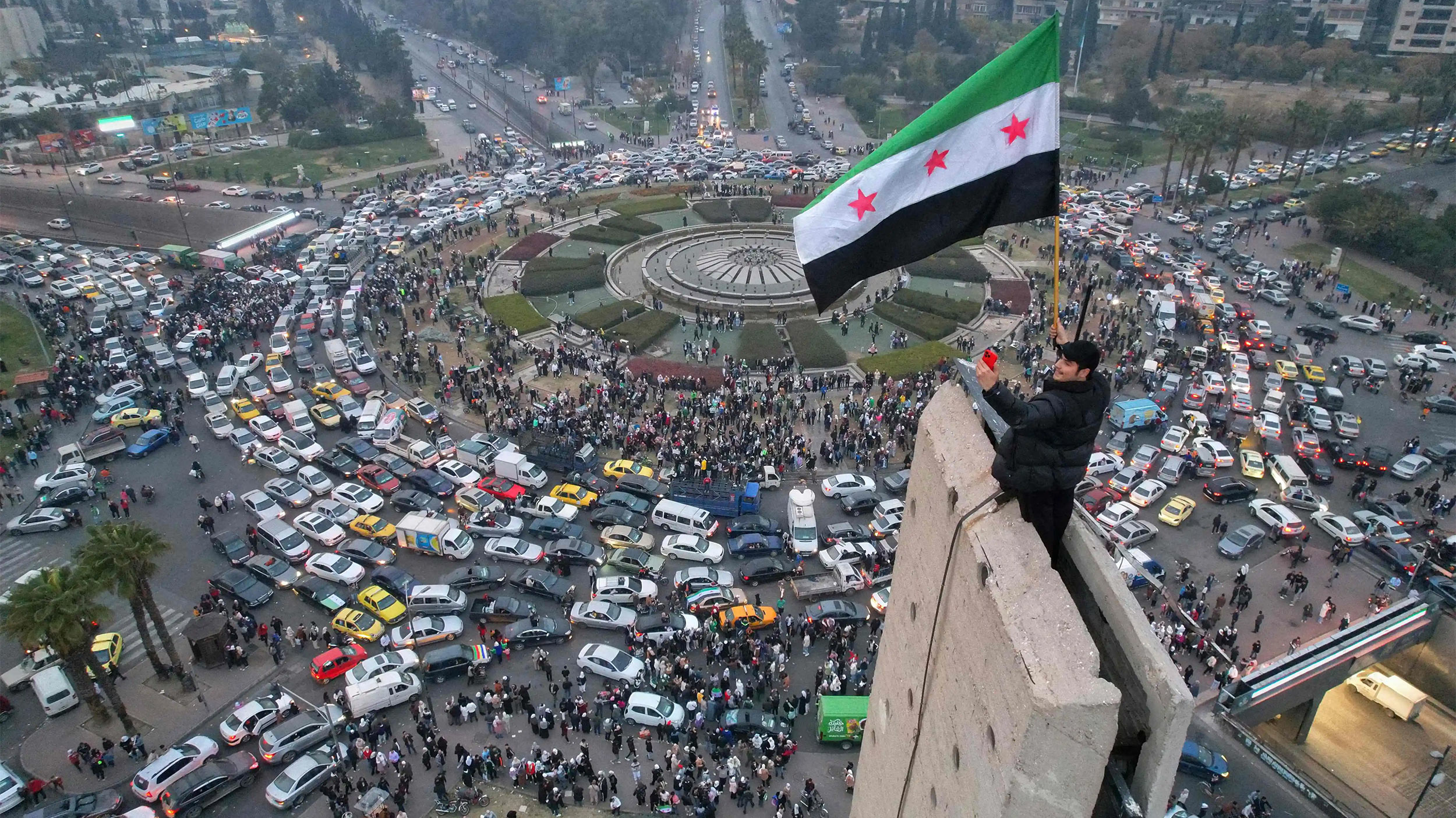
Two years after Bashar al-Assad’s fall, Syria has made diplomatic gains and contained some internal divisions, but restoring sovereignty, national cohesion and economic stability remains unfinished. The new leadership inherited a devastated, divided and economically paralysed country, with millions displaced.
The transitional government secured the lifting of sanctions imposed on Syria, its institutions and individuals. It rebuilt international relations through partnerships with Türkiye, Qatar and Saudi Arabia, closer ties with Arab and Muslim countries, and improved relations with the United States, Britain and the European Union, while preserving ties with Russia. Indirect parliamentary elections established the first parliament since Assad’s fall. Despite limited prospects for legislative reform, parliament provides representation and oversight and will help prepare a permanent constitution.
Security and sovereignty are closely linked. In late 2024, the Kurdish-led Syrian Democratic Forces (SDF) controlled much of the north-east, Druze militias dominated Suwayda, and American, Turkish, Russian and Shiite forces were present. Israel advanced into the south-west beyond the 1974 disengagement line, while airstrikes destroyed much of Syria’s remaining military capacity.
In March 2025, former-regime officers and militia leaders led an uprising in the Alawite coastal region. It was suppressed within days, but abuses killed hundreds of Alawite civilians. The Kurdish issue moved towards negotiation after Washington signalled its intention to withdraw and urged the SDF to reach an agreement with Damascus. On 10 March 2025, President Ahmed al-Sharaa and SDF commander Mazloum Abdi agreed to dissolve the autonomous administration and integrate its civilian and military institutions into the state. Government advances towards Hasakah in January 2026 and a decree restoring citizenship rights denied under the 1962 census accelerated implementation. Despite an announcement in August 2026 that integration was complete, central control over judicial and security institutions remained incomplete, Kurdish forces were not fully integrated, and some schools and universities remained outside state control.
Suwayda has proved more difficult. In July 2025, clashes between government forces and militias loyal to Sheikh Hikmat al-Hijri prompted Israeli airstrikes that forced Syrian forces to withdraw. Attacks and displacement of Sunni tribal residents drew relatives from other regions into the area, prompting communal clashes before Damascus intervened. Al-Hijri’s militias have since maintained control, suppressed opponents of separation and sought Israeli protection. Economic hardship and internal divisions have weakened their position, and a settlement based on a Syrian-Jordanian-American understanding is considered possible.
The Israeli presence remains the most intractable security issue. Damascus offered an enhanced security agreement and assurances that Syria would not threaten Israel in return for withdrawal to the disengagement line. American-mediated meetings in Baku in July 2025 and Paris in January 2026 reportedly produced a draft agreement, but Israeli Prime Minister Benjamin Netanyahu refused to sign it. Talks have stalled, although Israel’s broader effort to fragment Syria appears to have failed.
Economic recovery is essential to stability and refugee return. Syria inherited lost access to much of its oil, gas and agricultural wealth, capital flight, damaged production and weakened trade. The World Bank estimated direct damage to infrastructure and buildings at $108 billion and reconstruction needs at $216 billion. GDP per capita fell from about $1500 in 2011 to $670 in 2022. Poverty became widespread, educational attainment declined and household incomes fell far below basic needs.
The government adopted a mixed model of market mechanisms and continued state ownership, while avoiding foreign borrowing. It sought expatriate investment, Arab and Gulf assistance, European investment and private reconstruction, alongside control of oil and gas fields and trade routes. Results have been uneven. Some small investors returned, but most major expatriate businesspeople remained hesitant because of political and security uncertainty. Numerous agreements with Arab companies were announced, but few projects advanced substantially; the expansion of Damascus airport by a Qatari-Turkish consortium was a notable exception. Saudi Arabia and Qatar covered public-sector salaries for a year, while Türkiye, Qatar and Saudi Arabia provided practical assistance to ministries and municipalities. European and international grants largely supported humanitarian needs and institutional reforms.
Living conditions remain severe. Basic commodity prices rose by at least 34 per cent in a year, while currency depreciation eroded purchasing power. Poverty, unemployment, begging and child labour remain widespread. Reconstruction and refugee returns have been slow, and many returnees must repair their homes themselves. Financial strain is reflected in protests over wheat prices, delays in reinstating dismissed public employees, higher fuel and electricity prices, and reported late contractor payments.
Ultimately, national unity cannot be secured through territorial control and border protection alone. It requires decent living conditions, reconstruction, jobs, essential services, accessible education, refugee returns and a shared civic identity. Syria’s resources remain insufficient. Having strengthened Türkiye and the Gulf states by altering the regional balance of power, Syria needs sustained support from Arab and Muslim neighbours to restore sovereignty and national cohesion.
*This is a summary of a policy brief published in Arabic here.